On March 2 and 3, the United States and Israel continued their sweeping joint military campaign, hitting conventional battlefield assets and a variety of other regime targets across Tehran and central and western Iran. Strikes hit ballistic missiles and mobile launchers, missile production infrastructure, nuclear facilities linked to enrichment at Natanz, and senior political figures, including members of the Assembly of Experts meeting in Qom.
The US-Israeli operation also expanded to Iran’s internal security architecture, striking Islamic Revolutionary Guards Corps (IRGC), Basij internal security, police, intelligence, and special forces sites long used to suppress protests. From missile depots and air defense systems to repression hubs embedded in urban neighborhoods, the campaign degraded both the regime’s external strike capabilities and its domestic control apparatus.
Overview
The joint military campaign extended beyond conventional military targets, placing deliberate emphasis on dismantling the regime’s repression pillars, including police, IRGC, and Basij bases used to crush dissent.
The International Atomic Energy Agency confirmed on March 3 that entrance buildings at Iran’s underground Natanz Fuel Enrichment Plant were damaged in recent US-Israeli strikes, though the agency said that there were no additional impacts on the main facility nor any radiological effects.
On the political front, an Israeli airstrike on March 3 targeted the Assembly of Experts building in Qom as members of the Islamic Republic’s clerical body, which is responsible for appointing and overseeing the supreme leader, were reportedly meeting to deliberate on the country’s next leader.
The latest announcements from the US and Israel
On March 2, Trump warned the Iranian people to “stay inside” and added that “the big wave hasn’t even happened.” The same day, he had noted that the campaign could extend well beyond the projected four-to-five-week timeframe and did not rule out deploying U.S. ground troops to Iran if deemed necessary.
On March 2 and 3, US Central Command (CENTCOM) posted videos of strikes on Iranian ballistic missile capabilities, including footage of mobile launchers used to fire the projectiles.
CENTCOM’s March 2 statement said that three US F-15E Strike Eagles supporting Operation Epic Fury were mistakenly shot down by Kuwaiti air defenses during active combat involving Iranian aircraft, ballistic missiles, and drones; all six aircrew ejected safely.
The Israel Defense Forces (IDF) Persian account said on March 3 that the Israeli military struck multiple IRGC facilities in Tehran, including a missile production center in the Khojir area, a site used to develop components for surface-to-surface and surface-to-air missiles, the IRGC’s main production center where it manufactures solid fuel for missiles, and a chemical factory that produced missile components and fuel for both surface-to-surface and surface-to-air systems.
The IDF Persian account warned Iranians to evacuate zones within Tehran’s Esteghlal Industrial Area and Hakimiyeh Industrial Area, as well as the Payam Airport area in Karaj.
An IDF Persian post on March 2 stated that Israel had struck more than 600 regime targets using about 2,500 munitions, including hitting over 20 security leadership targets, more than 150 ballistic missiles, and over 200 Iranian air-defense systems.
The latest kinetic strikes
- Strikes reportedly hit the Iranian Army Air Force headquarters on Piruzi Street in eastern Tehran multiple times.
- A resident in Hamadan shared a video on Monday, March 2, reporting that an IRGC ballistic missile fell in the area.
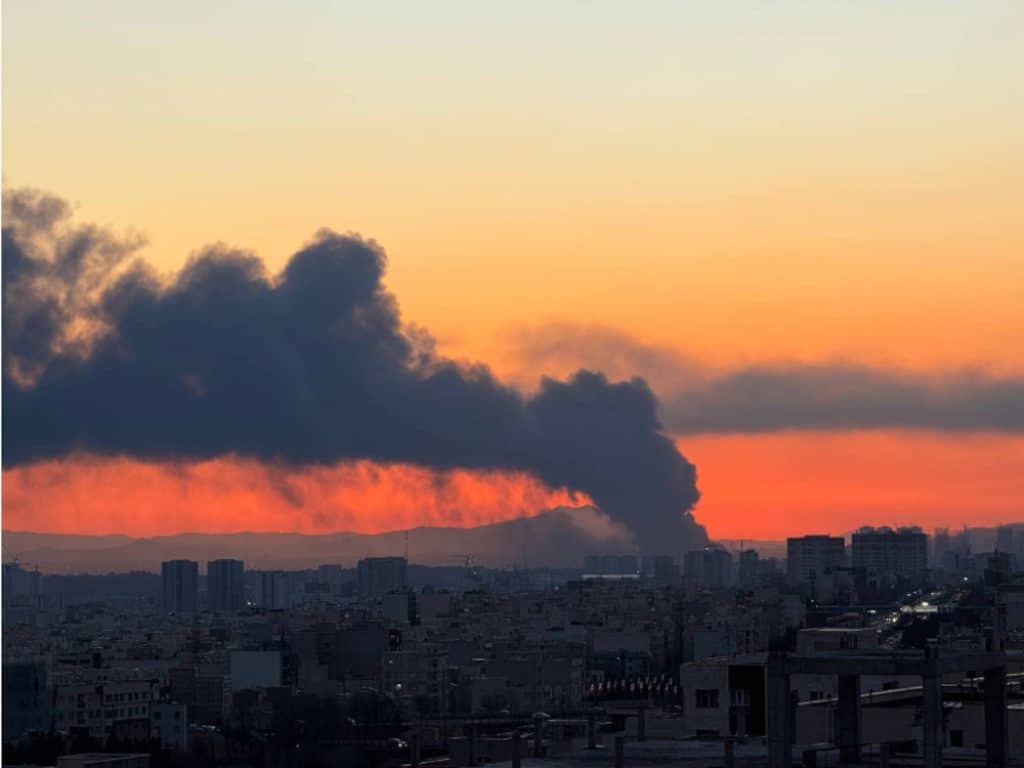
- A video sent by a resident reportedly shows thick black smoke rising over Shahin Shahr, with the sender saying the blast had struck Iran Aircraft Manufacturing Industries (HESA), which manufactures planes and drones.
- Images circulated on Monday, March 2, show Islamic Republic positions in Tehran’s Sohrevardi district reportedly hit by airstrikes.
- Video from Tehran shared on social media shows the IRGC’s Malek Ashtar building destroyed in a US and Israeli missile strike.
- Video shows smoke coming from an IRGC and Army base located in the southern city of Bandar Abbas.
- Tehran’s Zero-Six military garrison in the Pasdaran district was struck on May 3.
- Reports with footage claim that the military radar positions on Kish Island were eliminated.
The latest assassinations
The public relations office of the 84th Lorestan Infantry Division of Iran’s Army said that a US strike killed five members of the army’s 184th Brigade in Khorramabad on March 2:
- Behzad Dalvand
- Javad Khosravi
- Abolfazl Habibi
- Mehrdad Nazari
- Hossein Asadipour
ISNA reported on March 3 that an IRGC commander, Abdolhamid Rahbar of the 15 Khordad Group, and four other members of the unit were killed in a strike in Isfahan.
Attacks on the Islamic Republic’s repression apparatus
The Independent claimed that on the third day of the joint US and Israeli operation, strikes expanded beyond command centers and military facilities to focus on internal security infrastructure across dozens of cities.
It added that, since February 28, targets have included Basij bases, IRGC headquarters, police stations, and special police units in Tehran and at least the following cities: Isfahan, Tabriz, Zanjan, Hamadan, Babolsar, Karaj, Ilam, Bandar Abbas, Ahvaz, Shiraz, Sanandaj, Zahedan, Yazd, Kerman, Semnan, Mashhad, and multiple cities in Gilan Province.
In Tehran, reported strikes hit Basij bases in Khaniabad, Police Station 104 in Abbas Abad, Police Station 113 near 15 Khordad Square, a police facility in Shahr Rey, the Vali Asr garrison, and a main special police unit base. Similar targets were reported in Hamadan, including the Abu Dhar garrison and the Shahbazi IRGC camp, as well as in Sanandaj, where local sources said the city’s garrison was struck.
Following intense waves of attacks against repression sites, videos sent from residents on March 2 show the regime’s security forces using a local school as a base in the city of Qazvin. Another photo shows that the same forces were stationed at Roqaiiye Elementary School in Tehran.
Similarly, Ismail Baghaei, the spokesperson for Iran’s Foreign Ministry, held a press conference in a classroom at Shahid Mahallati School near the Chaharrah-e Ab Sardar intersection in Tehran.
The IRGC Intelligence Organization said that what it called “the enemy’s plan” now involves street unrest and warned that any activity it considers disruptive to security will be treated as “direct cooperation with the enemy.” It claimed that after the bombing of several military and police sites, the next step would be street chaos and said such actions would face a firm response.
The Islamic Republic’s Intelligence Ministry echoed these threats, saying that the government would act against what it called “internal mercenaries” and treat them as “Israeli soldiers.” Reported strikes against the regime’s internal security and suppression apparatus include:
- Footage shows the complete destruction of the Special Police Command headquarters in western Tehran on March 2, a site that played a central role in the killing of protesters.
- Police Station 104 in Abbas Abad, Tehran, was struck on Niloufar Street on March 2.
- Images shared by social media users in the early hours of Monday, March 2, show that the Security Police building in Tehran’s Yaftabad district was hit in an airstrike.
- Aryashahr Police Special Forces headquarters was reportedly destroyed in Tehran on March 2.
- Videos and reports from Monday, March 2, indicate that the Basij base in Tehran’s Naziabad district was destroyed in an Israeli airstrike.
- Videos posted on March 2 show a missile striking an administrative building belonging to the IRGC in Tehran’s Narmak neighborhood.
- Police Station 151 in Tehran’s Yaft Abad district was completely destroyed on March 2.
- Video from March 3 shows the ruins of Police Station 140 in Tehran’s Bagh-e Feyz district following airstrikes.
- Police Station 11 in Kamyaran, a city in Kurdistan Province in western Iran, was destroyed in an attack.
- Residents of Sanandaj in Kurdistan Province claim the local Basij base was struck.
- The Intelligence Department office in Mahabad, a city in West Azerbaijan Province in northwestern Iran near the Iraq border, was reportedly bombed.
- Local Kurdish media allege that minutes after Israeli and US fighter jets bombed Iranian military and intelligence sites in Marivan, all inmates at the city’s central prison were released.
- Reports say that a March 2 strike destroyed the Law Enforcement Command headquarters in Ilam Province, where multiple areas were reportedly hit. Separate footage shows damage to Bank Keshavarzi in the city of Sarableh.
- Positions in Sanandaj were bombed on the morning of March 2, with aircraft reportedly targeting the army’s 28th Division and IRGC command centers, including the IRGC detention facility known as Shahramfar Base.
- Video from Urmia on March 3 shows the Intelligence Department building in the city destroyed after airstrikes.
- Images shared on March 3 show the IRGC command headquarters in Oshnavieh, West Azerbaijan Province, hit in airstrikes.