The joint US and Israeli operation entered its second day, with American forces targeting command-and-control centers, Islamic Revolutionary Guard Corps (IRGC) headquarters, air defense systems, ballistic missile sites, and Iran’s naval forces. In parallel, Israeli strikes concentrated on targets in Tehran, including key pillars of the regime’s repression apparatus, as well as ballistic missile sites and launchers. Iranian retaliatory attacks killed three US service members and nine Israeli civilians.
Overview of US-Israeli operations
US Central Command (CENTCOM) summarized the first 24 hours of Operation Epic Fury in a post on X on the evening of March 1. It said that the operation had sought to dismantle the Iranian regime’s security apparatus, prioritizing locations assessed to pose an imminent threat. CENTCOM listed various targets, including command-and-control centers, IRGC joint headquarters, IRGC aerospace forces headquarters, integrated air defense systems, ballistic missile sites, Iranian naval ships, anti-ship missile sites, and military communication capabilities.
CENTCOM said the US employed numerous aircraft types, including B-2 stealth bombers, various fighters (F-18s, F-16s, F-22s, and F-35s), A-10 attack jets, and various drones and surveillance aircraft. The operation also involved naval strike assets, artillery systems, refueling and logistics platforms, and missile-defense systems, including the Patriot and Terminal High Altitude Area Defense (THAAD), reflecting a coordinated air, sea, and missile-defense campaign.
Israel Defense Forces (IDF) posts on social media noted that Israeli forces struck the regime’s most central systems, including its ballistic missile program, air-defense systems, and regime command-and-control targets.
The IDF’s Persian-language account posted an infographic claiming that Israeli forces had achieved air superiority over western and northwestern Iran, which it said enabled Israeli operations in Tehran and deeper into Iranian territory. Another post stated that Israel had carried out over 700 sorties and dropped thousands of munitions, striking ballistic missile launchers, various headquarters, and Iran’s air-defense systems.
The latest kinetic operations
- US forces struck an Iranian Jamaran-class corvette.
- Footage shows extensive bombing of the Islamic Republic’s Armed Forces General Staff building in Sepah Square in Tehran.
- The IDF said that it destroyed the headquarters of Iran’s internal security forces during a wave of airstrikes in Tehran. It stated that the site served as a command-and-control hub for coordinating forces involved in repressing the Iranian population. The IDF added that it also struck the Sarallah Headquarters, an Islamic Revolutionary Guard Corps unit responsible for security in the Tehran area.
- Social media footage shows that the Islamic Republic of Iran Broadcasting (IRIB) Channel Two building on Alvand Street was hit, resulting in a complete interruption of its broadcasts. The images also show damage to parts of the network’s facilities and transmission towers. This marks the second reported attack on the media organization’s infrastructure in Tehran. Videos posted by Iranians on social media also show that the IRIB was hacked and was airing the speeches from US President Donald Trump and Israeli Prime Minister Benjamin Netanyahu about solidarity with the Iranian people.
- Videos circulating online show heavy smoke rising from powerful explosions in Tehran’s Saadat Abad district.
- Footage shared online captures thick smoke rising from a massive explosion near Seoul Street in Tehran.
- A clip circulating online reportedly shows the Ministry of Intelligence building in Tehran’s Seyed Khandan area being targeted.
- The base of the Basij (the IRGC’s internal security force) on Azadi Street in central Tehran was destroyed.
- Citizen reporting indicates that the Islamic Revolutionary Guard Corps intelligence office in Maragheh, in East Azerbaijan Province, was attacked.
- The Tehran Revolutionary Court on Shariati Street was struck and destroyed.
- Israel destroyed two Iranian F-4 and F-5 fighter jets preparing for takeoff.
- A video on social media shows the moment a headquarters in the Majidieh area of Tehran was struck by three missiles.
- The Tehran Revolutionary Court building, located at the intersection of Shariati Street and Dabestan Street, was bombed on Sunday morning, with regime media reporting that the structure was heavily damaged.
- Heavy airstrikes continued against Islamic Revolutionary Guard Corps and Basij centers in Tehran, with a second wave of Israeli attacks targeting dozens of bases and facilities involved in suppressing protests.
The latest assassinations
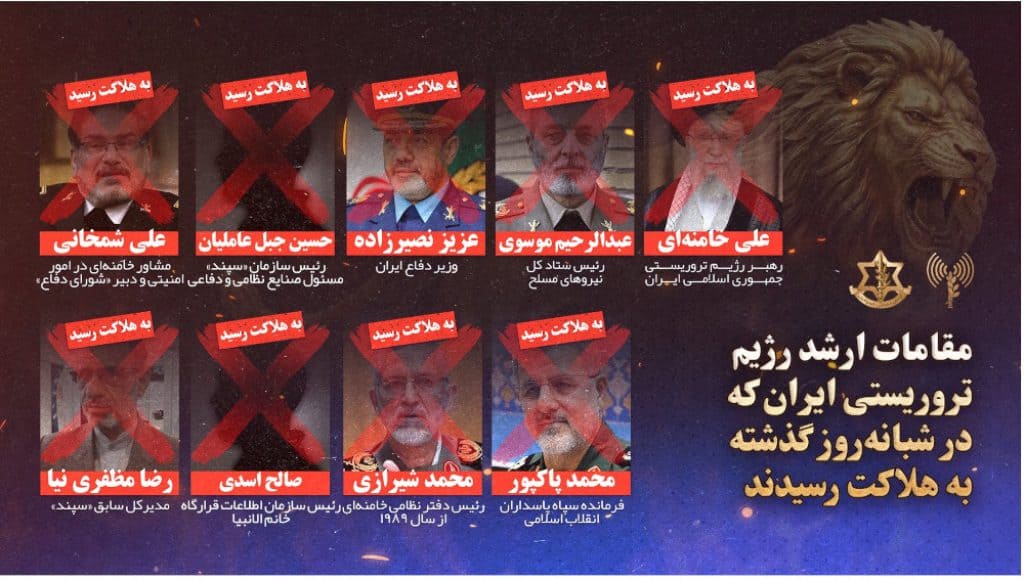
The regime-affiliated ISNA News Agency reported that 12 IRGC personnel were killed in the city of Kashan during Israeli and US attacks. The IDF’s Persian-language account also published a list of regime officials who were killed from February 28 to March 1:
- Ali Khamenei, the supreme leader of the Islamic Republic of Iran
- Ali Shamkhani, advisor to the supreme leader on security affairs and secretary of the Supreme National Security Council
- Mahmoud Ahmadinejad, former president of Iran
- Hossein Jabar Amelian, head of the Organization of Defensive Innovation and Research (SPND), which is responsible for the military and defense industries
- Aziz Nasirzadeh, Iran’s minister of defense
- Abdolrahim Mousavi, chief of the General Staff of the Armed Forces
- Reza Mozafari Nia, former director general of SPND
- Saleh Asadi, head of the Intelligence Organization of Khatam al Anbia Headquarters
- Mohammad Shirazi, head of the Supreme Leader’s Military Office since 1989
- Mohammad Pakpour, commander of the Islamic Revolutionary Guard Corps
The Islamic Republic’s Armed Forces General Staff confirmed in a statement that seven senior officials were killed in the recent attacks:
- Saleh Asadi, deputy for intelligence
- Mohsen Darehbaghi, deputy for logistics and support
- Bahram Hosseini Motlagh, head of planning and operations
- Hassanali Tajik, head of logistics
- Mohammad Shirazi, head of Ali Khamenei’s office
- Akbar Ebrahimzadeh, deputy head of Ali Khamenei’s office
- Gholamreza Rezaeian, head of the FARAJA intelligence organization
The regime forms an interim council and vows retaliation
The spokesman of the IRGC’s Khatam al-Anbiya Central Headquarters said that Iran will never kneel before the United States and added that US and Israeli attacks that killed the supreme leader did not diminish the regime’s military capabilities.
The regime’s remaining political and military leadership has formed an interim Leadership Council to assume authority. The body includes President Masoud Pezeshkian, Judiciary Chief Gholamhossein Mohseni Ejei, and Guardian Council cleric Alireza Arafi, who was appointed by the Expediency Discernment Council as the council’s third member.
International reactions to the war
- European Union foreign policy chief Kaja Kallas called for “maximum restraint, protection of civilians and full respect of international law,” along with a return to diplomatic efforts.
- China’s Foreign Ministry strongly condemned the US and Israeli strikes as “unacceptable,” called for an immediate ceasefire and renewed talks, and emphasized respect for sovereignty to prevent further escalation.
- United Nations Secretary-General António Guterres denounced the strikes as violations of international law, called for an immediate cessation of hostilities, and urged diplomacy to avert wider regional war.
- Russia’s Foreign Ministry described the US-Israeli attacks as “a preplanned and unprovoked act of armed aggression against a sovereign and independent UN member state” and called for an end to military action.
- Britain, France, and Germany said they would work with the United States to defend their interests and allies, especially against Iranian missile and drone threats, but stopped short of joining airstrikes and stressed careful coordination.