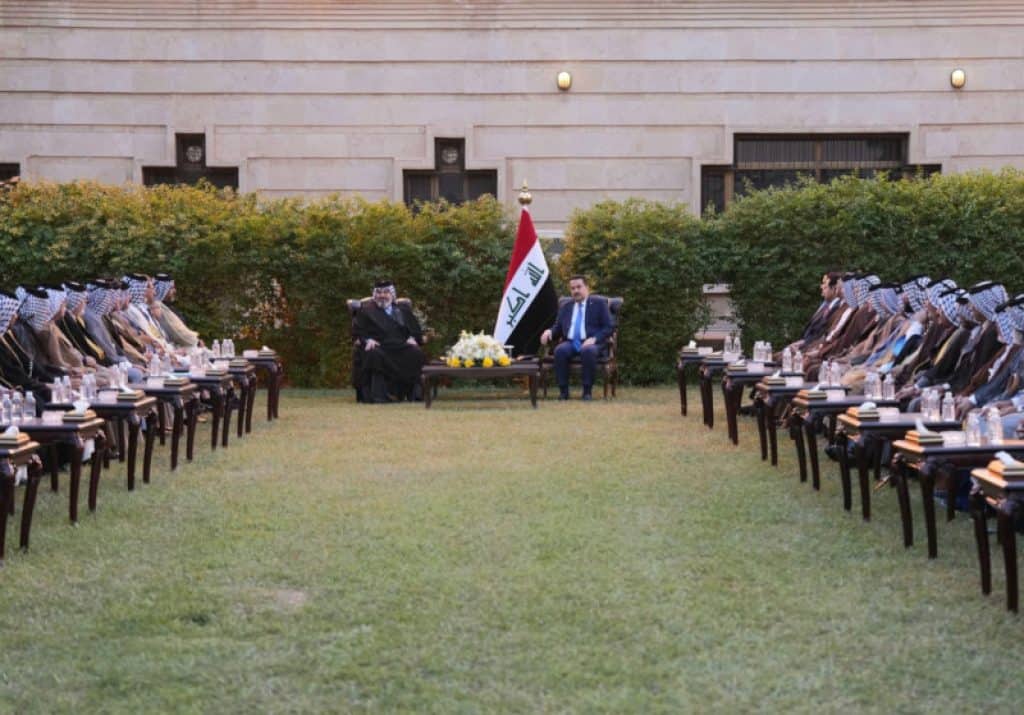
Iraqi Prime Minister Shia al Sudani “urged the United States to avoid unilateral decisions in Iraq, insisting that all actions impacting bilateral ties must go through formal diplomatic channels,” according to a report in Iraq’s Shafaq News Agency on October 22. Sudani made the comments during an October 21 call with US Secretary of State Marco Rubio, apparently in response to Rubio highlighting “the urgency in disarming Iran-backed militias that undermine Iraq’s sovereignty, threaten the lives and businesses of Americans and Iraqis, and pilfer Iraqi resources for Iran.” The call between Rubio and Sudani took place as an Iraqi security delegation visited Tehran and as the head of the Islamic Revolutionary Guard Corps-Qods Force (IRGC-QF) was in Baghdad.
Sudani “warned [the US] that bypassing established dialogue mechanisms could erode Iraqi sovereignty and weaken trust between both governments.” Rubio’s spotlighting of the Iranian-backed militias occurred two weeks after the US Treasury Department’s Office of Foreign Assets Control (OFAC) designated individuals and organizations affiliated with Kataib Hezballah (KH), one of the militias closely linked to Iran’s Islamic Revolutionary Guard Corps-Quds Force (IRGC-QF). It also comes after a September 2025 decision by the US State Department to designate the militias Harakat al Nujaba, Kataib Sayyid al Shuhada, Harakat Ansar Allah al Awfiya, and Kataib al Imam Ali as Foreign Terrorist Organizations (FTOs).
The dispute between Baghdad and Washington over Iraqi Shiite militias is part of a wider “test” of the US partnership with Iraq, according to Al Monitor. The Iranian-backed militias are part of the Popular Mobilization Forces (PMF) and closely linked to state institutions. Al Monitor notes that they are a “240,000-strong force with an annual budget of roughly $3.5 billion.”
The controversy over the militias’ role in Iraq is taking place as Iraqi officials are preparing for elections on November 11. In addition, Iraqi National Security Advisor Qasim al Araji was visiting Iran with an Iraqi “high-level security delegation” when Rubio spoke with Sudani. According to Al Ain News in the UAE, Araji met with the commander-in-chief of the Iranian Revolutionary Guard Corps, Major General Mohammad Pakpour, and the Iraqi official “affirmed his rejection of any exploitation of Iraqi territory against Iran and announced the formation of a joint committee to monitor the implementation of the security agreement between the two countries.” Chief of Staff of the Iranian Armed Forces Major General Abdolrahim Mousavi told Araji that the US was seeking to control Iraq’s airspace.
Shafaq News Agency also reported on October 22 that IRGC-QF Commander Esmail Qaani “arrived in Baghdad on Tuesday [October 21] for an unannounced visit and held meetings with several senior political figures.” Qaani appeared to be in Iraq to focus on Shiite political party politics in the lead-up to the elections. “The visit comes amid reported tensions within the Coordination Framework (CF), a coalition of Shiite parties, over the use of state resources and political influence in support of certain electoral lists ahead of Iraq’s upcoming elections,” Shafaq News Agency added.
Some Shiite political organizations, such as the Badr Organization, are also linked to the militias within the PMF. For instance, Shafaq noted that the Ataa Movement, which is part of one of the Shiite coalition parties, is “headed by Popular Mobilization Forces (PMF) chief Faleh al-Fayyadh.”
The Shiite Coordination Framework met on October 22 “to respond to the US State Department’s statement regarding ‘disarming armed factions loyal to Iran,’” a subsequent report noted. In addition, former Iraqi Prime Minister Nouri al Maliki, who heads the State of Law Coalition, warned on October 22 about “plots being hatched to undermine the political process in Iraq.”
Amid the controversies regarding the militias and the elections, Iraqi authorities said that they have solved the recent assassination of parliamentary candidate Safaa al Mashhadani, who was killed in a car bombing on October 15. Iraqi prosecutors have charged several men, some of whom share the same family name as Mashhadani. Reports say the attack was “criminal in nature” and linked to election rivalry, a narrative that seemingly contradicts the suspicion that Shiite political elements were behind the killing.