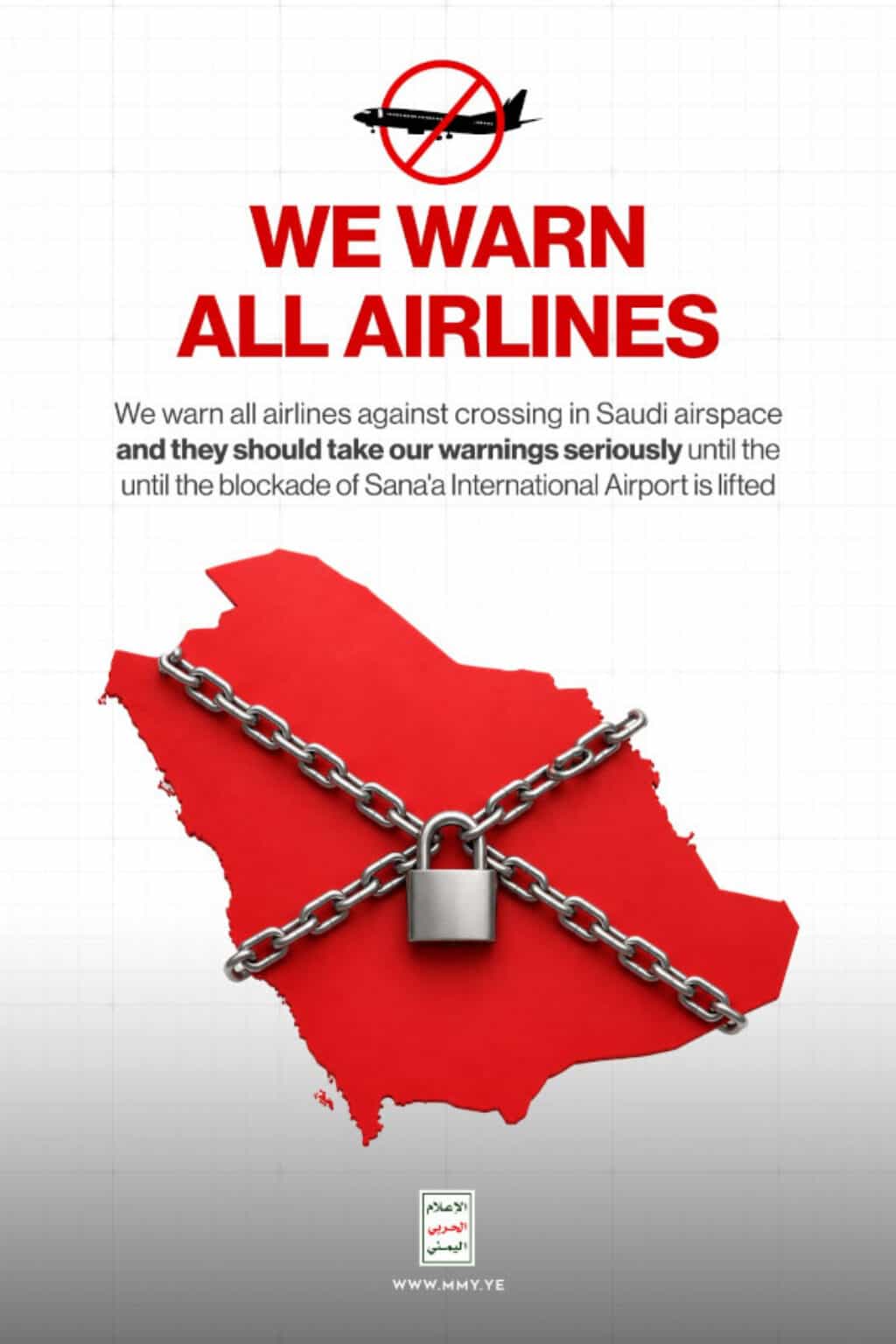
Saudi Arabia struck Sanaa International Airport in the Houthi-controlled Yemeni capital on July 13 to stop the landing of a plane carrying the Houthi delegation to slain Iranian Supreme Leader Khamenei’s funeral. The flight diverted to another Houthi-controlled airport in Hodeidah, on Yemen’s Red Sea coast. In response, the Houthis launched missiles at Abha International Airport in southern Saudi Arabia, which the Saudis intercepted. The Yemeni group also issued a statement on its military media X account saying, “We warn all airlines against crossing in Saudi airspace and they should take our warnings seriously until the blockade of Sana’a International Airport is lifted.”
“Air defenses have dealt with ballistic missile threats launched by the terrorist Houthi Militia towards the Southern Region, Major General Turki al Maliki, the spokesperson for the anti-Houthi Saudi-led coalition in Yemen, said. Maliki did not comment on the earlier strikes against Sanaa International Airport.
Rashad al Alimi, chairman of the Presidential Leadership Council, the Internationally Recognized Government (IRG) of Yemen’s executive body, claimed responsibility for the strike on Sanaa International Airport. “[The armed forces] implemented the necessary defensive measures by targeting the runway at Sana’a Airport to protect national sovereignty, ” Alimi said. Both the IRG and its armed forces are supported by Riyadh.
On July 3, Iran had sent a plane to Houthi territory to pick up the delegation. Saudi Arabia and the IRG objected to the flight, which the Yemeni government described as a “clear violation of Yemeni sovereignty.”
The Houthis consider the air blockade is an “unjust siege,” and Yahya Saree, the Houthi military spokesman, commended Iran for “taking the initiative to break the siege” in a speech following the July 3 flight. He also asserted that flights between Iran and Houthi-controlled Yemen would continue and threatened Saudi Arabia. “We warn the criminal Saudi enemy against repeating any attempt to breach the airspace or aggression targeting our country, as it will be met with a comprehensive response targeting its airports and vital interests on land and sea,” Saree said.
The Saudi-led Coalition responded with a statement from Maliki. “The Coalition will respond with unprecedented determination and force to any and all attempts to target the Kingdom, its citizens and residents and national assets, or any attempt to violate the sovereignty of the brotherly Republic of Yemen,” the statement read.
On July 14, the Houthis also claimed to have shot down a Saudi reconnaissance drone that was operating over Al Bayda, a south-central Yemeni governorate primarily controlled by the Houthis. Saudi Arabia has not commented on this claim.
Following the Houthi seizure of Yemen’s capital in 2014, Saudi Arabia implemented an air blockade of the country as part of the Saudi-led coalition’s efforts to support the IRG and fight the Houthis. The blockade was eased after the UN-brokered truce between the Saudi-led coalition and the Houthis in 2022, permitting some civilian flights. However, flights between Tehran and Houthi territory remained prohibited out of concern that the Islamic Republic would use direct air access to arm and support its proxy.