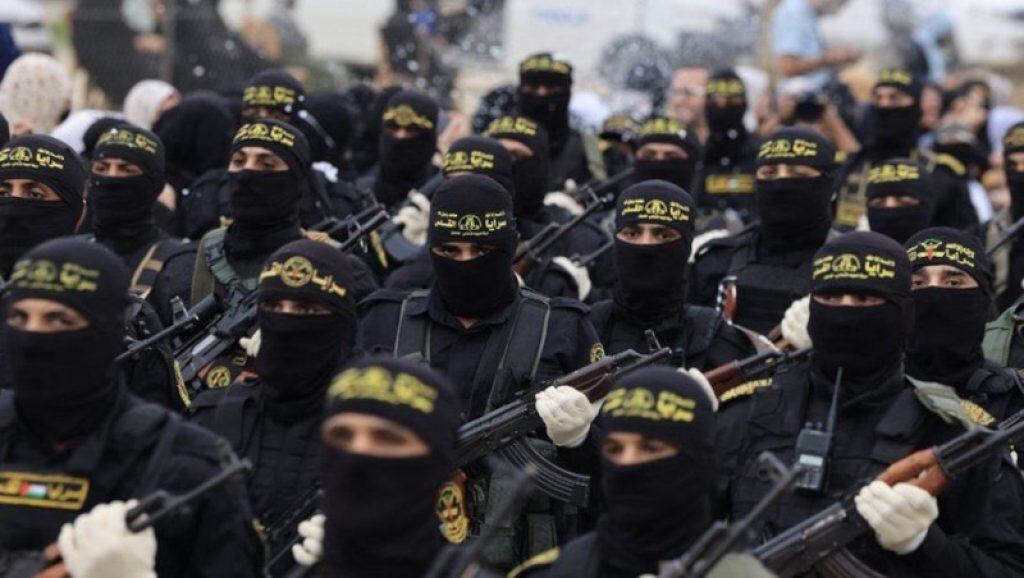
Israel’s public broadcaster KAN reported on November 26 that Palestinian Islamic Jihad (PIJ), the Gaza-based terrorist group, has been “increasingly strengthening its military wing in Syria in recent weeks,” particularly around Palestinian refugee camps in Damascus.
According to the report, PIJ views Syria as a “convenient region” to expand its military presence against Israel because of what it describes as an informal US restriction on Israeli strikes in Syria. The report also claims that Syrian President Ahmad al Sharaa has appointed a “special envoy” tasked with liaising with PIJ’s leadership, and that his government is fully aware of the group’s ongoing military buildup.
PIJ denied the Israeli media report, arguing that the information was “entirely fabricated” and aimed at “inciting against the Palestinian people and the Palestinian refugee camps.”
Palestinian Islamic Jihad is a terrorist organization that originated in Gaza in 1979. The group managed to establish a headquarters in Damascus in 1990, which brought “Islamic Jihad leaders into direct contact with Iranian officials for the first time.” PIJ maintained an operational presence in Syria since then, utilizing links between Syria’s former Bashar al Assad regime, Hezbollah, and Iran to support its terrorist activities in the West Bank and Gaza.
Israeli strikes over the past decade have exposed PIJ’s efforts to build a deeper military infrastructure on Syrian soil. Israel first targeted PIJ’s military commander, Akram al Ajouri, in a 2019 strike in Damascus; he survived that attempt and two subsequent attempts on his life. Israel has also conducted broader attacks on PIJ-linked sites around Damascus and in southern Syria, operations that intensified after October 7, 2023, as part of Israel’s campaign against Iran-backed factions. Additionally, multiple reports indicate that Iran has used Syrian territory to channel weapons and transfer rocket technologies to its Palestinian proxies, including PIJ.
Following the fall of the Assad regime in December 2024, Israel struck a PIJ command center in Damascus on March 13. The facility, located in the Dummar suburb, was reportedly being used to plan operations against Israel and deepen the group’s entrenchment in Syria. After the strike, Israeli Defense Minister Israel Katz issued a warning to the new Syrian government, stating, “Anywhere that terror groups organize against Israel, the extremist Islamist leader Jolani [Ahmad al Sharaa] will find air force jets hovering above.”
At the same time, in April 2025, reports indicated that the Syrian government had arrested two leaders of PIJ. The group stated that Syrian authorities arrested Khaled Khaled, the head of PIJ in Syria, and Abu Ali Yasser, the head of the terror group’s organizing committee in Syria. A PIJ official expressed his displeasure “with the manner of the arrest, which was carried out by kidnapping off the street rather than through a formal notification or summons.” The official noted that the movement’s offices in Damascus remained open and continued to operate.
The United States has demanded that the Syrian government expel Palestinian terrorist groups as a condition for sanctions relief. However, despite a handful of symbolic arrests, Sharaa’s government has shown notable leniency toward Palestinian militants operating on Syrian soil. Most of the arrests have targeted factions that were loyal to and fought alongside the Assad regime, such as the Popular Front for the Liberation of Palestine–General Command.