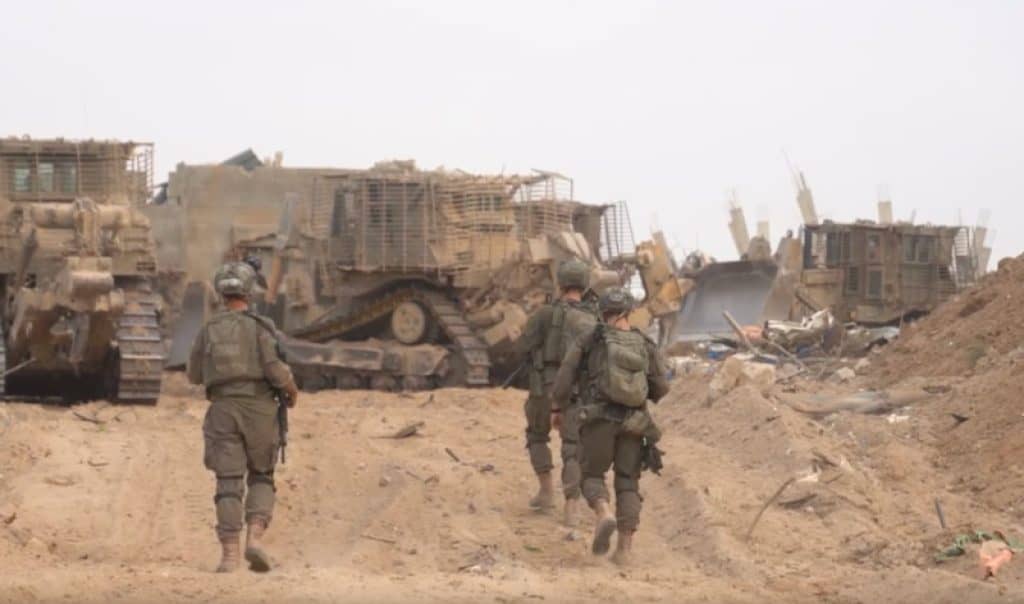
The Israel Defense Forces (IDF) began a campaign of airstrikes against high-rise buildings in Gaza, destroying them in daylight raids. On September 8, the IDF said that it had struck a high-rise building “that was used by the Hamas terrorist organization in the area of Gaza City,” claiming that “Hamas terrorists planted intelligence gathering means, explosive devices, and positioned observation posts” in the structure.
According to the IDF, the building, which it didn’t name, was used by terrorists throughout the war. The Israeli military published an infographic showing the structure and added that it had taken steps to reduce harm to civilians. The IDF asserted that these efforts included “advanced warnings to the population, the use of precise munitions, aerial surveillance, and additional intelligence.”
The campaign against high-rises began after Israeli Minister of Defense Israel Katz warned Hamas on September 3 that the group “will soon realize that it must choose between two options: Accept Israel’s conditions for ending the war, primarily the release of all hostages and disarmament, or Gaza will become equivalent to Rafah and Beit Hanoun.” The reference to Beit Hanoun and Rafah relates to two areas in Gaza that were systematically destroyed in previous fighting. Almost all the buildings in Beit Hanoun, a town near the border with Israel in northern Israel, have been leveled during the war.
On September 5, Katz declared that “the bolt is now removed from the gates of hell,” an apparent reference to the beginning of Israel’s campaign. He had warned Hamas in the past that Israel would open the “gates of hell” on the terrorist group. “The first evacuation notice has been delivered to a high-rise terror building in Gaza City before an attack,” Katz added on September 5.
Following Katz’s comments, the IDF also said that it had struck “a high-rise building that was being used by the Hamas terrorist organization in the area of Gaza City.” The BBC described this building as the Mushtaha tower, and other reports said it had 13 floors. The IDF claimed that Hamas had “established infrastructure that was used to advance and execute attacks against IDF troops in the area.”
On September 6, the IDF said it targeted another building, stating that Hamas had “installed intelligence gathering equipment and positioned observation posts in the building” and “planted numerous explosive devices near the building.” Katz posted an image of the second high-rise being destroyed. The BBC described it as the Sussi tower, and The Times of Israel and other outlets described the target as a 15-story building located in Tel al Hawa.
The operation followed a strike on September 7 against a high-rise that NBC described as the Al Ruya building. Social media posts and media reports, including from outlets sympathetic to the Palestinians, described the structure as containing the offices of clinics, human rights organizations, and law firms. The Al Ruya building airstrike was at least the third large high-rise that has been leveled by IDF strikes in several days.
On September 8, the campaign against the high-rises continued. Katz also again warned Hamas, saying, “A powerful hurricane will hit the skies of Gaza City today, and the roofs of the towers of terror will shake.”
As the IDF has ramped up airstrikes in Gaza City, it has also utilized Arabic social media to call on the city’s residents to evacuate toward southern Gaza and a humanitarian zone near Khan Younis. The IDF stated that the zone “includes vital humanitarian infrastructure such as field hospitals, water pipelines, and water desalination facilities, alongside the continuous provision of food supplies, tents, medicines, and medical materials.” A humanitarian zone in southern Gaza’s Mawasi area has existed since the early days of the war.
Israel estimates that 100,000 people have evacuated Gaza City, while the UN estimates there may still be a million people in the area. There are around 2 million people in Gaza overall, and the IDF controlled around 75 percent of the territory on the eve of the Gaza City offensive. When the strikes on the towers in Gaza City began on September 5, the IDF already assessed that it controlled 40 percent of the city.