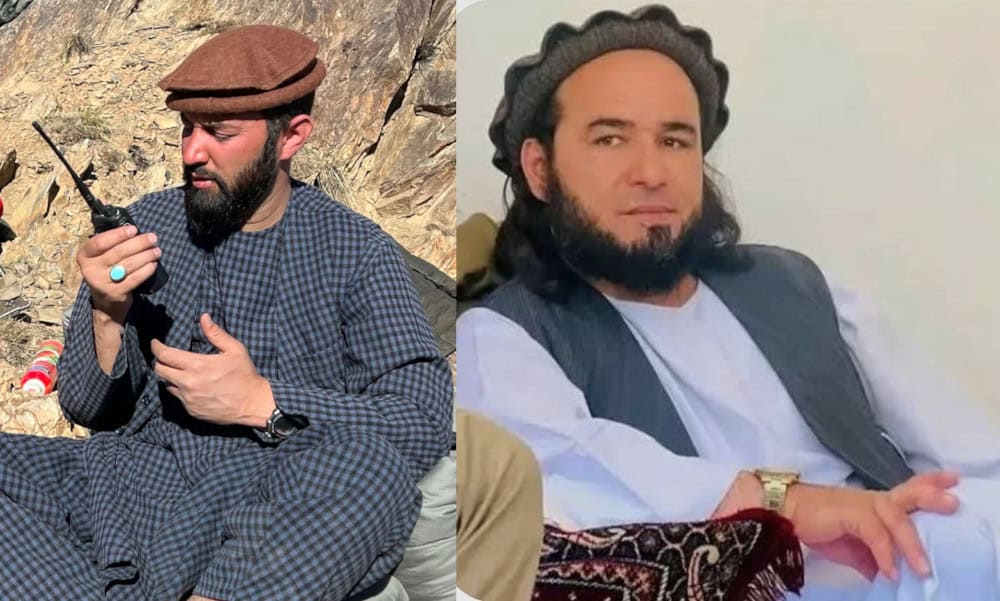
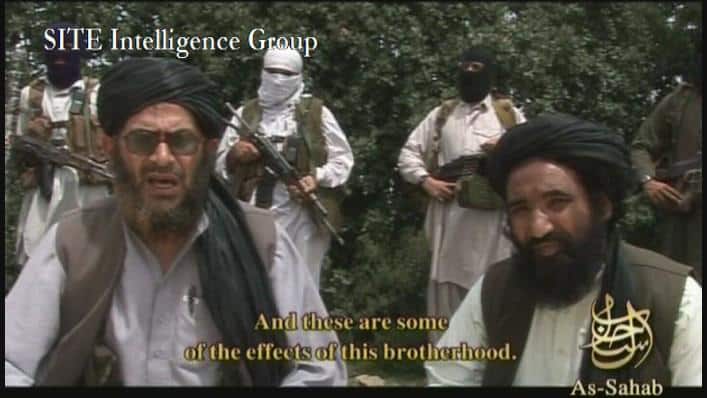
 Mustafa Abu Yazid, al Qaeda’s former emir for Afghanistan and general manager, and Mullah Mansoor Dadullah, a former senior military commander in the Afghan Taliban, from a video released by As Sahab. Screen capture from the Site Intelligence Group.
A former senior Taliban leader who was ousted by Mullah Omar in 2007 has rejected Mullah Akhtar Mohammad Mansour as the new emir of the group and accused Pakistan’s Inter-Services Intelligence Directorate of ordering him to conduct assassinations and attacks in Afghanistan.
Mullah Mansour Dadullah, the former Taliban commander, released a video addressing his complaints about the Taliban and Pakistan’s intelligence service to Afghan Islamic Press on Sept. 5. According to Afghan Islamic Press, Dadullah’s interview was recorded on Sept. 2, just days after his followers and the Taliban clashed in Zabul province.
Dadullah is the brother of Mullah Dadullah Lang, a revered Taliban military commander who was killed by Coalition forces in May 2007. After his brother’s death, Dadullah took over his job as the Taliban’s military commander in southern Afghanistan. But within seven months after taking command of forces in the south, Mullah Omar relieved Dadullah and expelled him from the Taliban.
“Mullah Mansour Dadullah is not [in] obedience to the Islamic Emirate of Afghanistan in his actions and has carried out activities which were against the rules of Islamic Emirate of Afghanistan,” Omar said in a statement attributed to him on Voice of Jihad in early January 2008. “So the Decision Authorities of Islamic Emirate of Afghanistan have removed Mansour Dadullah from his post and he will no longer be serving the Islamic Emirate of Afghanistan in [any way] and no Taliban will obey his orders any more.”
Less than two months after he was expelled from the Taliban, Dadullah was captured by Pakistani forces in Baluchistan province. Pakistan freed Dadullah in the summer of 2013 along with other Taliban leaders who were in custody. While the reason for his release was not disclosed, Dadullah and others were freed at a time when the Afghan government and the West had high hopes of conducting a negotiated settlement with the Taliban.
Taliban leaders “deceived” Muslims
Dadullah, in his latest videotape, accused the current Taliban leadership of being “lecherous, rakish and malicious” and described “intelligence networks,” which presumably include Pakistan’s Inter-Services Intelligence Directorate, as “dirty and disgraced,” according to a translation of the Afghan Islamic Press article that was obtained by The Long War Journal. Additionally, he claimed that Mullah Omar, who died in April 2013, months before Dadullah was released, was murdered:
“We have tried from the very first moments of jihad to give control of the Islamic army to a religious, brave, independent and free Muslim. Ever since the relation between His Excellency Amir al-Momenin [Leader of the Faithful] Mullah Mohammad Omar Mujahid was disconnected and lecherous, rakish and malicious people had entered in the middle, we have raised our voice of truth. Now, the situation is very clear and you see that in the name of the new Amir al-Momenin [Mullah Mansour], the sincere Muslims and mujahideen are being deceived again. The voice of truth, which the religious scholars raise, is prevented and dirty and disgraced intelligence networks once again dominate our faithful and Muslim nation. Thus, we openly made a decision once again and in consultation with religious scholars, and we clearly declared our separation from those lying lecher people, who kept the killing of His Excellency Amir al-Momenin Mullah Mohammad Omar Mujahid for over two years from all the Muslims and who imposed their hated thoughts in the form of the decrees of the Leader Mullah [Omar] on all the Islamic world. We cannot accept Akhtar Mohammad Mansour as the new Amir based on consultation with and fatwa by the religious scholars.”
According to the Afghan Islamic Press, Dadullah left Pakistan after the ISI offered to back him in exchange for favors. Dadullah said the ISI asked him to conduct assassinations and attacks on specific targets in Afghanistan in return for resources.
“The Pakistani intelligence agency summoned me,” Dadullah claimed. “They said that they had some demands. They presented their demands to me. One demand was that if they gave me some person or place as a target in Afghanistan, I would have to eliminate it. And similar other demands, which were contrary to Islam. They also offered lots of facilities as well such as one-third of the whole Emirate’s [Taliban’s] logistical, technical and military aid, but I left everything and came to Afghanistan. I was not ready to do business over the religion and the country.”
Dadullah’s accusation may be based in truth. He was ejected from the Taliban in late 2007 for unspecified reasons and arrested shortly afterward by the ISI. The Taliban’s top leadership, which is based in Pakistan and is known to have close ties to the ISI and the military, may have had the ISI remove an influential disgruntled commander from the complex landscape of Taliban politics.
Dadullah explained that he left Pakistan for Zabul province, Afghanistan. Mawlawi Matiullah, the Taliban’s shadow governor, sent a delegation to meet Dadullah once he arrived in Zabul. Matiullah wanted to determine why Dadullah moved to Zabul, and if he wanted to assume a leadership position.
“If I wanted leadership, I would not have come from Pakistan, because the posts of the Emirate are distributed in Pakistan,” Dadullah responded.
The Taliban ultimately attacked Dadullah and his followers on Aug. 23. Five people were killed in the clash, according to news reports. Shortly afterward, Mullah Mansour is said to have deployed an additional 600 fighters to Zabul to confront Dadullah and his followers.
A nod to al Qaeda
Despite his opposition to the Taliban, Dadullah has not indicated at this time that he and his followers would join the rival Islamic State’s Khorasan province, as other disaffected former Taliban commanders in the region have. And in Dadullah’s latest video, images of Osama bin Laden, former al Qaeda in Iraq leader Abu Musab al Zarqawi, former Islamic Movement of Uzbekistan emir Tahir Yuldashev, and former al Qaeda commander in Chechnya Ibn Khattab are shown. Additionally, photographs of his brother Mullah Dadullah Lang, Mullah Omar, and former chief of the Taliban press Ustad Yasir are displayed. Mansour does not mention or display images of any leaders of the Islamic State.
Dadullah’s acknowledgement of eminent slain Taliban and al Qaeda leaders indicates that he maintains a degree of loyalty to both groups, despite his dispute with the current leadership of the Taliban. Al Qaeda’s emir, Ayman al Zawahiri, sided with Mullah Mansour when Zawahiri swore an oath to the new Taliban leader.
Dadullah has historical ties with al Qaeda’s top leaders. In 2007, Dadullah appeared with Mustafa Abu Yazid (AKA Saeed al Masri), al Qaeda’s leader for Afghanistan and general manager who was killed in a US drone strike in 2010. In the video, Dadullah said that “The raids on New York and Washington had a major effect in cementing the ties of the Iman-based brotherhood between al Qaeda and their brothers the Taliban, both commanders and soldiers.”
Yazid, who was closely linked to the Taliban, responded that “The ties between the brothers in al Qaeda and brothers in the Taliban have increased.”
Five years after Yazid’s death, Mullah Mansour cemented those ties when he took the unusual step of publicly accepting Zawahiri’s oath of allegiance.