Lebanon’s central bank, Banque Du Liban (BDL), has revoked the operating license of Bank Saderat Iran, an Iranian financial institution with documented ties to Hezbollah financing. The move comes amid American pressure on Beirut to disrupt the group’s financial networks.
BDL Governor Karim Souaid confirmed the decision to Bloomberg on October 15, saying it was intended to protect Lebanon’s banking sector from sanctions-related risks.
The decision followed a September 28 meeting between US Treasury Secretary Scott Bessent, Lebanese Prime Minister Nawaf Salam, and Finance Minister Yassin Jaber. Treasury said Bessent urged Lebanon to disrupt Iranian and Hezbollah financial networks. On October 8, journalist Sabine Oueiss reported in the Lebanese daily An Nahar that Washington had specifically requested Bank Saderat’s closure and license revocation during that meeting. A member of the Lebanese delegation implicitly confirmed the request.
On October 16, the Lebanese daily Nidaa Al Watan,citing informed sources, reported that the revocation was final and had been formally communicated to Bank Saderat and the Higher Banking Commission, BDL’s banking disciplinary authority that would oversee the revocation’s implementation. The newspaper’s sources attributed the decision partly to repeated regulatory violations but did not identify the specific infractions.
However, the decision’s legal basis and effective date remain undisclosed, and neither formal delisting nor the initiation of liquidation proceedings or closure of the bank’s five branches has been independently confirmed.
Bank Saderat’s presence and operations in Lebanon
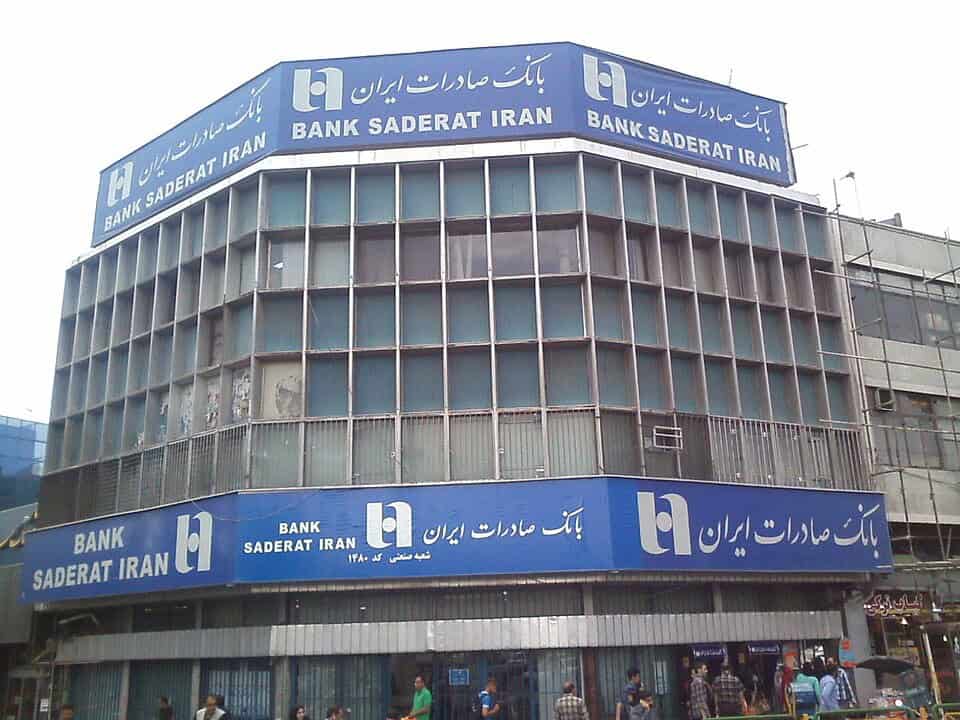
Founded in Tehran in 1952, Bank Saderat entered Lebanon in 1962. According to the Association of Banks in Lebanon’s (ABL) 2022 almanac, the bank held Lebanese banking registration number 67 and maintained its headquarters in Jnah, Beirut, alongside five branches: Ghobeiry, opened in 1986; Baalbek in 1990; Verdun/Ras Beirut in 1995; Bourj al Barajneh in 1997; and Sidon in 2001. Ghobeiry and Bourj al Barajneh are in Beirut’s southern suburbs, Baalbek is in the eastern Bekaa Valley, and Sidon is in southern Lebanon.
The almanac listed 57 employees and 20 billion Lebanese pounds in allocated capital, which it attributed to the Islamic Republic of Iran in its Lebanese institutional profile. The ABL suspended Bank Saderat’s membership in 2014.
The bank historically offered deposit accounts, lending, retail banking, and trade services. The ABL listed the Bank Saderat Iran network as its correspondent-banking network.
The ABL’s latest published financial figures, unaudited and dated December 2016, recorded 165.3 billion Lebanese pounds in assets, approximately $109.7 million at the then-official exchange rate, along with 105 billion pounds in customer deposits, 46.2 billion pounds in loans, and 86.5 billion pounds in claims on the Lebanese public sector. Bank Saderat accounted for less than 0.083 percent of Lebanon’s banking assets in 2012, based on figures reported by the Lebanese daily Al Safir, and approximately 0.054 percent in 2016, according to ABL and BDL figures.
Longstanding American sanctions have restricted Saderat’s international financial relationships. On October 4, the Beirut-based online newspaper Al Modon, citing Lebanese banking sources, reported that Saderat had become effectively isolated from Lebanon’s formal banking system. The sources described its remaining activities as limited, comparable to those of a small currency exchanger, and estimated that it employed no more than 70 people.
Nevertheless, Bank Saderat remained on BDL’s official banking register as of January 2026.
Bank Saderat’s links to Hezbollah financing
The US Treasury first excluded Bank Saderat from direct and indirect access to the American financial system in September 2006, accusing it of facilitating Iranian transfers worth hundreds of millions of dollars annually to Hezbollah and other designated terrorist organizations.
In October 2007, Treasury designated the bank under Executive Order 13224, a counterterrorism sanctions authority, detailing a specific financing channel through its Lebanese operation. According to Treasury, between 2001 and 2006, Bank Saderat transferred $50 million from the Central Bank of Iran through its London subsidiary to its Beirut branch for the benefit of Hezbollah front organizations. Treasury did not identify the Lebanese recipients.
Treasury also accused Hezbollah of using Bank Saderat to transfer funds to other terrorist organizations, including Hamas. The European Union reimposed sanctions against the bank in September 2025.
An archival fundraising appeal published by Baqiatollah, a Hezbollah-affiliated Lebanese magazine, identified Saderat’s Ghobeiry branch as accepting donations for Sheikh Ragheb Harb Hospital in Toul, near Nabatieh in southern Lebanon. The hospital was a project of the Martyrs Foundation, an Iran-linked organization with Lebanese branches providing financial and social assistance to Hezbollah-affiliated beneficiaries. The effort provided separate account numbers denominated in dollars and Lebanese pounds. The archived fundraising appeal concerned the hospital’s original construction project, whose foundation stone was laid in September 1993, and does not establish whether those accounts subsequently remained active.
The US Treasury designated the Iran-based Martyrs Foundation in July 2007, identifying its Lebanese branches as channels of financial assistance to Hezbollah and the families of its members.
Another connection emerged in December 2020 after hackers identifying themselves as SpiderZ exposed internal records belonging to Al Qard al Hassan (AQAH), a Hezbollah-affiliated association operating an extensive lending network without a Lebanese banking license.
In a May 2021 investigation, Foundation for Defense of Democracies researchers Tony Badran and Emanuele Ottolenghi identified Bank Saderat as the only Iranian bank appearing in AQAH’s leaked correspondent-account ledger. The records contained eight Saderat entries, four denominated in Lebanese pounds and four in dollars. Four of the eight entries also contained Bank Saderat account numbers.
The leaked records listed a financial-account relationship but did not establish transaction volumes, the dates of the latest transfers, or whether the accounts remained active in 2026.
In January 2026, journalist Fitat Ayyad reported in Nidaa al Watan that Jood SARL, a Lebanese limited-liability gold-trading company operating under AQAH’s supervision, had opened accounts at Bank Saderat in Lebanon. The report did not provide account records or transaction details.
The US Treasury designated Jood in February 2026, identifying it as an AQAH-supervised company established to convert Hezbollah’s gold reserves into usable funds. Treasury did not identify Bank Saderat as one of Jood’s banks.
What Lebanon’s license revocation accomplishes
Lebanon’s decision marks a change from its previous approach toward Bank Saderat. Despite longstanding American sanctions and reported US requests dating to 2017–2018 to close it, the bank retained Lebanese regulatory authorization until this week’s decision.
However, revoking its license does not necessarily establish that its Lebanese operations have been closed or liquidated.
Under Article 140 of Lebanon’s Code of Money and Credit, banks can be removed from the official register under specified circumstances. Article 141 provides that formal delisting automatically prohibits further banking operations and entails liquidation under applicable law. Article 142 provides for additional judicial measures to protect depositors, including sealing premises, inventorying assets, and appointing a custodian.
The Higher Banking Commission can impose operating restrictions and remove banks from the official register. Its delisting decisions must be published, according to the central bank.