After Yemen’s Houthis declared a maritime blockade of Saudi Arabia on July 20, the Iran-backed terror group has attacked Saudi Arabia directly and claimed attacks on eight Saudi-linked vessels transiting the Red Sea. The blockade and subsequent attacks came under the Houthis’ so-called “siege for a siege” campaign. The Houthis state that their blockade of Saudi Arabia is legitimate because Riyadh, at the request of the internationally recognized government of Yemen, prohibits certain maritime and air travel to Yemen to block enabling Iranian weapons supplies or material support.
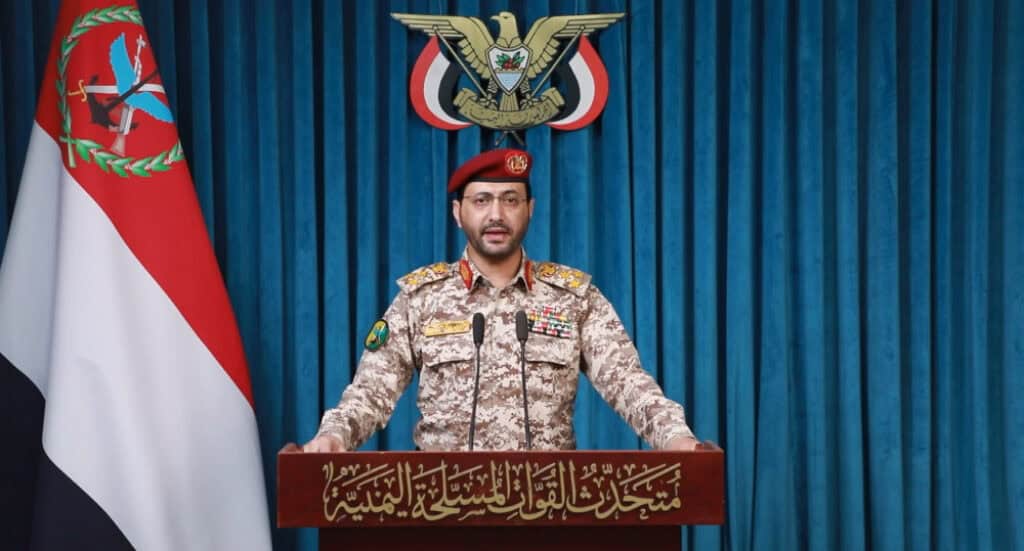
On August 5, Yahya Saree, the Houthi military spokesman, claimed that the group launched a ballistic missile attack on the Wafa, a Saudi oil tanker located near Yanbu, the kingdom’s Red Sea energy export hub about 1,000 km north of Yemen that exports around 4 million barrels per day (bpd). Later in the day, Saree said the Houthis had “successfully targeted the Saudi oil tanker Daisy in the Gulf of Aden using a ballistic missile.”
Saudi Arabia has not confirmed the targeting of either vessel, though Riyadh regularly does not confirm or share details on attacks that the kingdom faces from Iranian proxies. On August 5, the United Kingdom Maritime Trade Operations (UKMTO) Centre, which offers a monitoring and alert service for commercial shipping, reported an incident in the Gulf of Aden, stating, “The Master of a tanker reported hearing a loud explosion in close proximity to the vessel.”
Also on August 5, UKMTO reported an attack off the coast of Yemen, just north of the Bab al Mandeb Strait, the Red Sea’s southern chokepoint. The incident report said that a “vessel was attacked by an Uncrewed Surface Vessel, which caused a fire onboard. The crew has been rescued by local authorities and is safe and well. The vessel has been reported as sunk.” While this attack does not match Houthi-claimed attacks, the internationally recognized government of Yemen blamed the group.
In July, the Houthis claimed attacks on three Saudi tankers: NCC Ghazal, Encelia, and Layla. Riyadh confirmed on July 23 that an attack on the Encelia caused a fire. Saudi Arabia also confirmed that the Saudi-operated tanker, NCC Masa, sustained damage after an attack in the Red Sea on July 24 but continued to its destination.
The Houthis also struck Saudi territory on multiple occasions. On July 25, the Houthis claimed attacks on energy facilities at Yanbu and Jazan, an oil refinery on Saudi’s Red Sea coast that processes 400,000 bpd. Saudi Aramco, the state-owned oil company, suspended operations at Jazan following the attack. On July 27, Saudi Arabia’s eastern energy facilities, including Abqaiq, the world’s largest crude oil stabilization plant, were targeted by drones. Abqaiq was subsequently seen to be on fire. Riyadh blamed Iran-backed militias in Iraq, but the Houthis claimed the attack. Reuters reported on July 30 that the Houthis had attacked Saudi Arabia from Iraq but did not specify who hit Abqaiq.
Saree claimed an attack on Saudi Arabia’s southern Najran Airport on August 4. “This targeting comes in response to the Saudi enemy’s violation of the airspace in the provinces of Saada and Hodeidah with its drones,” he said, noting two Yemeni governorates that are central to the Houthis’ control in the country and ability to target the Red Sea.
Saudi Arabia is reportedly in discussions with the Houthis via Oman, which has served as a mediator in the past, including between the United States and the Houthis in May 2025 to end Operation Rough Rider, the seven-week US bombing campaign against the group. These reports say Riyadh hopes to contain the recent escalation. However, the kingdom denies talks.
Simultaneously, Saudi Arabia, which supports the internationally recognized government of Yemen and its armed forces, is evaluating military options to respond to the Houthis, including a ground operation that Yemeni forces would lead. On July 30, Saudi Arabia announced a maritime coalition to protect the Red Sea with 13 other countries. Notably, the coalition does not include the United States or the European Union, which were invited to join.