Hezbollah announced a yearlong housing-assistance program on October 13, offering eligible families displaced by the 2024 and 2026 wars with Israel up to $14,000 for rent and furniture. Lebanese Prime Minister Nawaf Salam also met separately with Hezbollah and allied Shiite Amal Movement lawmakers to discuss government-administered reconstruction projects in southern Lebanon and Beirut’s southern suburbs.
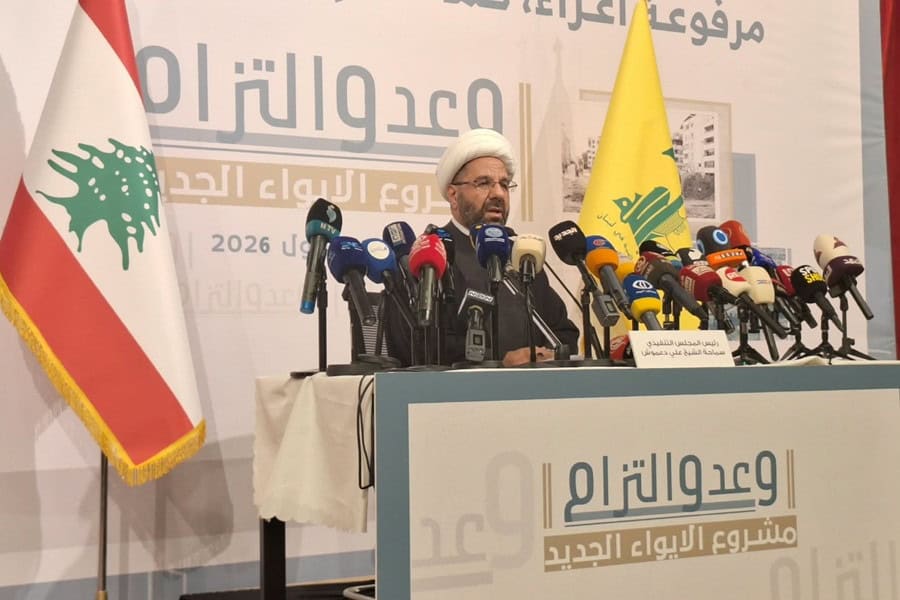
Hezbollah Executive Council Chairman Sheikh Ali Daamoush unveiled “Promise and Commitment” at Ghobeiry’s municipal center in Beirut’s southern suburbs. The US State Department designated Daamoush a Specially Designated Global Terrorist in January 2017 for heading Hezbollah’s Foreign Relations Department, which Washington accused of recruiting terrorist operatives and gathering intelligence abroad.
The new assistance program revives a post-2024-war initiative at the same payment rates. Daamoush said housing and furniture aid would form the first phase, with later phases to be announced when conditions permitted. He criticized the government for failing to assist displaced families directly or approve a mechanism to assess damage and calculate compensation. He also defended Hezbollah’s continued armed role and accused unnamed Lebanese institutions of helping enforce external restrictions on aid.
Who qualifies, how much they receive, and how payments work
Daamoush outlined the maximum assistance available for each eligible residential unit:
- Beirut and its southern suburbs: Up to $14,000, comprising $8,000 for furniture and $6,000 for rent.
- Elsewhere in Lebanon: Up to $12,000, comprising the same $8,000 furniture allowance and $4,000 for rent.
- Payment schedule: Four installments, one every three months over a year. The first is $3,500 in Beirut and its southern suburbs and $3,000 elsewhere for households qualifying for the full package.
Daamoush also warned landlords and furniture retailers against raising prices in response to Hezbollah’s program.
The program covers families whose primary homes were destroyed, rendered uninhabitable, or are in buildings designated for demolition. Also eligible are people unable to return to Israeli-held border villages or neighboring areas Daamoush described as effectively inaccessible, even if their homes were undamaged. The program excludes summer homes, secondary residences, and properties that are vacant because their owners live abroad.
Families owning another habitable home may receive furniture assistance but not rent money. Families given both allowances after the 2024 war can receive rent assistance again, but not a second furniture allowance, provided they lack alternative housing. Daamoush outlined separate rules for tenants, partially destroyed or uninhabitable homes, and other cases. He said the program would operate regardless of recipients’ sectarian or political affiliations.
Hezbollah’s regional committees are surveying affected homes using forms from Meamar Construction, a Lebanese engineering and construction company. The US Treasury Department sanctioned Meamar in September 2020, saying Hezbollah owned, controlled, or directed the company and used it to conceal financial transfers and evade US sanctions.
Meamar will compile beneficiary lists and prepare payment instruments for Hezbollah’s regional offices. Those offices will designate inquiry and payment centers, schedule collection, and notify beneficiaries when and where to collect and redeem the instruments. Daamoush did not identify the institution responsible for honoring them.
Significant Hezbollah-linked attendees
FDD’s Long War Journal identified six attendees in footage of Daamoush’s press conference:
Suhail Hassan Ghamloush is a Lebanese architect who serves as the structural rehabilitation coordinator at Hezbollah’s Jihad al Bina construction and reconstruction organization and served as deputy director of Arch Consulting, an engineering and consulting firm affiliated with Hezbollah. The US Treasury Department sanctioned Jihad al Bina in 2007 and Arch Consulting in September 2020.
Based on LWJ’s review of Lebanese corporate records, Ghamloush also holds a 50 percent ownership stake in Al Majabel al Amiliya LLC, a Lebanese company specializing in concrete, asphalt, and construction materials. The company operates within Ansar Group, which also includes National Crushers and Nour Trading and Contracting. On October 16, 2025, the Israel Defense Forces (IDF) reported striking a quarry near Mazraat Sinay that it alleged Hezbollah used to produce concrete for rebuilding its infrastructure. Lebanese reporting identified facilities belonging to Al Majabel al Amiliya among the sites struck, though the IDF did not name the company. In February 2025, Ghamloush reported that Jihad al Bina had completed more than 90 percent of its structural damage assessments in accessible areas, while in July 2026, he warned that 22 damaged buildings in Beirut’s southern suburbs were at risk of collapse.
Imad Faqih: A Lebanese civil engineer and general manager of Faqih Group, Faqih became a member of Beirut’s Municipal Council with Hezbollah’s backing in May 2025. He chairs its classified establishments committee and is identified by Lebanese media as Hezbollah’s representative on the council.
Nasser Zein al Din headed Hezbollah’s electoral operations in Haret Hreik during the May 2025 municipal elections.
Ahmad al Khansa: The mayor of Ghobeiry municipality since May 2025, Khansa was reportedly nominated by Hezbollah in coordination with Amal.
Sheikh Fouad Hanjoul directed Hezbollah’s Municipal Affairs Directorate in Jabal Amel I from at least 2012 through April 2019, before Ali al Zein was identified as his successor that July.
Ali Mohammad al Zein: The former president of the Jabal Amel Union of Municipalities, Zein became Hezbollah’s municipal-affairs director in Jabal Amel I by July 2019 and remained in the role as of July 2025. In March 2011, as municipal-union president, he signed a cooperation agreement with Jihad al Bina to implement agricultural, development, and training programs.
Earlier promises, suspended payments, and disputed Iranian financing
In August, Hezbollah Secretary-General Naim Qassem promised housing, repairs, and reconstruction assistance to families displaced by the war with Israel, particularly those who had lost their homes. He reiterated that commitment on September 27, pledging available resources and donations while insisting that Lebanon’s government bore primary responsibility for reconstruction.
On February 6, the Hezbollah-controlled financial institution Al Qard al Hassan announced it would resume redeeming new housing payment instruments on February 9 for February to April 2026. Only newly issued instruments marked for housing assistance qualified; older instruments for repairs, furniture, and housing remained frozen. The US Treasury Department sanctioned Al Qard al Hassan in July 2007, identifying it as an organization Hezbollah used to manage its finances. In July 2025, Lebanon’s central bank barred licensed financial institutions from transacting with Al Qard al Hassan and other unlicensed or sanctioned entities.
Hussein Khair al Din, a reconstruction coordinator with Hezbollah’s construction organization Jihad al Bina, told Al Ahed, Hezbollah’s official news website, that Jihad al Bina prepared beneficiary lists for Hezbollah’s regional offices. In a December 2024 interview, Khair al Din also identified himself as Meamar Construction’s director. The regional offices issued checks, contacted beneficiaries, and directed them to redeem the checks at Al Qard al Hassan to collect payments.
The announced February round provided three months of housing assistance: $1,500 in Beirut and its southern suburbs and $1,000 elsewhere. On February 9, however, Al Ahed clarified that Jihad al Bina was transferring beneficiary lists to Hezbollah’s regional offices for verification; payments had not begun. Disbursements had been expected later that week.
Asked about Hezbollah’s earlier obligations at his October 13 press conference, Daamoush acknowledged that outstanding repair allowances from the 2024 war remained deferred. He disclosed neither a total budget nor a final count of beneficiaries.
On October 7, Reuters, citing two people with direct knowledge, reported that Hezbollah received $200 million from Iran in September for displaced families, with intermediaries reportedly charging a 20 percent transfer fee. The sources did not explain how the money reached Lebanon. One said financial companies in Iraq and Dubai that previously handled transfers were unavailable, while firms in Turkey also faced pressure. Separately, on September 10, the US Treasury Department described an earlier channel moving Iranian oil-sale proceeds through front companies and Lebanese currency exchanges to Hezbollah couriers. Treasury said the network transferred hundreds of millions of dollars to Hezbollah between May and September 2025.
One Reuters source estimated that roughly 50,000 families would be prioritized, initially receiving $3,000 each. US State Department spokesperson Tommy Pigott disputed the money’s existence, and Daamoush declined to confirm or deny the report. Daamoush’s mention of an initial $3,000 payment outside Beirut matched the amount that Reuters’ sources anticipated.
Salam’s meeting and the government’s reconstruction projects
On October 13, Prime Minister Salam received seven lawmakers at the Grand Serail, the seat of Lebanon’s government in Beirut. Amal’s Development and Liberation parliamentary bloc was represented by Ali Hassan Khalil, Hani Qobeissi, Qabalan Qabalan, and Mohammad Khawaja; Hezbollah’s Loyalty to the Resistance bloc by Amin Sherri, Ali Ammar, and Hassan Ezzeddine. The US Treasury Department sanctioned Khalil in September 2020, accusing him of facilitating financial transfers to Hezbollah-affiliated institutions and engaging in corruption. It also sanctioned Sherri in July 2019 for acting on Hezbollah’s behalf, including by pressuring Lebanese financial institutions to assist the organization. Council for Development and Reconstruction (CDR) president Mohammad Ali Qabbani and Zahi Shaheen, director of the Central Operations Room at the Prime Minister’s Office, also attended, according to a statement published by the Lebanese network Al Jadeed.
Salam said contracts under the World Bank-backed Lebanon Emergency Assistance Project (LEAP) were close to being awarded, with roughly $70 million in projects expected to be awarded by year-end 2026. On October 9, the CDR, which administers LEAP, issued a provisional award notice for roughly $3.69 million for road-clearing and repairs in the Nabatieh district in southern Lebanon.
The meeting also addressed reinforcing and rehabilitating damaged buildings in Beirut’s southern suburbs. Lebanon’s emergency-relief agency, the Higher Relief Commission, was expected to begin that work within days, subject to funding. Participants also discussed roads, water networks, and public facilities.
In August, Social Affairs Minister Haneen Sayed announced a pilot cash rental-assistance program for displaced families during a visit to Beirut’s southern suburbs that was attended by Sherri and Ammar. Later that month, Salam directed officials to coordinate with the ministry on rental assistance for displaced residents of several southern villages.
The Council of the South, a state body under the Prime Minister’s Office, has longstanding political ties to Amal and parliamentary Speaker Nabih Berri. At the August meeting, Salam instructed the council to repair partially damaged homes and expedite prefabricated housing procurement alongside the Higher Relief Commission. Salam’s office confirmed in September that the council was also repairing schools, clearing rubble, and rehabilitating infrastructure while coordinating with the CDR. The independent Lebanese news website Al Modon reported on October 2 that the council was using remaining budget funds for these projects and contracting for prefabricated housing alongside the Higher Relief Commission.
World Bank financing and the June 26 Framework
LEAP was designed as a $1 billion reconstruction framework, with an initial $250 million World Bank loan for rubble management and restoring public infrastructure and essential services. The World Bank’s February summary identified a $750 million financing gap. Its February eligibility criteria covered areas damaged during the 2023–2024 conflict, not damage solely from the subsequent 2026 war. LEAP finances public works rather than direct compensation to owners of destroyed homes.
The June 26 US-brokered framework agreement aimed at ending hostilities between Israel and Lebanon, signed by Lebanon, Israel, and the United States, also addresses reconstruction financing, disarmament of non-state armed groups, and phased Israeli withdrawal from Lebanese territory. Paragraph 11 commits Lebanon and the United States to preventing funds from reaching individuals and entities affiliated with non-state armed groups and requires Lebanon specifically to prevent reconstruction funds from reaching those groups or connected entities. Under paragraph three, internationally supported reconstruction in designated southern border areas follows verified disarmament of non-state armed groups and the Lebanese Armed Forces’ assumption of full security control.