On the afternoon of April 8, Israel launched its deadliest and most intense wave of airstrikes in Beirut since the war with Hezbollah restarted in early March. Initial reports claimed that the Israel Defense Forces (IDF) had dubbed this wave of strikes “Operation Eternal Darkness,” a nod to the ninth Passover plague. The IDF later clarified, however, that “Eternal Darkness” was the name of the operational order, not a standalone name for the wave of strikes or the initiation of a new operation under that name.
The lead-up to the strikes
At 11:39 am local time, IDF Spokesman Colonel Avichay Adraee issued an evacuation warning to the residents of several neighborhoods—Haret Hreik, Ghobeiry, Laylaki, Hadath, Burj Al Barajneh, Tahwitat Al Ghadir, and Shiyyah—in Beirut’s southern suburbs, colloquially known as Dahiyeh. The area, though effectively Hezbollah’s nerve center, is also home to a population of approximately 400,000 people. It is unclear how many of the area’s residents evacuated in response to previous Israeli warnings, but March 30 reporting in L’Orient Today described the area as “largely deserted.”
Adraee’s warnings came several hours after the United States and Iran had agreed to a two-week cessation of hostilities mediated by Pakistan. Tehran and Islamabad alleged that this agreement included Lebanon, per a 10-point plan proffered by the Islamic Republic. Washington and Jerusalem, however, denied this condition. Hezbollah has yet to adopt an official position on the matter, but it effectively considers itself part of the cessation-of-hostilities framework.
Hezbollah’s last verifiable attack before the onset of Israeli strikes in Beirut occurred on April 7 at 11:20 pm. The earliest Israeli-side sign of renewed Hezbollah fire was a 4:24 pm “red alert” siren event on April 8 that Israeli reporting treated cautiously. The next Israeli alert was at 5:13 pm. Hezbollah’s first contemporaneous public claim of an attack was at 2:30 am on April 9. However, a 1:00 am record of an attack by Hezbollah appears in a later retrospective roundup of the group’s activities.
A map of Israeli Strikes in Beirut on April 8, 2026 (Google Maps annotated by LWJ):
Wave 1 of the Israeli airstrikes in Beirut
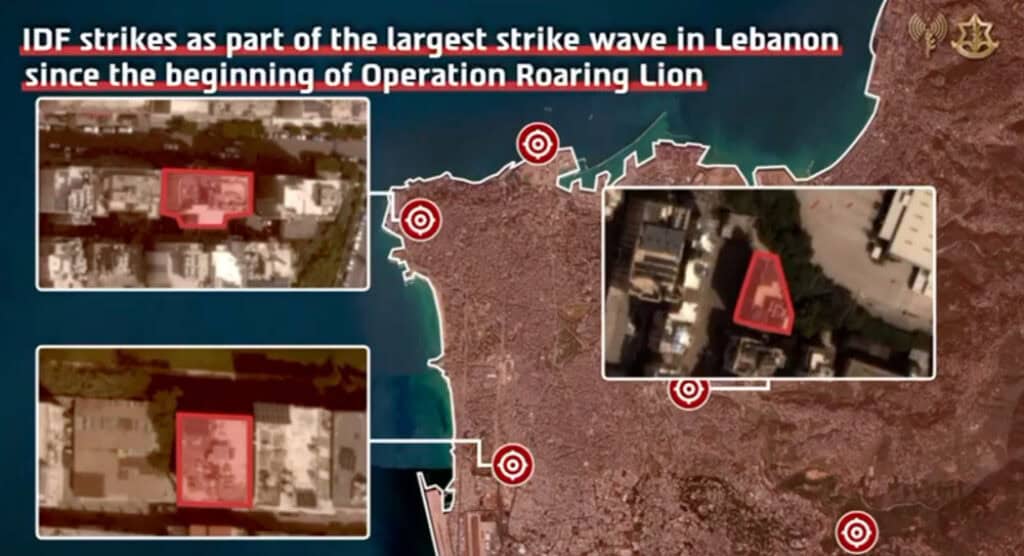
At 2:19 pm, NNA Lebanon reported that “a series of Israeli airstrikes targeted Beirut.” At approximately 2:26 pm, the IDF announced that it had completed the largest coordinated strike in Lebanon since the start of Operation Roaring Lion, which began on February 28. The Israeli military said it targeted more than 100 Hezbollah command centers and military sites in a matter of minutes in Beirut, the Beqaa Valley, and south Lebanon. Per the IDF, some 50 jets took part in the operation, and some 160 munitions were used.
Around 2:30 pm, Lebanese and international reports began claiming that the first wave of strikes targeted Beirut itself, not just its southern suburbs. Reuters claimed that at least five consecutive Israeli strikes hit Beirut city’s central areas that afternoon. Other outlets specified strikes in areas including Barbour, Ain al Mraisseh, Burj Abi Haidar, and Corniche Al Mazraa—the latter targeting a hangar located in the same building as Rifai Roasteries, a Lebanese nuts and snack foods company. The company denied any link to the hangar.
L’Orient Today included the areas of Salim Slam and Bashoura in Beirut and Kaifoun and Bshamoun to the capital’s southeast in its tally of strikes. Other outlets reported concurrent strikes in the Beirut neighborhoods of Musaitbeh, Ain al Tineh, Manara, Basta, and Ain al Tineh, as well as southeast of Beirut in Shuweyfat, Qmatiyeh, Ain al Saydeh, Aitat, and Souq al Gharb.
The Associated Press (AP) reported that the strikes hit these busy commercial and residential areas without prior warning. IDF channels did not issue evacuation warnings to the area’s residents, nor did Lebanese outlets, such as the state-run news agency NNA Lebanon, carry any of their routine reports of Israeli warning strikes prior to an aerial assault.
Several areas of Dahiyeh were also struck in this initial Israeli wave, including Bir Hassan, Al Rahhab, Hay al Sellom, Shiyyah/Maroun Misk, and Burj Al Barajneh/Raml al Ali. Jnah, on the outer northern edge of Dahiyeh, was also struck.
The post-strike Israeli statement, released at 2:26 pm, does not break down the target bank by area. A 3:28 pm post from Israeli Channel 12 claimed that “Hezbollah Secretary-General [Naim Qassem’s] emergency headquarters” was among the targets, but that Qassem was not present at the time of the strike. However, this report was later denied by Channel 11 military correspondent Itay Blumental, Israeli Army Radio’s Doron Kadosh, and an anonymous Israeli security source speaking to Ynet.
For the wave as a whole, which hit several areas in Lebanon simultaneously, the IDF said the targets were intelligence command centers and central headquarters,command-and-control infrastructure, firepower and naval-array infrastructure, and assets of Hezbollah’s Radwan Force and Aerial Unit 127. Israel has long argued that Hezbollah embeds such assets in civilian areas.
IDF Arabic Language Spokesperson Lieutenant Colonel Ella Waweya issued a statement at 3:09 pm, claiming that “the IDF had recently detected Hezbollah abandoning” the group’s “terror strongholds in Dahiyeh” and “[repositioning] itself toward northern Beirut and the city’s mixed areas.” The statement claimed Hezbollah had done so after realizing the IDF’s operations rendered Dahiyeh “no longer safe for” the organization.
Waweya concluded by warning that “the destruction Hezbollah has brought upon Dahiyeh will move with it,” warning Lebanese to prevent Hezbollah from repositioning itself in new areas, and threatening Hezbollah that “there is no safe place for you, as the IDF will continue to pursue you and act with overwhelming force.” Adraee’s Telegram channel carried an identical claim. However, while Lebanese reporting has noted a general movement by Shiites from Dahiyeh northward into areas of Beirut city, Israel did not publicly provide evidence for its claims that Hezbollah operatives had done so as well.
Wave 2 of the Israeli airstrikes in Beirut
A second wave of Israeli airstrikes targeted Beirut in the evening. At 6:39 pm, an initial strike reportedly hit northern Mar Elias, a demographically and socioeconomically mixed urban, commercial corridor in the city’s west-central district. The Israeli target remains unclear. One person was reported as a fatality after falling from a balcony.
At 6:55 pm, a second airstrike hit Tallet al Khayyat, a hilly, relatively affluent residential district in central/west Beirut. The strike reportedly destroyed an entire residential building. At 7:11pm, the IDF said it had “targeted a Hezbollah operative in Beirut a short while ago,” and that further details would be forthcoming.
Three people were killed in the Tallat al Khayyat strike, including poet Khatoun Salma and her husband, Mohammad Kresht. However, the IDF later said that its target, whom it claims to have successfully killed, was Ali Yusuf Hershi. According to the IDF, Hershi was the nephew of Hezbollah Secretary-General Naim Qassem, as well as Qassem’s personal secretary and personal adviser. Hezbollah has not acknowledged Hershi’s death, nor did Naim Qassem in his April 10 or April 11 missives.
Subsequent Israeli strikes followed later that night: one reported in an unspecified area of Dahiyeh sometime between 10:25pm and 11:01 pm, a strike in Laylaki-Kafaat between 10:58 and 11:09pm, a reported drone strike in Jnah at 11:03 pm, and a final strike near the electricity station on Sayyed Hadi Nasrallah Blvd at approximately 11:15 pm.
Fatalities of the strikes in Beirut
Israeli Defense Minister Israel Katz issued a statement on April 9 claiming that the IDF had killed “over 200 [Hezbollah] terrorists yesterday, bringing the number of eliminated [Hezbollah operatives] in this battle to over 1,400.” The cumulative Lebanese death toll to date is 1,953 dead, and 6,303 wounded.
In a non-final count on April 8, the General Directorate of the Lebanese Civil Defense claimed 92 dead and 742 wounded in Beirut proper, 61 dead and 200 wounded in Dahiyeh, and 17 dead and six wounded in the strikes on the Aley District southeast of Beirut.
On April 9, Lebanon’s Ministry of Public Health, which is currently headed by Rakan Naserreddine, a Hezbollah-affiliated minister within the Lebanese cabinet, issued a non-final casualty count from all Israeli strikes in the country the previous day, without breaking down the numbers specifically for Beirut and its suburbs. It said that 303 individuals had been killed across Lebanon, including 30 children, 71 women, and nine elderly individuals, and 1,150 were wounded. The next day, the ministry updated the total to 357 dead and 1,223 wounded, in yet another non-final count.