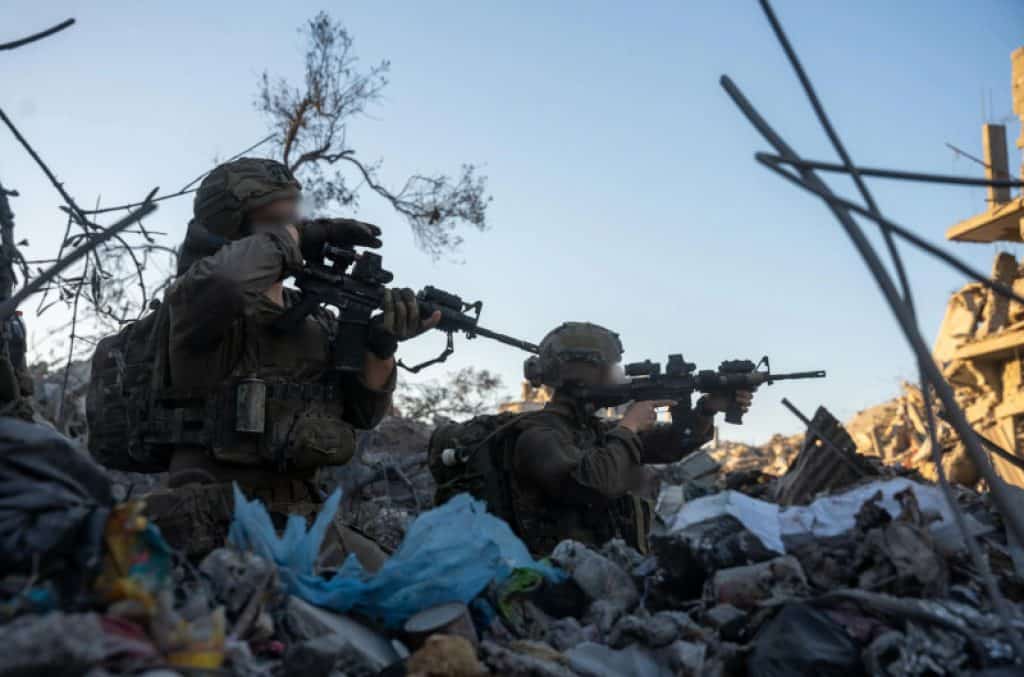
On July 7, five Israeli soldiers were killed and 14 were wounded in northern Gaza’s Beit Hanoun. The Israel Defense Forces (IDF ) said that terrorists activated three explosive devices as the troops passed them. Soldiers who arrived to rescue their comrades were then fired upon. “The troops continued the evacuation while engaged in combat under fire,” the IDF said in a briefing on July 8.
The operation began at night on July 7 in Beit Hanoun, a northern Gaza town that is within a mile of the Israeli border. Although the IDF has operated in Beit Hanoun several times during the war, it appears that terrorists were able to re-infiltrate the area. According to Israeli accounts of the incident, there were around 10 militants involved in the ambush. To bolster the Israeli forces operating in Beit Hanoun, the IDF sent the Givati Brigade’s combat team, according to an Israeli military statement on July 9.
The IDF has continued its multi-month operation in Gaza called “Gideon’s Chariots.” Its objective is for the IDF to retake around 65 percent of Gaza and then remain in areas it controls. This approach contrasts with 2024, when Israeli forces would enter areas such as Beit Hanoun and then leave after several weeks of fighting.
The IDF has deployed up to five divisions during the large operation, which began in mid-May. Beit Hanoun is one area that had not been recleared and controlled again during Gideon’s Chariots. The Israeli military initially left it as a pocket to the rear of forces operating in northern Gaza. On the night of July 7, the IDF sent the 97th “Netzah Yehuda” Battalion of the Kfir Brigade to clear the area. The operation fell under the command of the 99th Division and was backed by elements of the Northern Brigade of the Gaza Division.
“The objective of the operation is to dismantle the local Hamas battalion in Beit Hanoun and to clear the area of terrorist infrastructure, both above and below ground,” IDF Spokesperson Brigadier General Effie Defrin said on July 8. The IDF conducted airstrikes before sending in infantry and tanks.
Defrin said that Beit Hanoun “is a fortified target that currently contains dozens more terrorists and numerous underground tunnels that must be dismantled.” He also stated that the terrorists in the town continue to pose a threat to Israel because the area overlooks Sderot, as well as the Israeli community of Nir Am and a rail line. In his July 8 briefing, Defrin added that the IDF has eliminated more than 1,300 terrorists in Gaza since it resumed fighting in the territory in March after a ceasefire between Israel and Hamas broke down.
Defrin claimed that “[the Israeli] method of warfare is collapsing Hamas from within—we are targeting its military capabilities, undermining its control over Gaza, and eroding the population’s trust in Hamas. […] We will continue fighting Hamas and working to achieve the campaign’s goals in the Gaza Strip: the return of the hostages and the dismantling of Hamas.”
The fighting in Beit Hanoun and other areas of Gaza occurred as Israeli Prime Minister Benjamin Netanyahu flew to Washington for meetings with US President Donald Trump and other officials. One of the issues they will discuss is a possible 60-day ceasefire with Hamas that is intended to lead to a longer peace in Gaza. On July 8, Netanyahu said that as Israel works towards its objectives in Gaza, “this means–there will be no Hamas.” He added, “This entails efforts, some of which are painful, and some which will be very painful to Hamas, but the end result will be the release of all our hostages, and the defeat and dismantling of Hamas. Gaza will no longer constitute a threat to Israel, and we have yet to finish the work.”
In addition to operations in Beit Hanoun, the IDF has continued fighting in Daraj Tuffah in northern Gaza and parts of southern Gaza. In the northern part of the territory, the IDF said on July 9 that troops were fighting in Shejaiya and Zeitoun “to eliminate terrorists and locate weapons. Over the past day, the troops located and dismantled a cache of explosive devices and landmines that were hidden in a civilian structure.” The IDF also found tunnel shafts in Rafah in southern Gaza.