Today it emerged that Bulgaria is in possession of further evidence that ties Hezbollah to the July 2012 Burgas terror attack that killed five Israelis and a Bulgarian national.
“Investigators have discovered that a Hezbollah operative was the owner of a printer used to produce fake documents that facilitated” the attack, the Jewish Telegraphic Agency reported. The new disclosure was made during a European Union working group meeting that was discussing whether or not the EU should designate Hezbollah as a terror organization.
An EU diplomat who participated in the meeting told the JTA that “[t]he Bulgarians put new evidence on the table during this meeting … Their representative said the printer had been sold to someone from Hezbollah.” In February, in an interview with NOW, Bulgaria’s then-Foreign Minister Nikolay Mladenov had said that “[t]here are a number of findings that are still classified.”
On Feb. 5, Bulgaria’s then-Interior Minister Tsvetan Tsvetanov announced that the identities of three of those involved in the Burgas terror attack were known and that at least two of them are members of Hezbollah. While the real names of the two living suspects have not yet been released, authorities believe that they are now living in Lebanon.
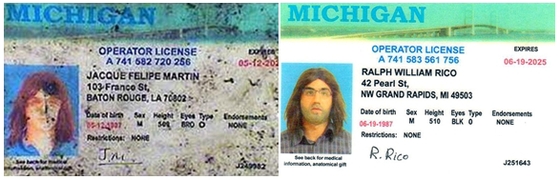
On Feb. 6, Tsvetanov revealed that the three members of the cell flew from Beirut to Warsaw before taking a train to Bulgaria. Although the two living suspects entered Europe on genuine Canadian and Australian passports, in Bulgaria they used forged driver’s licenses that were created by the “same source” in Lebanon, according to Europol.
The Canadian suspect is said to have used a US driver’s license under the name of Ralph William Rico, while the Australian used the alias Brian Jameson. The terrorist who has not been identified, but is believed to have been a relative of the Canadian suspect, had used the alias Jacques Felipe Martin on his fake US driver’s license.
According to Haaretz, “[t]he forged driver’s licenses that all three of them carried yielded the most significant smoking gun, since with the help of foreign intelligence sources the Bulgarians managed to locate the printer that had produced the forged documents − and it wasn’t in Canada or in the United States, but in Lebanon.”
In recent months, the European Union has held a couple of working group meetings to discuss whether or not Hezbollah should be designated as a terrorist group. While a “majority” of EU states reportedly back designating Hezbollah in some form, opposition from Austria and Italy, among others, has stalled the designation process, which requires a consensus from all 27 member states.
Europe’s inability to come to a consensus has frustrated American and Israeli officials alike. During a meeting today with Catherine Aston, the European Union’s high representative for foreign policy, Israeli Prime Minister Benjamin Netanyahu denounced the EU’s inability to reach agreement on the issue. “It’s hard to see how you cannot have a consensus on Hezbollah as a terrorist organization,” Netanyahu said.
The Burgas attack
On July 18, 2012, the 18th anniversary of the Buenos Aires AMIA bombing, a bomb exploded as Israeli tourists boarded buses at the airport in Burgas, Bulgaria. Five Israelis and one Bulgarian national were killed in the attack, which wounded dozens.
Bulgaria’s Interior Minister said the bombing was “a deliberate attack,” and Israeli officials quickly pointed the finger at Iran and Hezbollah. Israeli Prime Minister Benjamin Netanyahu soon declared: “I know based on absolutely rock-solid intelligence that this is Hezbollah and this is something that Iran knows about very, very well.”
Mohammad Khazaee, Iran’s Ambassador to the United Nations, countered by saying that Israel had carried out the attack. “Such [a] terrorist operation could only be planned and carried out by the same regime whose short history is full of state terrorism operations and assassinations aimed at implicating others for narrow political gains,” he claimed.
Despite Iranian allegations, American and Israeli officials were soon fairly certain that the attack had been carried out by Hezbollah with direction from Iran. “Israeli intelligence has evidence of many telephone calls between Lebanon and Burgas in the two months before the bombing … with the volume intensifying in the three days leading up to it,” the New York Times reported in early August.