|
|
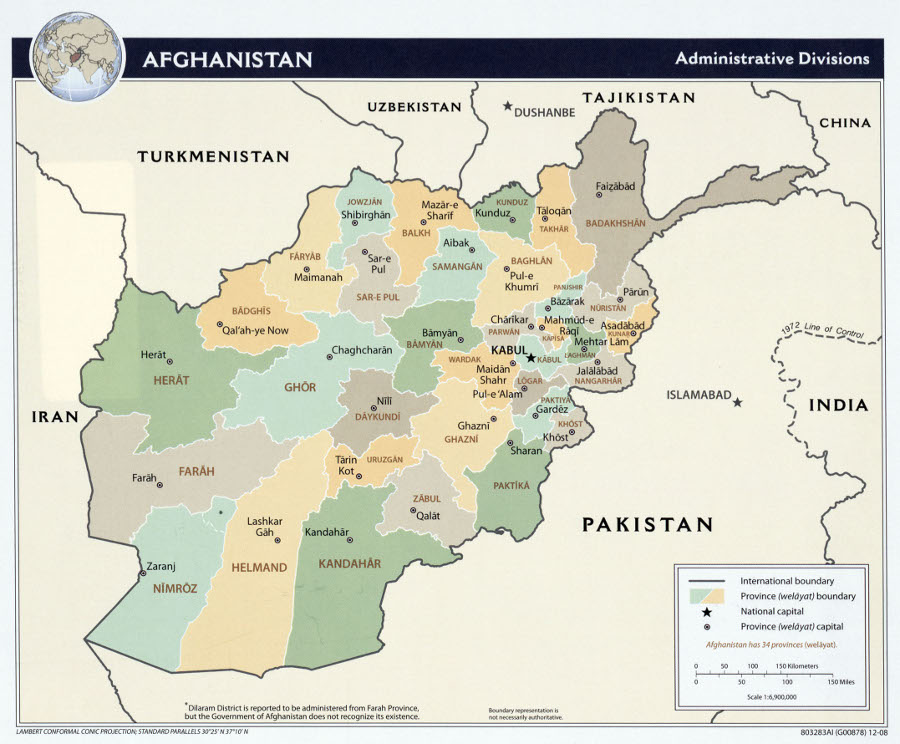
| Map of Afghanistan’s provinces. Click map to view larger image. |
Afghan commandos and Coalition special operations forces killed more than 70 “insurgents” during an operation in the remote, mountainous province of Nuristan yesterday. Much of the province is under the control of the Taliban and other allied insurgent groups.
The combined forces launched a clearing operation in the villages of Pol-e Rostam and Alwagal in Barg-e-Matal district, the International Security Assistance Forces stated in a press release. Barg-e-Matal is one of six of the eight districts in Nuristan that are under the control of the Taliban, Governor Mohammad Tamim Nuristani said on Sept. 4 [see LWJ report, Governor: Most of Nuristan under Taliban control].
Afghan commandos were attacked by the Taliban immediately after air-assaulting into Pol-e Rostam. Seven insurgents were killed during airstrikes, and another 33 were killed during “multiple engagements” as the operation progressed. The combined force was able to secure the district center.
In the village of Alwagal, the commandos again came under “heavy small arms fire from multiple directions” as they air-assaulted into the area. An additional 30 insurgents are thought to have been killed during heavy fighting.
One Afghan commando was killed during the operation. “Four coalition SOF, one Commando, one interpreter and the team’s military working dog were injured by an insurgent grenade,” ISAF stated.
ISAF stated that the purpose of the operation was to “disrupt insurgent activity and demonstrate the Government of the Islamic Republic of Afghanistan’s ability to place security forces into remote insurgent safe havens.”
Barg-e-Matal and other districts in Nuristan have changed hands between the Afghan government and the Taliban numerous times over the past several years. The Afghan Taliban, aided by the Pakistani Taliban and other groups, have launched repeated attacks against district centers in Nuristan, withdrawing their forces when Afghan and Coalition troops launch counterattacks. Then after the Afghan and Coalition troops withdraw, the Taliban retake control.
The Afghan government and the Coalition have given up on waging counterinsurgency operations in Nuristan and neighboring Kunar. Instead, conventional and special operations forces are launching periodic sweeps to cull the Taliban forces, or “mowing the grass,” as Major General John Campbell, the previous commander of Regional Command East, described it in April.
Nuristan is a Taliban and al Qaeda haven
The Barg-e-Matal district is a known Taliban and al Qaeda transit area to and from the northern Pakistani district of Chitral. In May 2011, the governor of Nuristan claimed that 25 al Qaeda fighters were killed and wounded while crossing the border from Pakistan into Barg-e-Matal.
In addition to the al Qaeda and Taliban presence in the area, large numbers of former Hezb-i-Islami fighters aligned with warlord Gulbuddin Hekmatyar and his top battlefield commander Kashmir Khan are also active in Barg-e-Matal. Affiliated with Hezb-i-Islami commanders are criminal elements who dominate the illegal lumber trade and gem mines in the region.
Barg-e-Matal borders the district of Kamdish, which has been effectively under Taliban control since US troops withdrew from combat outposts in the fall of 2009 after an attack by a large Taliban and al Qaeda force.
At the end of March 2011, the Taliban overran the nearby district of Waygal. Afghan police and officials abandoned the district center after hundreds of Taliban and al Qaeda fighters attacked from four sides. [See LWJ report, Northeastern Afghan district falls after Taliban assault.] Waygal, or Wanat as it is also known, is said to remain effectively under Taliban control.
In the fall of 2009, ISAF began withdrawing forces from remote districts in Nuristan and neighboring Kunar province as part of its new counterinsurgency plan that emphasizes securing major population centers over rural areas. According to ISAF commanders, the remote provinces of Nuristan and Kunar will be dealt with after more strategic regions in the south, east, and north have been addressed. But with the July announcement of the withdrawal of 33,000 US and thousands of additional NATO troops, the region will not receive additional Coalition forces. Instead, the area is being turned over to Afghan forces.
The outposts in Nuristan and Kunar were initially created in 2006 as part of a plan to establish a string of bases to interdict Taliban fighters and supplies moving across the border from Pakistan. But the plan was not completed, because US forces were diverted to the south in Kandahar after the Taliban began launching increasingly sophisticated attacks.
The withdrawal of US forces from the outposts in Nuristan and Kunar provinces has provided the Taliban and al Qaeda with safe havens in the region. The Taliban are using these new safe havens to stage attacks in the north. The neighboring provinces of Takhar and Badakhshan, particularly the Jurm district, have seen a spike in attacks. In the past, Afghan intelligence officials claimed to have intercepted rogue Pakistani Frontier Corps personnel and Pakistani Inter-Services Intelligence directorate agents penetrating Badakhshan from Kunar. The provinces of Badakhshan and Tahkhar had been peaceful up until 2009.
The US withdrawal from outposts in Nuristan and Kunar has also provided the Taliban with major propaganda victories. The Taliban have released tapes showing large-scale assaults on the US outposts followed by scenes of the Taliban occupying the abandoned bases. Weapons and ammunition that had been hastily abandoned by US and Afghan forces were displayed by the Taliban in the tapes.