 |
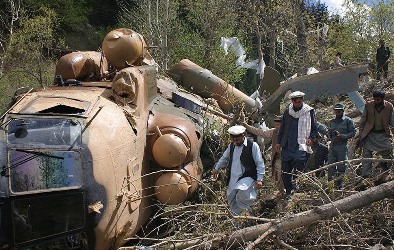
| Afghan intelligence and security forces secure the scene of a downed Afghan National Army helicopter that crashed in the Parun district, Nuristan province on May 10, 2011. Source: Los Angeles Times |
The Taliban now control six of the eight districts in Nuristan, according to the newly reinstated governor of the remote province, which lies in the rugged and inhospitable mountain ranges of northeastern Afghanistan.
Governor Mohammad Tamim Nuristani recently told Pajhwok Afghan News that the six districts under Taliban control are Barg-e-Matal, Kamdesh, Waigal, Mandol, Doab, and parts of Noorguram. This leaves only the provincial capital of Parun and its southerly adjacent district of Wama in the Afghan government’s control.
Security in greater Nuristan province has proved elusive since US forces built an initial forward operating base in the Kamdesh district in 2006. Development and reconstruction efforts in the province have been stalled by insecurity, logistical challenges posed by the terrain and climate, lack of infrastructure to move heavy equipment, and local government inefficiencies.
Governor Nuristani revealed that only six of 800 development projects approved two years ago have been completed; the rest have been stalled or canceled due to insecurity. In August, Nuristani replaced the longstanding governor of Nuristan, Jamaluddin Badr. Nuristani, a well known, educated, and respected elder from Nuristan, previously served as the province’s governor between 2005 until he was sacked in July 2008.
The effort to pacify the rugged countryside has been hard fought, including some of the most ferocious battles US forces have engaged in throughout the 10-year war in Afghanistan. On July 13, 2008 up to 200 Taliban guerrillas attacked a US patrol in the village of Wanat in the Waigal district, killing nine soldiers and injuring dozens of others. On Oct. 3, 2009 more than 350 Taliban fighters laid siege against US soldiers and Afghan police at Camp Keating (Kamdesh) in Nuristan. The attack completely destroyed the base, and eight US soldiers died defending it. At least seven Afghan security personnel were killed, and upwards of 100 militants were killed by US air strikes against their positions.
Just a few days after the attack on Camp Keating, US forces pulled out of two main bases and several small outposts in Nuristan under a plan by General Stanley McChrystal to relocate forces to population centers and other districts viewed as critical. Following the hasty US exit from Nuristan, Taliban militants quickly overran the former military outposts and soon established a functioning government structure in several of Nuristan’s more remote district capitals.
In addition to the Taliban, several regional mahaz (fronts) also operate in the province, including Hizb-e-Islami Gulbuddin (HIG), al Qaeda, and Jama’at al-Daw’a ila al-Sunnah of Afghanistan. Governor Nuristani has indicated that both Jaish-i-Mohammad and Lashkar-e-Taiba of Pakistan are also active in the province.
Attacks on both sides of the border are directed by Qari Zai Rahman, the dual-hatted Taliban and al Qaeda leader who operates in Pakistan’s tribal agencies of Bajaur and Mohmand, as well as in Afghanistan’s provinces of Kunar and Nuristan. Qari Zia leads forces in al Qaeda’s Lashkar-al-Zil, or Shadow Army [see LWJ report, Al Qaeda’s paramilitary ‘Shadow Army’ for more details].
The Taliban have stepped up their attacks throughout the province, even before the Taliban summer offensive began on May 30. The Taliban launched a series of major attacks against Barg-e-Matal, Kamdesh, and Waigal districts, and later intensified attacks province-wide. The Waigal district fell to Taliban fighters on March 29.
On May 4, Taliban fighters from the Chapa Dara district of Kunar crossed into Nuristan and rocketed several security posts in the Wama district, injuring at least six policemen. A few days later, approximately 400 Taliban fighters besieged an Afghan security barracks housing police-reserves in the Chitras (Chatrash) and Koshtal area, some 11 miles south of the provincial capital. Nuristani officials believe that the Taliban’s shadow governor for Nuristan, Sheikh Dost mohammed, recently lived in Chitras, where he also administered his network of fighters and antigovernment activities.
Afghan government reinforcements arrived the following day, although one of four helicopters belonging to the Afghan National Army assisting local forces in Nuristan crashed as it attempted to land inside a compound in Paroon, injuring nine security personnel who were on board. The Taliban claimed to have shot the helicopter down; however, the midday crash occurred after the helicopter clipped a tree as it entered a compound operated by the National Directorate of Security (NDS).
During the last week of May, the Afghan government withdrew its forces from the Doab district following two days of heavy fighting between militants and the besieged local administration. Both Hizb-e-Islami and the Taliban claimed credit for the attack, with a Hizb-e-Islami spokesman claiming that 20 policemen had surrendered with their weapons.
On July 5, an estimated few hundred militants from Nuristan and Pakistan attacked four police checkpoints in the Gawardish area of the Kamdesh district. Pitched battles between government forces and militants lasted a week, with 23 Afghan Border Police and some 40 militants killed in the first 24 hours of the battle, according to the government officials who spoke with Pajhwok Afghan News.
There are only 160 policemen in the Kamdesh district, far too few to secure the 70-kilometer border it shares with Pakistan, according to provincial authorities. Previously, the provincial governor publicly stated that 40 percent of the police in Nuristan lacked weapons and other essential equipment needed to fight insurgents.