The Israel Defense Forces (IDF) is shifting forces in southern Lebanon toward what Israeli security officials described as a “forward and offensive defense” posture. The officials said the IDF is also preparing positions for winter after months of clearing operations inside Israel’s self-declared security zone, Ynet reported on October 4.
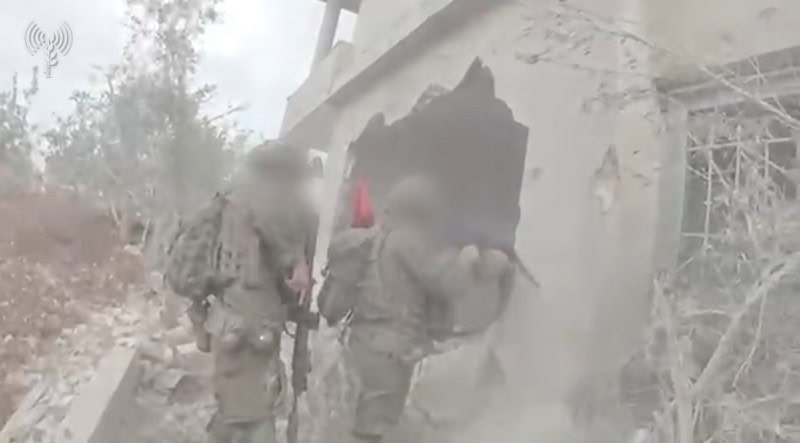
The change comes as the 55th Reserve Paratroopers Brigade completes a 100-day mobilization that included 80 days of operations in Lebanon. Ynet reported that the Bislamach Brigade and Gefen Battalion of the IDF officers’ course are replacing the reservists and preparing key positions for winter from which troops can observe areas deeper inside Lebanon and engage threats there with fire.
In the 55th Brigade’s sector, Ynet said the security zone defensive line reached roughly 12 kilometers from the Israeli border. That depth is not uniform along the Yellow Line, the boundary of Israel’s self-declared security zone. One of those deeper positions is around Majdal Zoun, a village in the western sector of southern Lebanon’s Tyre District, roughly 15 kilometers south of Tyre. An Israeli security official described the concept as “forward defense”: Israeli troops hold deeper positions inside Lebanon to detect and engage threats before they reach northern Israel. The official cited Majdal Zoun as an example of defending Nahariya from inside Lebanon rather than “from the gate.”
The October 4 report follows earlier Israeli reporting that the IDF Northern Command was considering reducing the number of brigade combat teams in southern Lebanon and concentrating troops on commanding terrain rather than physically occupying every point up to the Yellow Line. The Israeli daily Israel Hayom reported on September 14 that the proposed deployment would follow a “Gray Line” of commanding ridges and strategic positions inside the security zone, in places set back from the Yellow Line, while retaining control of the area up to it. The report attributed the operational plan to Northern Command and the IDF and said it had not yet received final approval. The outlet separately reported that the continued Israeli presence in the security zone reflected a decision by Israel’s political leadership. Israeli Prime Minister Benjamin Netanyahu said on October 5 that Israel would “continue to strike Hezbollah” while seeking to “create an opportunity for peace” with Lebanon.
On September 28, the IDF said the 55th Brigade had completed a brigade-level clearing operation in and around Mansouri, in Tyre District, aimed at preventing Hezbollah from reestablishing itself in the security zone. During the Mansouri operation, the IDF said troops found and destroyed a Hezbollah underground route inside a civilian home. Separately, across the brigade’s wider deployment in the security zone, the IDF said it destroyed more than 600 Hezbollah sites and eight underground routes and found dozens of launchers that had been left in the area before the June 19 ceasefire took effect.
Ynet additionally reported that Mansouri and Majdal Zoun contained pockets that had not been fully cleared before the 55th Brigade’s latest operations and that, according to Israeli security officials, Hezbollah used the period since the June 19 ceasefire to prepare the terrain against Israeli forces. The outlet said that during the brigade’s deployment, Israeli forces killed approximately 10 Hezbollah operatives who tried to cross the Yellow Line. Israeli security officials assessed that Hezbollah would continue trying to penetrate the security zone.
On September 30, the IDF announced that the Golani Brigade was leaving southern Lebanon for rest after seven months of operations under the 36th Division. The Israeli military stated that Golani troops had recently operated around Beaufort Ridge, southeast of Nabatieh and overlooking the Litani River, and had destroyed more than 900 Hezbollah sites during their deployment.
The emerging posture is consistent with Israel’s handling of Ali al Taher Ridge in September. After destroying Hezbollah’s underground complex there, Israeli troops withdrew and redeployed to commanding positions around Beaufort, from which they could monitor Ali al Taher and engage threats from a distance. IDF Chief of Staff Lt. Gen. Eyal Zamir said at the time that the mission had been to destroy the infrastructure and then “redeploy in the area,” while keeping the Yellow Line under full Israeli control.
The Beirut-based news outlet Al Modon reported on October 6 that Israeli forces were reinforcing positions, opening roads for military vehicles, and establishing barriers and additional positions in southern Lebanon. Separately, L’Orient Today, citing Sky News Arabia, reported on October 7 that an unnamed Israeli military source said that Israeli forces would remain in southern Lebanon “for years,” because Hezbollah infrastructure remained throughout the area south of the Yellow Line. The IDF has not publicly announced such a timeline.
Hezbollah Secretary-General Naim Qassem commented on October 6 that Hezbollah “cannot but be resistance as long as this aggression exists” and said a solution begins with Israel’s withdrawal. Qassem also said Hezbollah was prepared to cooperate with the Lebanese state on domestic issues, including the “monopoly of arms,” through Lebanon’s constitutional and legal framework and without foreign dictates. He did not say Hezbollah would surrender its arsenal.
In April 2025, Qassem explicitly distinguished “resistance weapons” from arms subject to state monopoly and said that a national defense strategy should determine how Lebanon could “benefit from the resistance and its weapons.”