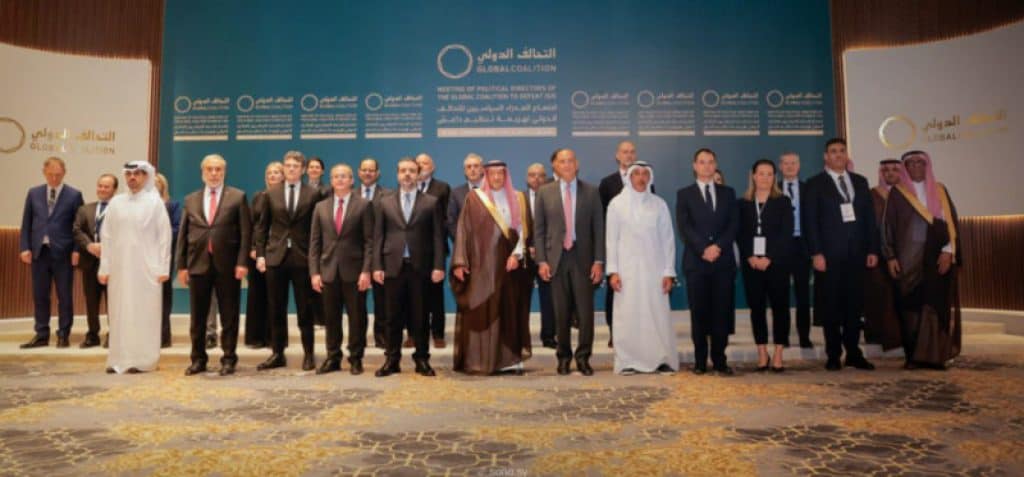
Syrian Foreign Minister Asaad Hassan al Shaibani took part in a meeting of the US-led anti-Islamic State coalition in Saudi Arabia on February 9. Syria joined the coalition in November as its 90th member. The meeting took place after a January 29 agreement between the Syrian government and the Syrian Democratic Forces (SDF) that enables the government to deploy forces to areas of northeastern Syria that the SDF has controlled for 10 years. This transition process is ongoing, with concerns arising over the humanitarian situation in the Kurdish city of Kobani.
“Syrian Foreign Minister Asaad Hassan al-Shaibani and intelligence chief Hussein al-Salama are participating in the meeting of Political Directors of the International Coalition to Defeat ISIS, being held in the Saudi capital, Riyadh,” Syria’s state-run Syrian Arab News Agency (SANA) reported. US Envoy to Syria Tom Barrack, who also met with the Syrian foreign minister, wrote on X that “Syria’s participation in the D-ISIS Coalition meeting in Riyadh marks a new chapter in collective security.”
A joint statement by the United States and the Kingdom of Saudi Arabia, issued after the coalition meeting, praised the recent agreement between the Syrian government and the SDF. “They [the participants] noted the Government of Syria’s stated intention to assume national leadership of counter-ISIS efforts and expressed appreciation for the sacrifices made by the Syrian Democratic Forces in the fight against ISIS/Daesh,” the statement said. In addition, the statement referenced the transfer of Islamic State detainees from Syria to Iraq and the coalition’s continued coordination with Iraq and Syria regarding the campaign against the jihadist group. “Coalition members underscored their readiness to work closely with the Syrian government and encouraged members to provide direct support to Syrian and Iraqi efforts,” the statement said.
SDF commander Mazloum Abdi met with French Foreign Minister Jean-Noel Barrot in Erbil on February 6. The SDF noted in a post on X that the meeting covered the importance of protecting the Kurdish regions of Syria and Kurdish rights. The SDF also emphasized the importance of integrating its forces with the government, including members of its Women’s Protection Units, which served alongside the SDF in the war on the Islamic State. France is concerned about a possible resurgence of the Islamic State in Syria, Le Monde noted.
Since the agreement between the SDF and Syrian government, the government has deployed Interior Ministry forces to Al Hasakah and Qamishli in northeastern Syria. A meeting was held in Al Hasakah on February 10 to continue coordination between the forces in eastern Syria, North Press Agency reported. Syrian government officials also visited Qamishli airport on February 9.
However, the transition has faced hurdles in the Kurdish city of Kobani in northern Syria on the border with Turkey. On February 9, the Kurdish outlet Rudaw Media Network reported that Kobani was “under a crippling humanitarian siege, with a local politician warning that the situation is heading toward ‘a catastrophe’ as residents face severe shortages of food, water, electricity, fuel, and medical supplies.”
Kurdistan24 reported on February 10 that the UN is concerned about conditions in the city. “The echoes of calm that followed the SDF–Damascus agreement have not translated into relief on the ground for Kobani, where failing services and displacement continue to define daily life despite a measurable drop in violence,” the report stated. The UK-based Syrian Observatory for Human Rights said on February 10 that a woman had died due to challenges in reaching a medical center in the Kobani countryside.
Neither Syrian state media nor the SDF on its official X page have mentioned the situation in Kobani over the last several days, leaving both sides’ stances on the situation unfolding in the city unclear.