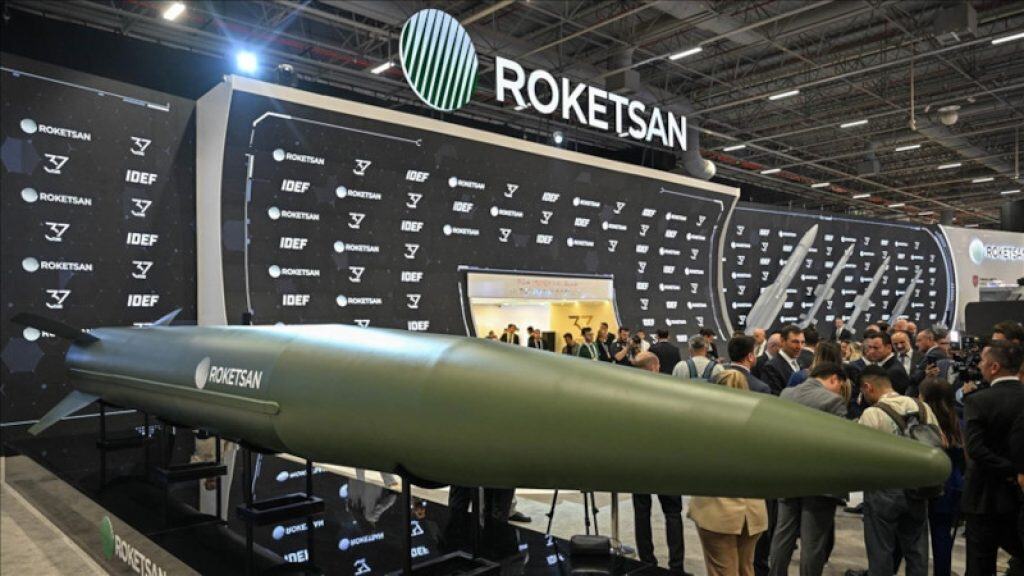
In late July, Turkish defense contractors used the 2025 International Defense Industry Fair (IDEF) to showcase the latest additions to the country’s arsenal. Headlining the event were some striking developments: the “Tayfun Block-4” ballistic missile and the “Gazap” and “Hayalet” 2,000-pound bombs. Both weapons, which the Turkish military might soon deploy, could threaten additional targets inside the territories of Israel, Greece, and Cyprus—neighbors that already view Ankara’s ambitions with deep suspicion.
Turkish President Recep Tayyip Erdogan characterized the debut of these systems as a national milestone. Speaking at IDEF’s opening ceremony, he declared, “Today, we are not only witnessing the development of the Turkish defense industry, but also the march of a nation toward independence; we are seeing the story of a country rising under its own sky, on its own wings.”
Erdogan’s framing is deliberate. The rollout of the Tayfun 4, Gazap, and Hayalet is not an isolated event, but the latest phase in a broader transformation. Under Erdogan’s leadership, Turkey’s defense sector has expanded into one of the world’s largest, supplying what he claims is an estimated 80 percent of the country’s military needs. The industry now comprises more than 3,500 companies, employs over 100,000 people, and generates an annual turnover exceeding $20 billion.
Turkey’s push for a self-reliant defense industry dates back to the 1970s, when the United States imposed a years‑long arms embargo on Turkey following the latter country’s 1974 invasion of Cyprus. The freeze cut off spare parts and key systems for Turkey’s air and armored units, spurring Ankara to launch policies aimed at domestic production. For decades, progress remained modest and largely confined to state-run initiatives under the Mechanical and Chemical Industry Corporation (MKE).
The situation changed after Erdogan came to power in 2003. His government made defense innovation, research, and development a national priority, fostering public-private partnerships and moving aggressively into high-end systems. The results have been tangible: the development of homegrown tanks, submarines, combat ships, helicopters, and Ankara’s fifth-generation stealth fighter, the “Kaan,” which Ankara claims is in testing.
The Tayfun 4, Gazap, and Hayalet represent additional progress. Turkish officials describe the Tayfun (Typhoon) as a “block four” measuring 10 meters (33 feet) in length and weighing 7,200 kilograms (15,873 pounds). The Gazap (“wrath” in Turkish) and the Hayalet are some of the country’s largest domestically produced air-launched munitions. Both systems expand Turkey’s offensive capabilities, reinforcing Ankara’s ability to project power across the eastern Mediterranean and deep into the Middle East.
For Greece and Cyprus, the new weapons validate longstanding concerns. Both EU members point to Turkey’s “Blue Homeland” naval doctrine, which seeks to revise the maritime boundaries in the Aegean and eastern Mediterranean Seas in ways that would dramatically shrink their territorial waters. With advanced missile capabilities, Ankara can now deploy strike assets along its coastline or in areas of Northern Cyprus under Turkish occupation—placing much of Greece’s island chain and Cyprus itself within range.
Israel’s apprehensions run along parallel lines. Since the October 7 Hamas attacks, Ankara has openly aligned with the Palestinian group, offering political and material support aimed at undermining Israeli security. Turkish activity in Syria has also increased, including efforts to counter Israeli operations assisting the Druze minority. Analysts note that Turkey’s overseas basing agreements—such as a military presence in Somalia—and its existing forces in Northern Cyprus position it to threaten Israel from multiple axes. The addition of new weapon systems sharpens that perceived encirclement.
For Erdogan, the message at IDEF was one of self-reliance and technological achievement. For Israel, Greece, and Cyprus, the subtext was a warning: Turkey is arming itself not just for defense, but for strategic dominance in a region already thick with fault lines.
Editor’s note: This article has been amended from its original version to provide clarity by the author after further consultation with weapons experts. Specifically, references to the description of the Tayfun 4 missile being “hypersonic’ were removed; there is nothing yet to indicate it has any characteristics associated with highly maneuverable hypersonic weapons. The range of the Tayfun missile is also unknown. In the case of the Gazap 2,000-pound bomb, the reference to it being a “non-nuclear” weapon was removed, as it may lead readers to assume that Turkey has built or attempted to build nuclear bombs previously––it has not. An additional reference to the Hayalet bomb was added to designate Turkey’s development of bunker-busting munitions capabilities.