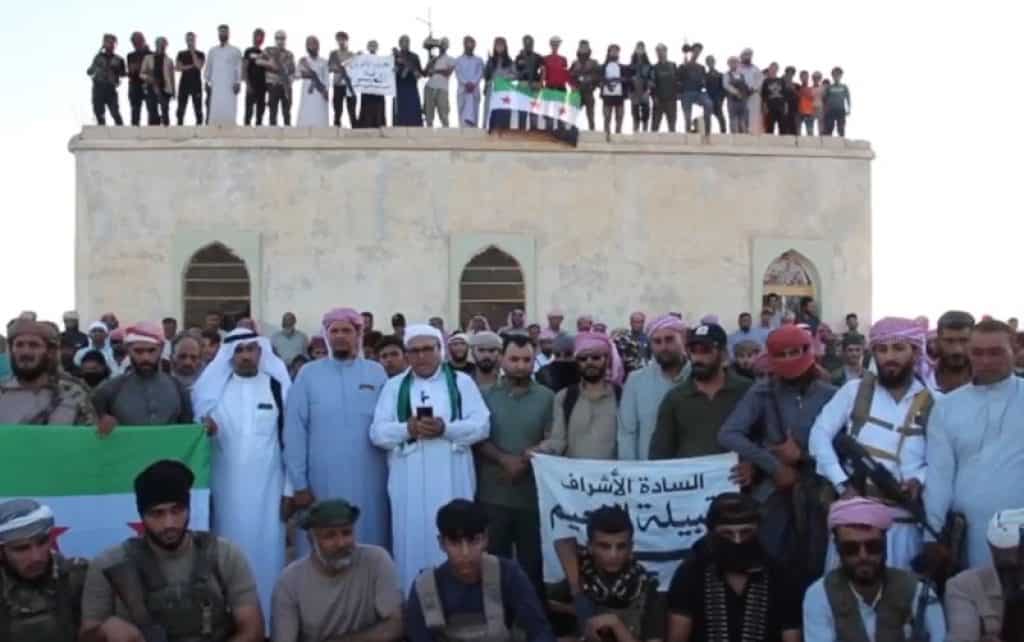
Several Sunni Arab tribes in northeastern Syria, an area that encompasses 30 percent of Syrian territory and is currently under the control of the Kurdish-led Syrian Democratic Forces (SDF), have called for a general mobilization against the SDF. Members of the Al Naim, Al Bushaaban, Qais Aylan, and Al Baqara tribes have explicitly called for a nafeer aam (general mobilization) against the SDF. These tribes are spread across the governorates of Deir Ezzour, Raqqa, and Al Hasakah, all of which are under SDF control.
Sheikh Faraj al Salamah, a tribal leader in the region, stated, “Coordination is underway with all the tribes that have called for mobilization, and everyone is waiting for the right moment to begin moving.” He described their goal as the “liberation of the Syrian Jazira,” referring to areas in northeastern Syria.
Relations between Arab tribes and the SDF are complex. After the SDF and an international coalition defeated the Islamic State (IS) between 2016 and 2019, the SDF expanded into former IS-held territory, long considered the heartland of Syria’s Arab tribes. The area’s tribal chiefs fell into three broad categories at that time: those who worked with the Syrian opposition and Turkey during the civil war; those who feared the Bashar al Assad regime and formed arrangements with the SDF; and those who remained loyal to Assad and aligned with Iranian-backed proxies fighting the SDF.
Of the SDF’s estimated 100,000 fighters, around 65,000 are Arabs, with the remainder made up of Kurds, Assyrians, and other minorities. However, the SDF’s core and most influential forces—the People’s Protection Units (YPG) and Women’s Protection Units (YPJ)—are predominantly Kurdish, leaving Arab fighters with less influence. Many Arabs joined the SDF when Assad was still in power, drawn by higher monthly salaries and because of mandatory conscription in the northeast, where Arabs make up roughly 75 percent of the population.
Deir Ezzour Governorate, whose population is entirely Arab, has been a flashpoint in SDF-Arab tribal tensions for years. Currently, the SDF has extensive control over the governorate except for the city of Deir Ezzour. In 2023, clashes erupted between the SDF and Arab tribes, many of whose members were senior leaders in the Deir Ezzour Military Council (DMC), an SDF constituent military council.
Fighting began after the SDF arrested and dismissed Abu Khawla, the DMC’s commander. Arab tribal representatives also accused the SDF of stealing oil resources to fund Kurdish-majority areas. At the time, it was widely believed that the Assad regime, working with Iran and Russia, stoked the unrest to spark an uprising against the SDF. Pro-Assad tribal militias joined the clashes in an unsuccessful bid to retake the governorate for Assad’s government. The SDF retained control in the end.
The latest clashes erupted on August 14 in the town of Gharanij in eastern Deir Ezzour, where Arab tribal fighters “surrounded members of the Syrian Democratic Forces (SDF) inside a pharmacy they were visiting on an unofficial mission.” The confrontation escalated into intense clashes, leaving three attackers wounded and one dead. Six SDF soldiers were abducted; two were later released, while four remain in captivity. The attackers also seized a military vehicle accompanying the SDF team.
Since the downfall of the Assad regime and the rise of the new Syrian state under former Al Qaeda and Hayat Tahrir al Sham commander Ahmad al Sharaa, integrating Kurdish-held territories into the new government has remained a challenge. An agreement signed in March between the Syrian government and the SDF has stalled over fears about the Syrian government’s jihadist origins and the centralization of power under Sharaa.
While clashes between the new Syrian Army and the SDF have occurred, both sides have avoided a full-scale confrontation until now. Still, with Arab tribes calling for mobilization, the risk of renewed fighting grows. The Syrian state may intervene to protect the tribes if clashes intensify, like its actions in southern Syria during the Druze clashes with Bedouin tribes in Suwayda Governorate.