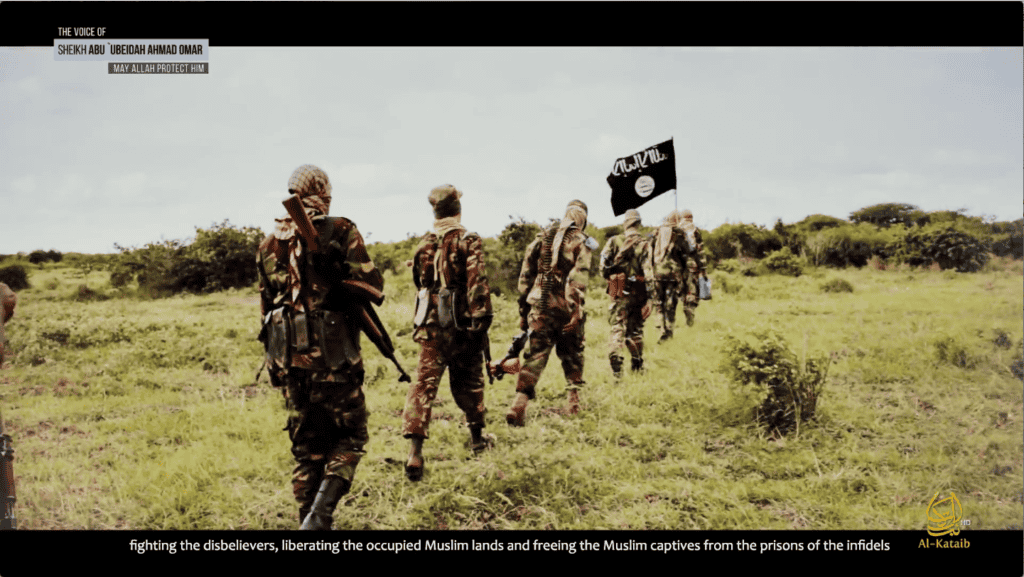
An Islamic State suicide bomber pictured before today’s attacks in Aden, Yemen.
The Islamic State’s “Aden-Abyan Province” claimed responsibility for four suicide bombings in Yemen earlier today. The attacks targeted forces from Saudi Arabia, the United Arab Emirates, and the deposed Yemeni government, all of which have been battling Shiite Houthi rebels.
The Islamic State’s claim was disseminated via Twitter and translated by the SITE Intelligence Group.
The first bomber targeted the Al Qasr hotel, where members of President Abdu Rabu Mansour Hadi’s former government have been reportedly stationed. Yemeni Prime Minister Khaled Bahah was also staying at the hotel, according to Agence France Presse.
The Islamic State describes Al Qasr as the “government’s headquarters.” A second attacker followed up the first by driving a “booby-trapped Hummer to bring down the headquarters of the government,” which is apparently a reference to the same hotel.
In the “second operation,” a pair of “martyrs” driving “booby-trapped armored vehicle[s]” targeted the “Central Operations Headquarters of the Saudi and Emirati forces” and “the Emirate Military Administration Headquarters.”
There was confusion in the immediate aftermath of the bombings, with officials saying the Houthis’ rockets were to blame. But the Islamic State later issued a formal statement, saying four of its operatives were responsible for the “blessed” raids.
Initial casualty reports indicate that 15 soldiers were killed, including four from the UAE and one from Saudi Arabia.
The coordinated suicide bombings are a departure from the Islamic State’s usual operations inside Yemen. The “caliphate’s” terrorists typically target mosques and other “soft” targets frequented by civilians. Such attacks have been denounced by Al Qaeda in the Arabian Peninsula (AQAP), which the Islamic State’s “Aden-Abyan Province” rivals. AQAP has rejected Abu Bakr al Baghdadi’s caliphate claim. And al Qaeda believes that indiscriminate attacks on civilians, including Shiites, alienate the Muslim population, thereby jeopardizing the jihadists’ support base in the long run.
AQAP quickly distanced itself from the Islamic State’s first major attacks in Yemen in March, when two suicide bombers struck mosques attended by both Shiites and Sunnis. Citing Ayman al Zawahiri’s general guidelines for waging jihad, AQAP argued that the jihadists should avoid “targeting mosques, markets, and public places out of concern for the lives of innocent Muslims, and to prioritize the paramount interests.” [See LWJ report, Analysis: Why AQAP quickly denied any connection to mosque attacks.]
However, the Islamic State’s bombings today struck military forces that are opposed to the Houthis. AQAP has benefited from the Saudi-led campaign in Yemen in some ways, capturing territory in southern Yemen since the beginning of the year. But AQAP will probably find it difficult to openly criticize the Islamic State’s attacks in Aden, as the group cannot be seen as siding with Saudi Arabia, the UAE or Yemeni officials.
Not long after the attacks in Aden, the Islamic State’s men returned to form by striking a mosque in Sanaa. The Islamic State claimed its victims included Houthis who were preparing to be deployed for battle.