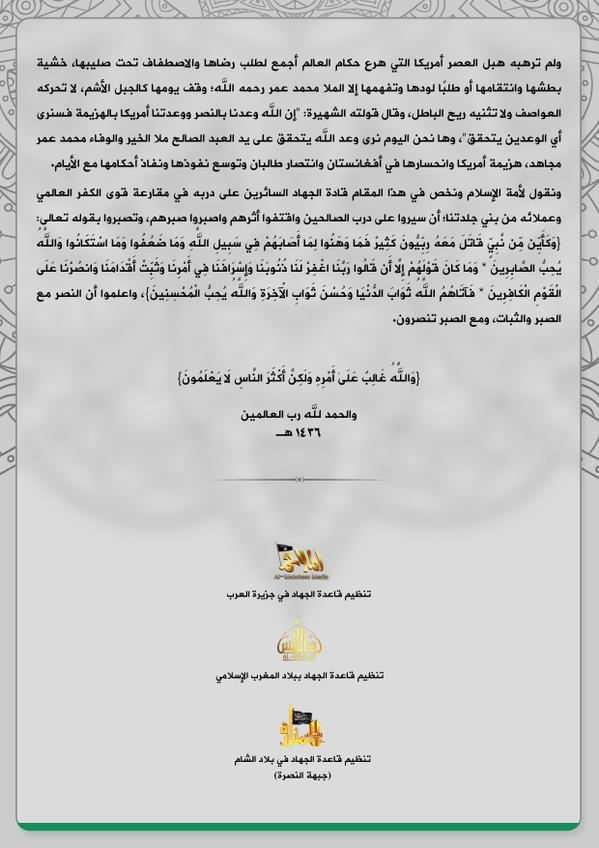
Three al Qaeda branches have released a joint statement commemorating Mullah Omar’s jihadist career. The Al Nusrah Front, al Qaeda’s official branch in the Levant, posted the eulogy on Twitter on August 5. Al Qaeda in the Arabian Peninsula (AQAP) and al Qaeda in the Islamic Maghreb (AQIM) are also signatories. The statement, which is included at the end of this article, was translated by the SITE Intelligence Group.
The al Qaeda groups mention Omar’s decision to harbor Osama bin Laden twice, noting that he refused to bow to pressure from the US and the international community.
Omar “reached the pinnacle on the day when he refused to turn over Sheikh Osama…and a small group of the immigrants,” SITE’s translation reads. The statement continues with a quote attributed to Omar: “Verily, the issue of Osama is no longer the issue of an individual, but it is an issue of the glory of Islam.”
Omar’s decision to continue to provide bin Laden safe haven after the 9/11 attacks earned him al Qaeda’s enduring loyalty. In fact, bin Laden swore bayat (an oath of allegiance) to Omar prior to al Qaeda’s greatest day of infamy. A video of bin Laden shows him explaining in mid-2001 why all Muslims should pledge their loyalty to Omar. And al Qaeda renewed this oath in July 2014, as the Islamic State began to challenge al Qaeda’s leadership of the global jihadist community. In a news bulletin released online, Ayman al Zawahiri’s organization confirmed “that al Qaeda and its branches everywhere are soldiers among [Omar’s] soldiers.”
Al Qaeda advanced this narrative in response to the Islamic State’s claim to rule as a caliphate across much of Iraq and Syria, with Abu Bakr al Baghdadi declaring himself to be the caliph. Baghdadi and his followers refer to him as the “Emir of the Believers,” a title usually reserved for the caliph. The Taliban and al Qaeda previously gave Omar this same honorific, although they refrained from claiming that Omar was a caliph.
Omar’s mysterious death creates a significant issue for al Qaeda. Al Qaeda had portrayed Omar as the legitimate alternative to Baghdadi as the “Emir of the Believers.” But now that the Taliban has confirmed Omar’s death, al Qaeda does not have an obvious substitute to contrast with Baghdadi. The claim that Omar died as early as April 2013 also hurts al Qaeda’s cause, because it means that Zawahiri reaffirmed his organization’s allegiance to the Taliban leader long after he had passed away.
The three al Qaeda branches make no mention of Osama bin Laden’s and Ayman al Zawahiri’s bayat to Omar in their eulogy. Nor do they mention Omar’s successor, Mullah Akhtar Mohammad Mansour. In addition to being the Taliban’s new emir, Mansour has also been described as the “Emir of the Faithful.”
Their silence is not altogether surprising, however. In al Qaeda’s hierarchy, the regional branches (Al Nusrah, AQAP, AQIM, Shabaab in Somalia and al Qaeda in the Indian Subcontinent) swear allegiance to Zawahiri, the organization’s overall emir. Each is still outwardly loyal to Zawahiri to this day. Zawahiri, in turn, pledged fealty to Omar. So, Zawahiri and his immediate advisers now have to determine how to handle the thorny issue of Omar’s death.
The three al Qaeda groups praise Omar’s leadership, saying he “unified the mujahid Afghan Muslim people under the banner of the Taliban.” Omar also “honored the immigrants and did not forget their favor,” turning Afghanistan into a “house of immigration and jihad, and a school from which lions and thirsty heroes graduated.”
The statement repeats one of Omar’s “well-known” sayings: “Verily, Allah has promised us victory and America has promised us defeat, so we shall see which of the two promises will be fulfilled.” The al Qaeda branches say that Omar’s prediction is coming to fruition, as America’s “defeat” and “collapse in Afghanistan” are a reality. The Taliban’s “victory,” “expansion of its power” and ability to impose sharia law (“implementation of its rules”) are now supposedly within reach as well. Indeed, the Taliban has achieved steady gains in recent months.
The eulogy also reminds readers of Omar’s decision to eradicate symbols of Afghanistan’s pre-Islamic history. The al Qaeda authors ask a rhetorical question: “Who among us can forget his historic position in destroying the idols of Buddha and what accompanied that of pressure and temptation?” Here, the statement is referring to the Taliban’s destruction of massive Buddhist monuments, a move that was denounced by nations around the world.
Al Qaeda’s international network continues to honor this act. Indeed, there is evidence that bin Laden’s men were directly involve. For instance, a footnote in the 9/11 Commission’s report says that Ramzi Binalshibh, al Qaeda’s point man for the simultaneous hijackings, told authorities after he was captured that the “muscle hijacker recruits fought on the front lines alongside the Taliban and participated in the March 2001 destruction of the giant Buddha statues in the Bamian Province” of Afghanistan.
Al Qaeda’s branches have issued joint statements in the past, showing a degree of collusion across the international network. In September 2014, AQIM and AQAP urged the jihadists in Syria to unite against the West. The message was intended to encourage the Islamic State and its rivals in the Al Nusrah Front and other jihadist groups to come together against their common enemies. However, the gambit did not put an end to the jihadists’ infighting.
In January, officials from Al Nusrah and AQAP joined other jihadist ideologues in denouncing the commanders who had defected from the al Qaeda-affiliated Islamic Caucasus Emirate (ICE) to Baghdadi’s organization. In the months that followed, additional leaders and fighters in ICE joined the Islamic State, thereby creating even more problems for al Qaeda.
The Al Nusrah Front, AQAP, and AQIM eulogize Mullah Omar in the two-page statement below: