|
|
|
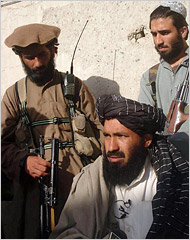
South Waziristan Taliban leader Mullah Nazir [bottom-center]. |
A Taliban leader who is supported by the Pakistani state has vowed to ramp up attacks on NATO forces in Afghanistan after the US launched several Predator airstrikes in his tribal areas over the past week.
Maulvi Younus, a senior Taliban commander and spokesman for Mullah Nazir, who leads Taliban forces in the Wazir areas of South Waziristan, said his group would “send more fighters” into Afghanistan in an effort to kill US soldiers. Pakistan’s military and intelligence services consider Nazir and his followers “good Taliban” as they do not openly seek the overthrow of the Pakistani state, despite the fact that they shelter top al Qaeda leaders and carry out attacks in Afghanistan.
“Because the United States is launching these strikes we will send more fighters to Afghanistan and step up our operations against US forces,” Younus told Reuters. “We have no other option. We have no weapons which shoot them (drone aircraft) down so we will fight the United States in Afghanistan.”
Qari Yousaf, one of Nazir’s aides, claimed that the Taliban have “lots of mujahideen” to send to Afghanistan and that the Predator strikes will help with recruiting more fighters.
“We have lots of mujahideen (holy warriors),” Yousaf told Reuters. “It is not a problem. If drone strikes continue we believe many tribesmen will join us because they (drone strikes) are killing ordinary people. Our shura will decide on the appropriate time to send more fighters and how many will go.”
The US has conducted five Predator airstrikes since June 3 in areas under Nazir’s control, including one strike today. On June 5, the US launched three strikes in South Waziristan that killed 18 Taliban and Punjabi fighters. And four days ago, the US launched another strike in South Waziristan that also targeted Punjabi fighters. Ilyas Kashmiri, a top al Qaeda leader and the commander of the Harakat-ul-Jihad-al-Islami and Brigade 313, is reported to have been killed in the strike, although the reports have not been confirmed. A purported statement released by HUJI announcing Kashmiri’s death contains errors, while a photograph supposedly showing Kashmiri after his death was actually that of a Lashkar-e-Taiba fighter killed during the November 2008 assault on Mumbai, India.
The US has been pounding terrorist targets in South Waziristan this year, and has already exceeded last year’s total number of strikes in that tribal agency. In 2010, only seven of the 117 strikes took place in South Waziristan (104 took place in North Waziristan). So far this year, 10 of 34 strikes have taken place in South Waziristan (24 took place in North Waziristan).
“Good Taliban” leader Mullah Nazir also an al Qaeda leader
Nazir has openly supported Taliban emir Mullah Omar and al Qaeda leader Osama bin Laden, and wages jihad in Afghanistan. In an interview with the Asia Times, Nazir rejected claims that he opposed al Qaeda, and affirmed that he considered himself to be a member of the global terror organization.
“Al Qaeda and the Taliban are one and the same,” Nazir said. “At an operational level we might have different strategies, but at the policy level we are one and the same…. This is wrong that I am anti-al Qaeda. I am part of al Qaeda.”
Despite Nazir’s affiliations with terror groups, the Pakistani military has entered into several peace agreements with him. In the summer of 2009, the military signed a peace agreement with Nazir stipulating that he would not shelter al Qaeda or members of the Movement of the Taliban in Pakistan, which were based in the Mehsud tribal areas of South Waziristan. The Pakistani government launched a military operation against the Movement of the Taliban in Pakistan in October 2009, but left Nazir’s areas untouched. Nazir has continued to allow the Movement of the Taliban in Pakistan, al Qaeda, and other terror groups safe haven in his tribal areas.
Significantly, more senior al Qaeda leaders have been killed in Nazir’s tribal areas during the US air campaign than in those of any other Taliban leader in Pakistan. Nazir also shelters the Mehsuds from the Movement of the Taliban in Pakistan, in violation of the peace agreement with the Pakistani government.
In the past, the US has killed several senior al Qaeda leaders in Nazir’s territories. One of the most senior al Qaeda leaders killed was Midhat Mursi al Sayyid Umar, who is better known as Abu Khabab al Masri. Abu Khabab was killed along with four members of his staff in a Predator strike on July 28, 2008.
Two other top al Qaeda leaders killed while in Nazir’s care were Osama al Kini (Fahid Mohammed Ally Msalam), al Qaeda’s operations chief in Pakistan; and Sheikh Ahmed Salim Swedan, one of al Kini’s senior aides. Both men were wanted by the US for their involvement in the 1998 suicide attacks on the US embassies in Kenya and Tanzania.
In another strike in Nazir’s territory, US Predators also killed Abu Hazwa Jawfi, who is said to have led Jundallah, a Pakistani terror group that is based in Karachi and maintains close ties with al Qaeda.