On March 1, a loitering munition struck the UK Royal Air Force (RAF) base in Akrotiri on the southern tip of Cyprus at approximately 10:03 pm. The drone, reported to be an Iranian Shahed-type platform, struck and caused minor damage to one of the base’s hangars. Cypriot President Nikos Christodoulides identified the drone as Iranian, but his foreign minister told The Guardian that it was launched from Lebanon. Additional drones fired at the RAF’s Akrotiri base over the coming days were intercepted.
No party took responsibility for the attacks. However, over the coming days, senior Cypriot officials hardened their attribution to Hezbollah. Lebanese government officials would soon also blame the group, albeit initially hesitantly and indirectly.
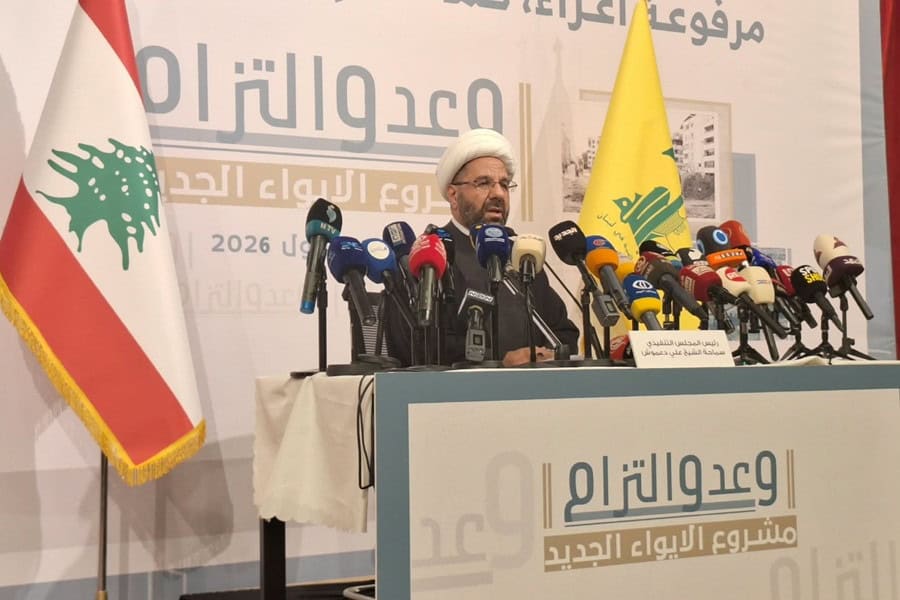
On March 4, Lebanese Foreign Minister Youssef Raggi posted to X “in solidarity with Cyprus,” while noting that he had briefed his Cypriot counterpart Constantinos Combos on the “decision taken by the [Lebanese] government to move forward with the decision to place all weapons under the authority of the state.” Raggi was referring to the Lebanese government’s March 2 decision to proscribe Hezbollah’s “military and security” activities, and order to the group to “surrender its weapons to the Lebanese state.”
Raggi addressed the matter again in a more direct March 8 post on X, expressing his hope that the attack would not lead Cyprus to “confuse the Lebanese state with those acting outside its authority and legal framework.” The Lebanese foreign minister again “recalled the recent decision of the Lebanese government declaring all military and security activities carried out by Hezbollah to be unlawful,” and stated that the “attacks against Cyprus must be understood in this context.”
Later that day, Raggi officially named Hezbollah as the actor responsible for the attacks, saying that the group’s “unlawful activities of which the blatant attack on Cyprus was one such manifestation, defy the will of the Lebanese government and people.”
Strengthening the allegations against Hezbollah is its history of threatening to attack Cyprus. On June 19, 2024, then Hezbollah Secretary-General Hassan Nasrallah alleged that his group possessed information that Israel conducts annual drills in Cyprus, and that Israel might need to use Cypriot airports and bases in a future war if Hezbollah struck Israeli runways. Nasrallah warned that if Cyprus opened those facilities to Israel for operations against Lebanon, “that means the Cypriot government has become part of the war,” and Hezbollah would treat Cyprus as “part of the war.”
Nevertheless, Iranian responsibility for the drone attacks is also possible. Despite the drones almost certainly originating in Lebanon, evidence from Israeli targeting in Beirut suggest Iranian operatives may have targeted the base. On March 6, after completing a wave of airstrikes in Hezbollah’s stronghold in Beirut’s southern suburbs, the Israel Defense Forces released a statement on its targets, which “include[ed] an Islamic Revolutionary Guard Corps Aerospace Force Headquarters” in Dahiyeh. The IRGC’s Aerospace Force is the primary branch responsible for the development, production, and operation of the Shahed drone series, precisely the type of weapon that was used in the attacks on Akrotiri.
The public record on Akrotiri’s and other British facilities’ role in the war is mixed. Reuters reported that Britain had moved additional air assets to Akrotiri in anticipation of US action, but also quoted UK Foreign Secretary Yvette Cooper as saying that the US had not specifically requested access to Akrotiri. In addition, UK MP Stephen Doughty stated that the RAF base was not being used by US bombers.
However, some reports indicate that British sovereign bases in Cyprus were employed in support of the US war effort against Iran, though Cyprus itself has remained officially neutral. The UK officially acknowledged that it had accepted a US request to use British bases for “specific, limited defensive” strikes on Iranian missile depots or launchers. Reuters also published a photo caption showing a US U-2 aircraft taking off from the RAF base on March 3, strongly suggesting that at least some US-linked surveillance or support activity originated from Akrotiri.