COMBAT OUTPOST SABARI, AFGHANISTAN: The first explosion rocked Combat Outpost Sabari at about noon. A 107-mm rocket fired from the southwest arced over the base and detonated into a road 30 meters beyond the wire. It was immediately followed by a recoilless rifle round from the northwest that plowed into the hill in front of a guard tower, and the rhythmic thump of an American .50 caliber machine gun returning fire. Afghan and American soldiers shot back at the source of a flash and smoke trail from the enemy recoilless, a ridge about 80 meters to the northwest.
The crackle of additional M-4 rifles and a .240 medium machine gun joined in from three guard towers, while booming thunks began to echo from an Afghan Army Dushka machine gun on the summit of a hilltop observation post above the valley. Despite the suppressive fire, two more rockets streaked into the base from the southeast. One exploded at the foot of one of the guard towers, while a second skipped off the roof of a building and failed to detonate as it broke into pieces that peppered a nearby civilian bazaar.
Satisfied with the surprise attack and scared of US airpower, the insurgent shooters stowed their weapons and made a run for it. In the American Tactical Operations Center (TOC), the hunt was on.
Before the day was over, six members of a joint US-Afghan patrol sent to investigate the attack would be injured, three seriously enough to be medevaced to a hospital. They were all Americans. The soldiers of an Afghan army unit accompanying them on the search would emerge unscathed.
Vectoring
Captain Aaron Tapalman, commander of Bravo Company, 1/26th and responsible for COP Sabari, directed a flurry of activity within the TOC. He assigned personnel to investigate the site and source of the enemy fire while scrambling air assets to find the shooters. Within five minutes, close air support (CAS) consisting of two F-15 Eagle fighters streaked overhead, looking for targets. They were joined a few minutes later by “Bounty Hunter,” a pair of small Kiowa attack-reconnaissance helicopters from the aviation task force based out of FOB Salerno.
The helicopter pilots spotted a white Toyota sedan running from the ridge that had hosted the recoilless rifle. They could not positively identify any shooters, but the vehicle was speeding away and matched the description of a car that had been used in a previous attack. The Kiowas held their fire and tracked the suspicious Toyota to a “qalat,” a walled compound of interconnected residences, nearly six kilometers to the northwest of the American base.
“[After an attack] you always see a white [Toyota] running from the scene,” said Staff Sergeant Joshua Pless-Mosley, the Fire Support Non-Commissioned Officer in the TOC. “And [the Kiowa pilots] saw the [drivers] pushing the car under something, pull something out of the back, trying to hide what they were pulling out.”
Frago’ed
At 2:08 p.m., 18 US soldiers, 15 Afghan soldiers, one interpreter, and one reporter poured out of COP Sabari’s front gate. Led by First Lieutenant Christopher Scrupps, the patrol had been frago’ed (diverted) from its original mission: a ‘key leader engagement’ with a prominent tribal leader the Americans are attempting to coax into open relations with the Afghan government. The US and Afghan infantrymen would instead travel to the site of the suspicious qalat, searching out the white car, insurgents, and any weapons.
The Afghan soldiers (“ANA”) traveled in armored Humvees, while the Americans were ensconced in two classes of Mine-Resistant Ambush Protected Vehicles (MRAPs): the RG-31, which is a long armored truck capable of carrying eight men, and the smaller MaxxPro, which receives high marks for safety, but “rides bumpy as Hell,” as one soldier described it. The 20-minute ride lived up to the warning, as the vehicle awkwardly swayed and hopped over lush green hills and valleys surrounded by the purple peaks of the Hindu Kush.
“This country would be a tourist trap, if it weren’t for …” remarked a soldier during the ride, leaving the war unsaid.
An uneven slog
The Americans and Afghans parked in an idyllic, grassy field some distance from their target. The joint patrol was to walk to the qalat through roughly 500 yards of sticky rushes, corn fields, and irrigation ditches surrounding the community.
Almost immediately, a problem that would plague the patrol presented itself: the Afghan soldiers were slow to form up and follow the Americans. The uneven pace of movement – fitful starts and stops through head-high corn fields with limited visibility – caused the soldiers to repeatedly bunch up or spread thin like a broken accordion.
Platoon leader Scrupps admonished the Afghans to pick up the pace and maintain proper dispersion, through the translation of “Bob,” a linguist with a quiet, skulking demeanor. The urgency of the requests failed to resonate, however. The ANA continued to set their own pace. And while the Americans always plowed through a difficult but safer path of sucking mud overlaid by the cover of thick crops, the Afghan soldiers sometimes skirted the tougher sections of the route to walk along elevated, exposed footpaths crisscrossing the fields.
There was no doubt the residents of the targeted village knew the soldiers were coming. Two men who looked like spotters for indirect fire were watching the patrol’s approach.
“I see two guys on the roof,” said Staff Sergeant Christopher Ackley, peering through an EOTech scope mounted on his rifle as he stood on the edge of a cornfield. “They’re ducking their heads up and down, peeking at us.”
“Let’s get moving,” said Scrupps. He turned to “Bob” and Afghan Army Lieutenant Musa. “ANA, take the lead, move toward that qalat straight ahead. After they move 50 meters, tell them we’ll follow.”
Bob delivered the translation and the Afghan soldiers began to move west, instead of south.
“Where are they going?” asked Scrupps. “Tell them they need to go to the qalat.”
Bob moved out into the open field to hail the Afghan soldiers, and repeatedly pointed at the proper destination.
“Don’t point,” groaned Ackley, bemoaning the fact that the interpreter was telegraphing their destination to any enemy spotters.
Eventually, an apparent miscommunication cleared up: the Afghans had moved west to find an easier pathway before cutting south into the village. In contrast, the Americans plowed straight to the destination, through the cover of the muddy fields.
Cussed out
The American and Afghan soldiers began searching a series of qalats within a small community of interconnected stone and mud residences. Colorfully painted corrugated metal gates or hanging fabrics marked the doorways of each household, behind which were typically several smaller rooms and a courtyard that housed a mixture of people, cows, goats, and chickens. It was late afternoon, and in some homes pots with cooking oil had been hastily abandoned as the women and most female children were quickly stowed away from the eyes of the strange males searching the rooms.
|
|
| A girl looks on as Afghan and US troops search her family’s residence. Photo by Bill Ardolino/LWJ. |
American and Afghan soldiers attempted to question the residents of each searched house about the recoilless rifle and the white sedan, while a civil affairs detachment led by First Lieutenant Andrew Docksey tried to make polite inroads by offering agricultural assistance. Although some of the Afghans were friendly, most were reserved, and a few openly gave the Americans “the stinkeye.” The civilians were almost universally more at ease with the ANA, and many exchanged friendly jokes and handshakes with the Afghan soldiers. The Afghan personnel led the way into every residence, steered the foreigners away from the rooms containing females, and assisted in gathering information. Whatever their tactical deficiencies, it was clear that the Americans could not conduct counterinsurgency without them.
At one residence, an ancient man leaning on a stick and hopping on one leg materialized from a room to harangue the searching soldiers. He unleashed a bitter litany of gripes against the foreigners, including vague claims about family members who had been killed by their guns. Lieutenant Scrupps patiently listened to the man’s energetic diatribe, offering to sit and talk about his complaints, but the elderly assailant barely paused yelling to draw breath. The Americans gave up and left the qalat, as an Afghan boy smiled and waved his hand at his head, a gesture that seemed to communicate that the old man was crazy.
The patrol found no weapons or insurgents on their search of several residences. The Afghan soldiers insisted that they knew one man was Taliban, but there was no evidence to detain him. The Americans scanned his retina for entry into a database of suspected insurgents and moved on. Civil Affairs Lieutenant Docksey was excited about a “good conversation” he’d had with a farmer, who seemed very interested in his offer of agricultural help.
Waiting
Toward the end of the patrol, US and Afghan soldiers milled about with children and men at a crossroads within the narrow alleys of the qalat. The Afghan soldiers were fasting during the daylight hours for Ramadan, and had reached the limit of their endurance for a single patrol. They complained to the Americans that it was time for them to return to base. Despite this, Scrupps insisted they help search another residence. The platoon leader had “a feeling” that there were insurgents or weapons caches in the qalat, and he didn’t want to leave without finding anything.
The last search progressed slowly. The soldiers waited in the crossroads formed by two perpendicular alleys. A throng of Afghan men and children surrounded them. A US soldier joked with some boys, imitating characters from the movie “Rocky.” When he commanded the laughing kids to “chase a chicken, Rock!” his Burgess Meredith impression was uncannily accurate. A little girl shyly circled the visitors before growing bolder. She began to point at and name her favorite cows to the Americans, in between haughtily chiding them for some unknown faux pas.
“That one’s going to lead a women’s movement someday,” said Docksey with a grin.
After 30 minutes, the men finished their search and moved to leave the qalat.
Fragged
Walking in a staggered column down one of the narrow stone alleys, the soldiers came to a left-hand turn. The corridor cut 90 degrees left into an enclosed space, almost like a courtyard, that had a far exit surrounded on three sides by high walls. The Afghans at the head of the column had already moved out of the qalat, while six Americans in the center of the patrol were moving through the courtyard. As the men passed through the space, a faintly hissing pair of spheres arced over the far wall and bounded into the patrol. Three men shouted “grenade!” as the deadly objects landed in their midst.
The soldiers at the head of the column surged forward to the exit or ducked toward the wall of the courtyard. The men who were closer to the courtyard’s entrance turned around en masse and lunged for the cover of the alley behind them. Some ran, most dove. An explosion split the air, followed by a blast of overpressure and a stench of smoke. Those who were uninjured or lightly hit huddled against the wall or continued plunging down the alley. In a queerly lucid, slow-motion millisecond, this reporter had registered multiple shapes flying in my direction. I turned and dove for the ground as the first grenade detonated, then scrambled forward screaming “Keep going!” as a second explosion rent the air behind me.
“Get back!” yelled Specialist Steve Bonnani. A machine gunner who had been out of the blast radius near the rear of the column, he ran forward along the alley toward the men clambering away from the grenades.
Specialist Chase Brown stumbled before he dove toward the cover of the alley, and he was hit. As the second grenade exploded, he half-limped, half-crawled forward along a wall, hobbled by a wound to his leg. Bonnani moved to the injured Brown and pulled him forward and to his feet before running past him to look for an angle of suppressive fire in the courtyard.
The crackle of close small arms fire echoed deafeningly throughout the narrow stone walls of the qalat. It was impossible to determine at the time what portions of the fire were incoming and outgoing, though soldiers later pieced together that it was all outgoing. Toward the head of the column, Lieutenant Scrupps and Staff Sergeant James Fisher shot their M-4 rifles at the source of the grenades, a copse of trees that lined the outside of the courtyard’s stone wall.
But most of the shooting was later described by US soldiers as an Afghan Army “death blossom,” a derisive term for wild return fire in multiple directions. The ANA, who had been ahead of the Americans in the line snaking out of the qalat, unleashed their weapons, including long cyclic bursts from two light machine guns. Most of it was quickly and accurately directed at the source of the grenade, effectively suppressing the enemy. But because of the angle, the US soldiers later believed that some of the bullets flew high and wide over the courtyard.
Seconds after the twin blasts, the Americans burst through the blue metal door of a residence that faced the alley just outside the grenade-strewn courtyard. A preternaturally calm Afghan man stood aside as the soldiers surged into his home, and then tried to motion the interlopers toward the further cover of an inside room. For this reporter, it was difficult to trust a strange Afghan after the ambush, but the man’s placid and entreating eyes weirdly shone through the wash of adrenaline. The soldiers limped or pulled the wounded into the courtyard of his residence to set up a “casualty collection point.”
The explosions and gunfire ceased. But as the troops assessed injuries and set security, they quickly realized their new predicament: the group was undermanned and vulnerable. The Afghan soldiers had run off toward their vehicles, leaving only a squad of US soldiers, about half of them wounded, trapped in the qalat.
Taking stock
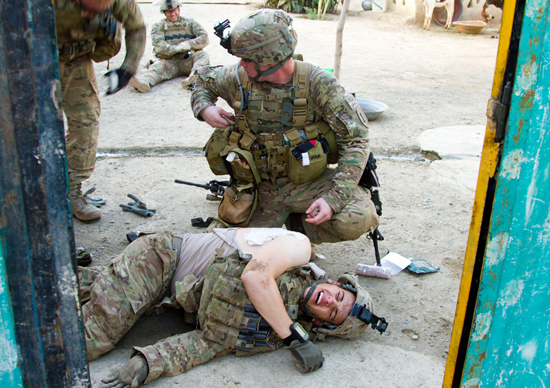
American soldiers were moaning, shouting, and cursing. Six men had caught shrapnel. Four men – Scrupps, Docksey, Fisher, and Ackley – had been hit with minor fragments to their upper leg or buttocks, and were walking wounded. Specialist Brown could barely walk after his lower leg had been sliced through with the tiny pieces of metal. Specialist Brendon Karlsson-Tuttle was the most seriously injured – one of the grenades had actually bounced off his back before he turned to run from the blast. Shrapnel peppered the rear of his body in a few spots from ankle to shoulder blade. He lay on the ground while other men began to cut his clothes off to assess the wounds.
“It’s gas, I smell gas! I can’t breathe!” he shouted in near-panic. The air smelled like acrid smoke. As the soldiers rolled the wounded specialist onto his side, they found the source of the choking smell.
“His radio is on fire!” yelled one man. “Get it off of him!”
Once the large pack was removed and tossed back into the alley, Karlsson-Tuttle became calm. As the others continued to assess his wounds, he offered an apology.
“I’m sorry, lieutenant,” he said.
“For what?” responded Scrupps.
“For getting hit, sir,” replied the young specialist.
Scrupps gently admonished the wounded soldier to stop being ridiculous, and told him he was going to be fine.
Specialist Brown was the next most seriously injured. But once Private First Class Richard Konish and Ackley had applied a tourniquet and wrapped his leg, he sat back on his hands and calmly shook his head.
“This is the thing I hate about the enemy,” said Brown. “You don’t see ’em. They throw grenades over walls, shoot IDF (indirect fire) from a mile away, and shoot from the mountains. It’s frustrating. I mean, you’ve got people wounded here and you’ve lost two guys for at least a couple of weeks, all because some coward threw a grenade over a wall and … ran and hid.”
Scrupps, Fisher, Ackley, and Docksey ignored their less significant wounds. Scrupps posted his remaining uninjured men, plus Fisher, at the corners of the alley to establish security around the residence. Lieutenant Docksey questioned the civilian about who had attacked them, angrily at first, until he determined that the man had had no part in the attack. Ackley paid no attention to the shrapnel in his butt as he treated Brown and Karlsson-Tuttle. He also insisted on wrapping this reporter’s minor abrasion, despite his own more serious injury.
Remarkably, a prone, bleeding Karlsson-Tuttle also showed concern as he was being wrapped in gauze.
“Sir, are you ok?”
He then asked for one of the men to get a small stuffed koala bear from his pack.
“My niece and my girlfriend gave it to me,” he explained. “It’s my lucky charm.”
Getting out
The Americans were stuck in the qalat. Their vehicles were 500 meters away across open ground, and their Afghan partners had deserted them. The remainder of the patrol didn’t have enough men to maintain security and carry the wounded at the same time. Scrupps decided that the squad would hold in the residence until the vehicles moved closer and air support arrived to cow any insurgents who might be waiting to ambush them as they left the structure.
Within five or ten minutes, the distant roar of a pair of F-16 Falcons could be heard high overhead. Fifteen minutes after that, Kiowa attack-reconnaissance helicopters buzzed into the airspace, making low, looping passes in a protective circle around the stricken squad. The US armored vehicles had pulled to within 100 meters of the qalat, but the soldiers would still have to move out from the safety of the enclosed residence to get to them. There weren’t enough men to carry the wounded. They would have to walk.
Soldiers treating Karlsson-tuttle put a boot back on his shrapnel-punctured foot. The young specialist bit down on the plastic arm of his sunglasses. Brown was pulled to his feet and began to hop toward the door of the residence. Both men staggered in the middle of a protective column for the slow march toward the MRAPs. As the soldiers moved into the open, the Kiowas whirred in tight circles overhead, often so close to the ground that the pilots’ cocked heads were clearly visible.
Lieutenant Docksey loudly berated the Afghan civilian on the way out of the man’s residence.
“You tell him we’ll be back, and when we are, we’re going to find out which of his buddies did this!” he screamed.
The vitriol was just for show, however. The civil affairs team leader wanted onlookers to know that the civilian had been forced to cooperate, so he would not be subject to retaliation from insurgents.
The bumpy road home
For the wounded, the bumpy ride back to base in the MaxxPro was a painful one. Alert to the potential for a second ambush, the vehicle’s driver sped as fast as he could along an unfinished mountain path, and each jolt sent bolts of pain through the men with shrapnel in their body. In one vehicle, with his fellow soldiers stabilized and safer, Staff Sergeant Ackley finally began to acknowledge his injury. Each bump sent a shiver through the gash in his rear end, and he gritted his teeth as he leaned to one side to lessen the impacts. One particularly nasty drop slammed his wound so badly the other men were afraid he’d passed out, but he remained conscious. By midway through the trip, Ackley had lost feeling in his leg.
As the convoy wound its way home, a pair of loud whooshes sounded close by, capped with crackling booms.
“They’re shooting RPGs at us!” yelled one soldier.
“No, no, it’s Bounty Hunter [the Kiowas],” yelled one of the men in the front seat. “Show of force.”
The helicopters had maintained their protective circle around the moving vehicles, and began shooting rockets into the empty countryside to deter a second attack. The brief moment of alarm morphed into a feeling of immense comfort as the helos continued to escort the MRAPs home with explosions.
Less than 30 minutes after leaving the village, the speeding armored vehicles reentered the gate. A team of medics directed by Sergeant Maki Juillerat was waiting for them. They stripped off the men’s clothes to check for hidden shrapnel injuries, then wrapped the wounded in dressings and insulating blankets. Staff Sergeant Dustin Bell, a droll mortarman regarded as the unit’s “best combat lifesaver” by the medics, cracked jokes to relax the patients.
“Good thing you’re wearing boxers, Karlsson,” he said. “Otherwise I’d be staring at your [nakedness] right now.”
Inebriated on pain medication, Karlsson-Tuttle laughed.
“This guy is high,” Bell later continued. “You’re gonna love that helicopter ride. Just kick back and let yourself go, Karlsson. You ever seen the [drug-fueled hallucination] scene in the movie ‘Tenacious D and the pick of Destiny?’ That’s you. You’re the sasquatch.”
Within 40 minutes, medevac Blackhawks from Task Force Tigershark landed at the COP’s blacked-out landing zone. Three patients were loaded on helos for further treatment at Forward Operating Base Salerno. Fisher, Scrupps, and Docksey had minor wounds and were not evacuated, though the latter would travel to the hospital to be X-rayed for shrapnel in the morning. The soldiers sent to the hospital were checked for nerve damage and monitored for traumatic brain injury. All were cleared, expected to make a full, quick recovery, and will return to duty soon.
The next day, Captain Tapalman, the US commander, met with Lieutenant Colonel Nasratullah Nasrat, the commanding officer of the Afghan Army kandak (battalion) partnered with the Americans, to discuss the patrol. He informed the Afghan officer that his men had left the US soldiers undermanned and stranded in the qalat.
“Your men abandoned my guys in the qalat,” said Tapalman. “They fired off some rounds and then ran to their trucks.”
Nasrat replied that this was “the first [he’d] heard of it,” and promised to “talk to [his] men.”
At the conclusion of the meeting, Tapalman was not optimistic.