|
|
|
Map of Gaza. Click map to view. Created by Bill Raymond for The Long War Journal. |
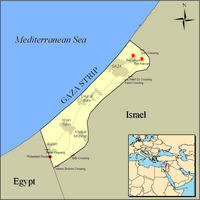
Israeli ground forces pushed into the Gaza Strip early Sunday morning after eight days of airstrikes on Hamas’ military and political infrastructure. The incursion is aimed at routing Hamas’ military and halting the rocket attacks that have targeted Israeli cities in the south.
The ground offensive began after thousands of Israeli troops massed on the Gaza border. At least three infantry brigades – Paratrooper, Golani, and Givati – backed by armor, engineers, artillery, and special forces then moved into southern, central and northern Gaza. The thrusts divided Hamas’ strongholds, severed communications, and disrupted the flow of weapons throughout the strip.
The initial push into Gaza met relatively light resistance. One Israeli soldier was killed and 30 were wounded, two seriously, in the first 24 hours of fighting. More than 100 Hamas fighters are said to have been killed during the ground offensive and dozens were captured. Hamas is estimated to have 20,000 fighters under its command.
The Israeli Defense Force was able to negate Hamas’ prepared anti-tank defenses by moving infantry ahead of its armored units to clear the tank traps. Hamas is said to have prepared anti-tank bunkers and mine fields to blunt an armored spearhead as it moved through the densely populated urban areas of the Gaza strip.
The deployment of infantry ahead of the Israeli armor also prevented Hamas forces from laying ambushes. On the first day, Hamas was relegated to lobbing mortars at Israeli forces during the initial ground assault.
Israeli troops have trained for urban combat in Gaza for over the past year, The Jerusalem Post reported. All of the units in the Gaza operation have cycled through the IDF’s Ground Forces Command Urban Training Center. “There, the IDF has built a mock-Palestinian city where the forces train on operating in populated areas,” the Israeli paper reported.
The urban warfare training will be needed. Fighting has intensified over the past 24 hours, according to reports from Gaza. Heavy, close-quarters street fighting has been reported in Beit Lahiya and Beit Hanoun in northern Gaza. To the west, Gaza City is partially surrounded.
Israeli troops are also moving along the Philadelphi Corridor along the Egyptian border, where Hamas has built an extensive network of tunnels to smuggle weapons and other items into Gaza. Last weekend Israeli strike aircraft pounded more than 30 known tunnels.
The Israeli government has indicated that operations in Gaza are designed to destroy Hamas’ ability to strike inside Israel.
“The aim is simple,” Defense Minister Ehud Barak told the Foreign Affairs and Defense Committee. “No terror activity from Gaza – either against civilians or against our soldiers, a dramatic change in weapons smuggling and quiet in the South.”
IDF spokesman Captain Benjamin Rutland said the operation is designed to deal “a heavy blow to Hamas’ terrorist infrastructure and rocket-launching capability.”
Israeli forces are moving to hold known rocket launch pads that are used to strike at Israeli towns and cities in southern Israel. Hamas missiles have reached as far north as the city of Ashdod. Despite the ground operation, Hamas was able to fire off more than 30 rockets on Monday.
The Israeli government and military are keen to avoid the mistakes of the 2006 war with Hezbollah in Lebanon, US officials told The Long War Journal. Unlike the 2006 war in Lebanon, the Israeli military launched its ground assault as soon as the targeting of Hamas infrastructure and leaders by air began to dry up.
Israel also faces fewer challenges geographically in Gaza than it did with Hezbollah in Lebanon. Israel has the capacity to control Gaza’s three land borders, including the southern border with Egypt, and has blockaded the Palestinian territory by sea. Israel was never able to control the long border between Lebanon and Syria, a primary backer of Hezbollah along with Iran.
The question remains whether the Israeli government has the political will to see the operation through. In order to ensure Hamas can no long fire rockets in Israel, the IDF will need to maintain a presence in Gaza. The reoccupation of Gaza has no political support within Israel. And destroying Hamas’ military capacity will take months or longer. International pressure is already mounting on Israel to halt operations and accept a ceasefire.