|
|
|
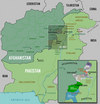
Pakistan, Afghanistan, and the tribal areas. Map from PBS’ Frontline. Click to view. |
Pakistan reopened the vital Torkham border crossing point to NATO traffic destined for Afghanistan today.
The border crossing point in the lawless Khyber tribal agency was closed Saturday after Taliban forces hijacked and looted a convoy of trucks containing supplies and equipment for NATO forces, including two US-made armored Humvees, on Nov. 10.
The Pakistani military is now providing armed escorts for the NATO convoys, which are driven by Pakistani truckers. Prior to this, the government relied on Frontier Corps and checkpoints manned by the Afridi tribe that are dotted along the road stretching from Peshawar to Torkham.
The US military is concerned about its tenuous supply lines that stretch from the port of Karachi, then northward to Peshawar, then westward through Khyber into Pakistan. While the security situation in much of Pakistan’s Taliban-controlled tribal agencies has deteriorated over the past several years, the road through Khyber has largely remained secure.
To keep the road open, the US paid off members of the Afridi tribe to secure the road through Khyber, a senior US intelligence official told The Long War Journal. “This strategy clearly is not working any longer,” the official said.
The US military is uncomfortable relying on Pakistan’s Army and paramilitary Frontier Corps to keep the supply line open. “These same Pakistani units have been defeated by the Taliban in past battles in North and South Waziristan, Bajaur, and even in Swat,” the official said, noting that entire Pakistani Army companies have been captured or routed by the Taliban in the past.
The Khyber crossing route is the main supply line for US and NATO forces operating in neighboring Afghanistan. An estimated 75 percent of NATO supplies move through Khyber. The rest of the supplies pass through the Chaman border crossing point in Baluchistan or arrive via air.
The crossing was also closed on Sept. 6 in protest against US airstrikes and an air assault against Taliban forces in South Waziristan. Pakistan reopened the crossing after one day.
The US has been quietly trying to secure alternate routes through central Asia, but the routes are less dependable and increase the amount of time it takes to move the supplies into Afghanistan.
But the military is concerned these alternate routes can be shut down if the US has major disagreements with Russia or China, who control these routes.
“We’d have to depend on Russia or China for our supplies to reach Afghanistan,” a senior US military officer told The Long War Journal.
“Over time, this is not sustainable. Take the Georgian crisis,” the officer said, noting Russia’s invasion of the Republic of Georgia last summer. “If we move our supplies through Russia, and another crisis like this arises, say in the Ukraine, our hands will be tied. We will have to choose between supporting a burgeoning democracy and supporting the protracted fight in Afghanistan.”
The officer also expressed concerns about the US’ ability to deploy more forces into Afghanistan to fight against a resurgent Taliban given the poor security in Pakistan. “Adding three more brigades of troops and their accompanying support elements means we need to significantly increase the supplies moving through Pakistan,” the officer stated. “We are only increasing our logistical problems and betting on Pakistan to keep these routes open is a bad play.”