|
|
| Forward Operating Base Salerno, situated north of Khost City, is a main Coalition hub for operations in southeastern Afghanistan. Photo courtesy of the Market Garden Commemorative Committee. |
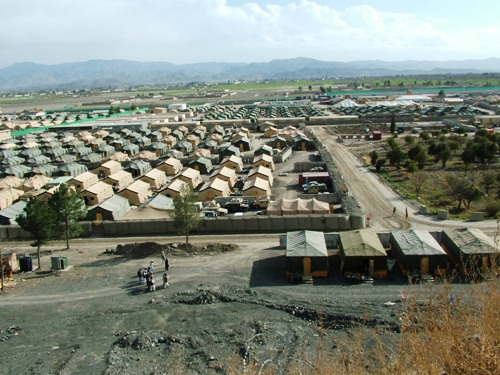
Nearly 30 Taliban fighters attempted to storm a major US base in eastern Afghanistan a day after a double car bombing attack was attempted on the same base.
Forward Operation Base Salerno, the biggest Coalition base in southeastern Afghanistan, withstood Monday’s failed car bombing attempt, but one of the bomber’s managed to detonate his vehicle at the base’s perimeter, killing 10 Afghans and injuring 13 others, according to a US military press statement condemning the attack. Afghan security personnel were quick to spot a second would-be suicide bomber and shot and killed the driver before he could detonate his car stuffed with explosives. A second man found inside the vehicle was detained by security forces.
The following day saw an estimated 30 Taliban fighters, including at least seven suicide bombers, launched a “wave of attacks against the base beginning around midnight,” according to Arsallah Jamal, the provincial governor of Khost. Mortars and rockets struck the base shortly before midnight, a diversionary attack while the suicide-bomb cadre made its way near the base’s air field. Three US soldiers and six Afghan commandos were wounded in the attack.
The Taliban attackers tried to breach the entrance to the airstrip contained within the base, an indication the Taliban may have wanted to detonate themselves on or near Coalition aircraft in what would have been a major propaganda coup for the Taliban.
The Taliban group was observed “posturing for an attack” nearly 1,000 meters outside the base’s perimeter before Coalition forces opened up with small-arms fire, according to an International Security Assistance Force press statement. Helicopter gunships later pounded the Taliban’s staging area resulting in the death of three out of seven suicide bombers.
Three other suicide bombers detonated themselves shortly before they were racked by heavy machine-gun fire. Afghan commandos are credited with surrounding the Taliban shortly before the attack could be launched, shooting dead several of the suicide-bombers before Coalition aircraft pounded the remaining fighters.
The double attack on FOB Salerno was claimed by the Taliban through their spokesman for their “eastern zone,” Zabibullah Mujahid. He claimed 15 Taliban suicide bombers, backed up by a force of 30 other Taliban, managed to breach the base’s perimeter and detonated at least one bomb within the airfield, killing a large number of American soldiers and destroying some aircraft. The Afghan Defense Ministry, ISAF, and the Coalition have all denied this allegation.
“This was a major group of terrorists in suicide bomber form, an attack on the Coalition forces base, and it was a major operation of the Afghan National Army commandos who succeeded in eliminating 10 suicide bombers before they could do anything,” General Azimi, the spokesman for the Afghan Defense Ministry, told reporters in Kabul.
A hornet’s nest
The sprawling FOB Salerno, which now includes a state-of-the-art medical wing and burn center, is situated a few kilometers north of Khost City, the provincial capital of Khost. Several insurgent groups including the Taliban, al Qaeda, and the notorious Haqqani Network are active throughout the province, which borders Pakistan’s restive tribal agencies.
The Haqqani Network has conducted a devastating car bomb campaign throughout the region this spring and summer, with the March 3 truck bombing of the Sabari district headquarters being the most spectacular. The building was brought down by an estimated four-ton truck bomb detonated by a Turkish-born German citizen who was recruited into the Haqqani Network in neighboring North Waziristan, Pakistan. Two US soldiers and scores of Afghan security forces were killed in the attack.
The province has undergone a flurry of other attacks including a massive frontal attack launched by the Taliban against the Spera district headquarters in late July. Provincial authorities later estimated between 50-75 fighters were killed in the fierce battle.
The early morning attack began when nearly 100 heavily armed Taliban fighters approached the Spera district headquarters, approximately nine miles from the Pakistan border, and engaged Afghan police personnel in a gunfight. Afghan and Coalition soldiers responded to the attack and drove the Taliban back using small-arms fire and helicopter gunships. Fleeing Taliban fighters were caught in the open and hit with missiles fired from aircraft resulting in the large number of Taliban killed, according to Afghan security officials.
Alarming discovery
Insurgents continue to use remote areas of Khost province as key logistical and training grounds for spectacular terrorist attacks. Both Siraj and Jalaluddin Haqqani were suspected of hiding in northern Khost between March and July of this year. And in an additional alarming development, insurgents in Khost have acquired a sophisticated batch of Type 69 airburst, anti-personnel rocket-propelled grenades, a deadly breed of munitions rarely seen in Afghanistan before a cache of 89 was unearthed during a Coalition raid in late June. The grenade is designed to bounce off the ground near enemy troops before exploding six feet off the ground unleashing 800 steel ball bearings into a kill radius of 15 meters. More ordnance including 25 anti-tank weapons and 25 mortars were also discovered in the same cache.
The source of the weapons has not been identified but it is likely the weapons were smuggled over the porous border with Pakistan. Insurgents in Iraq are known to use similar devices but there is no evidence these weapons came from Iraq.
For more information on the Haqqani Network and Khost province see:
• The Haqqani Network: Reign of terror
• In Pictures: A memorial ceremony at FOB Salerno, Afghanistan
• Unprecedented Coalition strike nails the Haqqani Network in North Waziristan