|
|
|
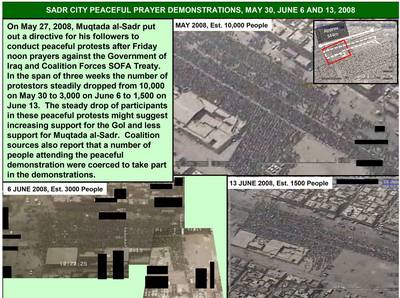
Click to view graphic of the demonstrations in Sadr City. |
Muqtada al Sadr, the leader of the Mahdi Army and the Sadrist political movement, has ordered the formation of “cells to resist the occupation,” according to a statement read at Sadr’s mosques on Friday. The news comes as US forces continue to target the Mahdi Army command structure and Sadr’s planned demonstrations against the status of forces talks draw few protesters.
Sadr said a new organization, separate from the Mahdi Army, would be formed. The new organization will strike exclusively at US and Coalition forces in Iraq, and not target Iraqi security forces. The Mahdi Army would be transformed into an organization that focuses on “religious, social and cultural affairs” that will “fight the Western ideology and liberate the minds from domination and globalization,” according to a translation of Sadr’s statement obtained by CNN.
“The resistance will be exclusively conducted by only one group,” Sadr said. “This new group will be defined soon by me. The weapons will be held exclusively by this new group, and they should be pointed exclusively at the occupier. We will not stop resisting the occupation until liberation or martyrdom.”
Sadr’s political office confirmed the letter and said the statement is in line with the Sadrist political movement’s ideology. “The declaration by Sayyed Muqtada al Sadr to form cells to resist the occupation comes in full conformity with the approach of the Sadrists,” Sheikh Liwa Semaysam told Voices of Iraq. The newly create organization has “a written authorization by Sayyed Muqtada al Sadr to carry out their task, on the condition that arms will only be in their hands for use against the occupier and none else.”
Sadr’s open defiance may change the calculus on how the US military and the Iraqi government deal with the Sadrist movement and the Mahdi Army. The US military has long attempted to separate Muqtada al Sadr and the Mahdi Army from what it labels the “Special Groups” criminal elements supported by Iran’s Qods Force. This was done in an attempt to provide Sadr and the less radical elements of his followers and opportunity to join the political process while US and Iraqi troops target the extremist elements of the Mahdi Army.
The efforts to blur the lines between the Special Groups and Sadr and the Mahdi Army began to crumble after the Iraqi government launched an offensive in Basrah on March 25 to wrest the city from the Sadrist’s control. The fighting soon spread to Baghdad’s Sadr City and the wider South.
After six days of heavy fighting in Basrah, the Mahdi Army pushed for a cease-fire. The Iraqi security forces also dealt the Mahdi Army a heavy blow in the southern provinces of Najaf, Karbala, Qassadiyah, and Wasit.
The Iraqi security forces and the US military also confronted the Mahdi Army in Sadr City in Baghdad. After six weeks of heavy fighting, the Mahdi Army and the Iraqi government signed a cease-fire that allowed the military to enter Sadr City uncontested.
During the month of May, the Iraqi security forces expanded operations throughout Basrah province in Az Zubayr, Al Qurnah, and Abu Al Khasib along the Iranian border. This week, an operation kicked off in Dhi Qhar province. An operation is said to be in the works in Maysan province, where the Mahdi Army is said to have reorganized after defeats in Basrah and Baghdad.
Sadr’s protests draw few protesters
As Sadr calls for attacks against Coalition forces, his planned weekly protests against the current negotiations over the proposed status of forces have drawn fewer protesters each week, according to numbers compiled by the US military.
The US military released imagery of the demonstrations held in Sadr City that occurred the past three Fridays. The first week, the military estimated Sadr had 10,000 protesters in attendance on May 30, about 3,000 on June 6, and 1,500 today. Sadr City contains an estimated 2.5 million Shia. In 2006 Sadr’s protests drew hundreds of thousands of Iraqis.
The military also noted that some Iraqis in Sadr city were “coerced” to join the demonstrations. “Clearly the number of participants is decreasing,” said Lieutenant Colonel Steve Stover, the spokesman for Multinational Forces Baghdad. “The steady drop might suggest increasing support for the GoI [government of Iraq] and less support for Muqtada al Sadr.”
Raids against the Mahdi Army continue
The Iraqi and US military continue to strike at the Mahdi Army leadership in Baghdad and the South. Coalition forces killed five Mahdi Army fighters and detained two others during a raid on a leader’s safe house in Hillah.
In Baghdad, Iraqi Special Operations Forces conducted two separate raids on June 12. In one raid, Iraqi troops captured the leader of a 250-man battalion behind roadside bomb attacks against Iraqi and Coalition forces as well as running a kidnapping ring. The second raid netted a Mahdi Army leader behind the “kidnapping, interrogating, torturing and murdering Iraqi citizens” as well as “conducting fake Iraqi Police checkpoints and ordering improvised explosive device attacks against Coalition forces.”