
|
|
|
Iraqi Army soldiers stand guard in a tank as they provide security while Multinational Division Baghdad soldiers from Company A, 64th Brigade Support Battalion, 3rd Brigade Combat Team, 4th Infantry Division, transport concrete barriers in Sadr City on May 3. (US Army photo/Specialist Joseph Rivera Rebolledo) |
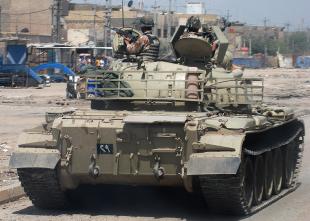
US and Iraqi troops continue to battle Mahdi Army fighters in Sadr City and greater Baghdad. Eighteen Mahdi Army fighters were killed and 11 captured during raids and attacks, while the Iraqi government arrested 42 policemen for colluding with “outlaws” and arrested 35 hospital workers for treating Mahdi Army fighters.
Latest fighting in Baghdad
The Mahdi Army continues to attack US and Iraqi forces as they erect the barrier on Qods Street, which divides the southern third from the northern portion of Sadr City. US and Iraqi troops responded, killing 18 Mahdi Army fighters and capturing 11 throughout Baghdad.
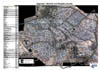
US and Iraqi troops and US air weapons teams killed 11 Mahdi Army fighters as they attacked barrier emplacement teams and planted roadside bombs in Sadr City on the night of May 5 and the morning of May 6. Iraqi soldiers and police also uncovered numerous weapons caches in northern and eastern Baghdad. In one raid, Iraqi police discovered a weapons cache in the courtyard of the Imam Ali Mosque in the Al Ghadeer neighborhood in New Baghdad (number 31 on map). “The [National Police] found five explosively formed projectiles, two improvised explosive devices, five rocket rails, three grenades and numerous rounds of various ammunitions,” Multinational Forces Iraq reported.
|
|
|
Map of Baghdad neighborhoods. Click to view. |
Iraqi and US forces continue to conduct intelligence-driven raids against the Special Groups, the Iranian-backed elements of the Mahdi Army. The Iraqi Counterterrorism Force teams conducted two raids in Baghdad on May 4 and May 5, killing seven Special Groups operatives and capturing two.
Iraqi security forces take in infiltrators
Iraqi soldiers arrested 42 policemen and detained 35 hospital workers in Baghdad. The policemen are “suspected of collaborating with ‘outlaws,'” Reuters reported. It is not clear if the police are local or national police, or are members of the Facilities Protection Services, which guard infrastructure and are part of the Interior Ministry.
Iraqi soldiers also detained 35 hospital workers in the Mohammed Bakr Hakim hospital in the Shula neighborhood in northwestern Baghdad (number 61 on the map). The hospital workers are suspected of treating wounded Mahdi Army fighters.
The hospitals in Sadr City are known to be infiltrated with Mahdi Army and Sadrist bloc members who continue to use the hospitals for criminal activities. The Mahdi Army used hospitals as staging areas for sectarian attacks and weapons storage depots. On May 3, US forces knocked out a Special Groups command and control center situated next to a Sadr City hospital. The Sadrist bloc ran the Health Ministry prior to withdrawing from the government in 2007.
Background on the recent fighting in with the Mahdi Army
Mahdi Army forces openly took up arms against the government after the Iraqi government started the assault on Basrah on March 25 to clear the city of the Mahdi Army and other Iranian-backed Shia militias. Sadr called for his forces to leave the streets on March 30 just as Iraqi Army and police reinforcements began to arrive in Basrah. Sadr later admitted he ordered his followers within the Army and police to abandon their posts and join the fighting against the government.
In Baghdad alone, US and Iraqi forces killed 173 Mahdi Army fighters during the six days of fighting from March 25 up until Sadr declared a cease-fire. The fighting has not abated in Sadr City and other Mahdi Army-dominated neighborhoods in northern and eastern Baghdad. A total of 520 Mahdi Army fighters have been confirmed killed in and around Sadr City since March 25.
Sadr and his political movement have become increasingly isolated since the fighting began in Basrah, Baghdad, and the South. The Iraqi government, with the support of the political parties, said the Sadrist political movement would not be able to participate in upcoming provincial elections if it failed to disband the Mahdi Army. On April 13, the cabinet approved legislation that prevents political parties with militias from contesting provincial elections this year. The bill will now be sent to parliament for approval. Grand Ayatollah Ali al Sistani, the top Shiite cleric in Iraq, said the Mahdi Army was not above the law and should be disarmed. Sadr has refused to disband the Mahdi Army.
On April 20, Sadr threatened to conduct a third uprising, but later backed down from his threat, claiming it was directed only at US forces. The Maliki government has stood firm and said operations would continue until the Mahdi Army and other militias disarm and disband. On May 1, the Iraqi government sent a delegation to confront Iran on its involvement with the insurgency, but Sadr, who is currently in Iran, refused to meet with the Iraqi government representatives.


5 Comments
The evidence against Iran continues to build.
MNF-Iraq: Two key suspects captured in Musayyib operations
It appears that the Islamic gangsters now prefer to fight at night. My impression was that US forces had a night vision advantage for night time combat. Has the balance shifted? Or is there a nighttime advantage for dense urban insurgency?
Or maybe the gangsters believe that more civilians will get caught in the crossfire at night?
i think that MNF probably still retain initiative at night though mahdi’s may have some night vision equipment, though i can’t recall seeing that anywhere.
i think what is driving this is wall construction is occurring during the night AND i think the air weapons teams are really taking a toll during the day. both of these events dictate attacking more at night to try and gain some measure of surprise and cover. just my opinion based on what i glean from various new reports.
i’d like to see more info on the hospitals in sadr city as i think they are a key in establishing effective control over the area. are all hospitals Ministry of Health facilities? how many are there?
The Thunder Run has linked to this post in the blog post From the Front: 05/07/2008 News and Personal dispatches from the front lines.
Its a step forward when you arrest over 40 dirty cops, and shut down a hospital that helped heal Mahdi members. Its been a known fact that US Soldiers, Marines did not trust the Iraqi Police. Maybe the Iraqi Army should line ’em up against a wall and shoot them. Traitors. It may deter other shaky cops. As far as the Mahdi fighting at night, there have been reports of Night Vision devices gone missing, and how easy it was to buy equipment like that right off the Internet. Sadr has NO intention of laying down his weapons, so its best to keep the pressure on them, and get rid of as many of them as possible. If the Iraqi gov. starts executing traitors like those cops, they may think twice before betraying gov. forces.