
|
|
|
Muqtada al-Sadr. |
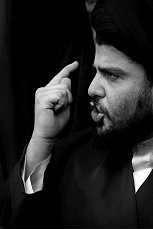
Muqtada al Sadr, the leader of the Sadrist movement and the commander of the Mahdi Army, has ordered the extension of the cease-fire, anonymous senior officials in his movement have told Reuters. The cease-fire, which was put in place after a major clash in Najaf in August 2007, will be extended by six months.
“Sadr had issued a declaration to preachers to be read during midday prayers on Friday at mosques affiliated with the cleric,” Reuters reported. “The general idea is that there will be an extension,” an unnamed senior official in Sadr’s movement in Baghdad told the news agency. “Sayed (Sadr) has distributed sealed envelopes to the imams of the mosques to be read tomorrow. They cannot be opened before tomorrow.” Another senior official in Najaf said the cease-fire would be extended by six months.
Pressure on Sadr
Multinational Forces Iraq and the Iraqi government have conducted a concerted campaign to pressure Sadr to order his Mahdi Army to end the fighting, extend the cease-fire, and rejoin the political process. Multinational Forces Iraq began associating the actions of the Iranian-backed Special Groups terror cells with the Mahdi Army during the summer of 2007, and have executed numerous raids against the Special Groups in central and southern Iraq. At the same time, the Iraqi military began targeting Mahdi Army in the southern cities of Samawah, Al Kut, Diwaniyah, and Basrah.
Reporting on activities against the Special Groups and the Mahdi Army went fallow in January 2008, but US and Iraqi security forces began stepping up operations against the Special Groups in early February. Over the course of one week in mid-February, and average of three to four raids a day were conducted against Special Groups. The Iraqi government has also taken legal action against members of the Mahdi Army accused of using the Health Ministry to conduct sectarian kidnappings and murders.
US and Iraqi efforts to pressure Sadr to extend the cease-fire appears to have paid off. Sadr was due to make a decision on the truce extension on Feb. 23. Several senior Sadrist leaders and Mahdi Army commanders have lobbied to end the cease-fire due to Iraqi and US military pressure on the Mahdi Army and the Sadrist movement.
While the reporting has focused on the negative implications the US and the Iraqi government if Sadr ended the cease-fire, Sadr himself had his own problems if the truce was ended. After Sadr’s political movement withdrew from the government in early 2007, Prime Minister Nouri al Maliki had a greater freedom of movement to tackle Sadr and his Mahdi Army. Since then, the Iraqi military has repositioned itself to take on the Mahdi Army in the south.
The US and Iraqi security forces have demonstrated a willingness to strike at Sadr’s Mahdi Army, even in his purported stronghold of Sadr City in Baghdad. General David Petraeus pressured Maliki at the onset of the surge to take on the extreme elements of Mahdi Army as well as al Qaeda in Iraq, and Maliki approved. If Sadr ends the truce now, the US military is still at its peek in the number of combat brigades available for use in tackling the Mahdi Army.
By calling off the cease-fire, Sadr risked reigniting the violence in Iraq, which has dropped dramatically since last summer. Sadr risked alienating Iraqis as well as exposing his real level of support in the Shia community. The Iraqi government had the option of declaring the Mahdi Army and the Sadrist movement as illegal groups, and barring Sadrist politicians from running for political office.
In addition, Sadrist Movement politicians have been renegotiating a return to Maliki’s government after it survived their April 2007 protest walk-out over long-term security agreements with the US. And Sadrist legislators had been lobbying for recently passed legislation that hastens provincial elections, believing they can challenge their Islamic Supreme Council of Iraq rivals in southern Iraq through democratic means. Both of these political developments contradict and would be imperiled by any return to hostilities.
Sadr will now have to deal with the implications of extending the cease-fire within his political and military movements. Some Sadrist politicians and Mahdi Army commanders have warned they may break from Sadr and fight on.
The Special Groups, Iran, and the Mahdi Army
The Special Groups was created by Iran’s Qods Force, the special operations branch of the Iranian Revolutionary Guards Corps, to destabilize the Iraqi regime, strike at US and Coalition forces, and extend Iran’s sphere of influence in southern and central Iraq. Iran established the Ramazan Corps as a sophisticated command structure to coordinate military, intelligence, terrorist, diplomatic, religious, ideological, propaganda, and economic operations. The Special Groups falls under Qods Force’s Ramazan Corps.
Iran has co-opted elements of the Mahdi Army to form the Special Groups. Sadr is currently sheltering in Iran and is studying the radical Velayat-e-Faqih Shia strain of Islam that promotes theocratic rule and is the foundation for Iran’s form of governance. Special Groups leaders have been directly linked to Sadr. On Feb. 11, Multinational Forces Iraq captured a senior regional leader of the Special Groups who also has ties to the Sadrist movement and 10 others in Hillah. On Feb. 18, US forces reiterated Arkan Hasnawi’s role as a commander in the Mahdi Army and his role in attacks against US and Iraqi security forces in northern Baghdad.
Bill Ardolino contributed to this report.

15 Comments
This guy will be a thorn in the side of the Iraqi government in the future, but at this time this decision to extend the cease fire doesn’t really come as a surprise. Sure they could make life more difficult for us and the IG but the Iraqi citizens are experiencing life with a dramatic reduction in violence and I think they would reject an upwards spike in the violence if he were to let his fighters loose again. I have to think it was made clear to him behind the scene’s he would have a huge target on his head, chest and back if he didn’t extend the cease fire officially.
The Thunder Run has linked to this post in the – Web Reconnaissance for 02/21/2008 A short recon of what’s out there that might draw your attention, updated throughout the day…so check back often.
Motown67, your take on events is different from others I have read, e.g. your generous view of Sadr’s actions and motives. On what do you base your interpretations? Any links to share?
AMac,
I would guess this piece from the WaPo is what Motown67 is referring to. I found it to be a wonderful Mahdi Army propaganda piece.
Sadrists have repeatedly complained about US and Iraqi assaults, detentions and such. The cease-fire wasn’t put in out of a moment of strength. It was done after the Karbala attack, when the Iraqi government was considering pounding the Mahdi Army, with US support. If everything was going so well, if Sadr has had the upper hand, why call a cease-fire? The US and Iraqi raids are designed to remind Sadr of what can happen if he crosses the line again. To think that this hasn’t influenced Sadr’s decision is, in my opinion, wishful.
Motown67:
Remember the movie “The Godfather”. At the meeting of the Five Families, Don Corleone finally agrees to an ceasefire in the mob war and “pledges on the lives of his childern that he will not be the one to break the peace”.
Afterwords, Michael asks him “wont the others see this as a sign of weakness” Don Corleone says “It IS a sign of weakness”.
Your analysis makes the assumption that the “fringe groups” and “rogue elements” make up a small part of the Sadrists and that after they are “gotten rid of” that the “Sadrist” will still represent a large movement.
Lets try making another assumption. What if the “fringe groups” and “rogue elements” actually made up a major portion of the Sadrist? After Sadr “gets rid of” of them, what if the remainer in his “centrallized command”, turns out to be quite a tiny group?
In that case, “US raids” would have to be considered pretty significant, wouldnt they?
Motown67,
Nice list of sources, and I understand your point that there are other significant reasons Sadr is extending the cease-fire. I do think you are a bit hasty in discounting both the magnitude and effect of constant military pressure against Sadr. Your sources are vary good and I don’t discount them. I’ve personally read at least half of them. But the viewpoint expressed does tend to be bit monolithic. I don’t see a sign that you have followed the ongoing conflict involving Sadr’s organization with the same rigor. In fact Bill’s web site seems to be rather singular in offering that sort of analysis (outside of military sources). Consistently following the conflict from that angle gives a different set of conclusions about what degree Sadr is responding to outside or internal pressures. I might suggest that the two points of view are not so divergent and that Sadr is responding in very large degree to both.
I think Bill’s thoughts on the subject are best taken alongside others considering the mater. I’m not sure anyone has a complete handle on Sadr’s line of thinking. I find Sadr a rather inscrutable figure in many ways too. I’m not sure my lack of understanding is purely cultural either (or resulting from my own dim wittedness). His own followers seem a bit mystified too. The third factor in Sadr’s decision making are going to always be from his own internal impetus. While Sadr’s actions aren’t exactly what I would call arbitrary, I’m not sure they follow any completely coherent line of reasoning either.
While there is always definite danger of overselling the impact of US action there is also a danger of imposing an academic line of reasoning on the subject that may not be entirely appropriate. Chronically underselling the impact of US military action because one does not like the viewpoint can also be a significant impediment to understanding the subject as well. I think some sources are guilty of that too.
A significant element is missing here in analyzing Sadr’s decision making, and that is the direct political influence of Iran. For years now, Iran has successfully been hedging its bets on the various Shia factions. Every time Sadr feels threatened or insecure, he seeks personal security in Iran. Iran has now positioned itself as Sadr’s primary sponsor for the long run, in the pursuit of someday installing him as an Ayatollah in Iraq, possibly along similar lines to Iran’s Khamanei.
I would argue that, politically, the Iranians have been more successful than the US State Department, in their dealings with the Iraqi government and various Shia factions. And I would also argue that Iranian influence has far more to do with Sadr’s current decision making than any posturing or actions taken by the US military.
Mark,
Iran’s place in this has been discussed too, many times over. There is all sorts of interesting discussions on the subject in the past archives. One of the disadvantages to the website is there is no topical indexing for the archives. The investment in time and money are probably prohibitive. I’d better hush about that before Bill gets any ideas.
Motown67,
Thanks for the source listing and the extended explanation of your point of view. Per Neo’s comments, there now seems to be less contradiction between your interpretation and Bill Roggio’s, and more a difference of degree.
In general terms, it seems that many academics readily view non-Western movements as ideologically based rather than as focused on power and spoils. These are not incompatible goals. I don’t assume that Sadr and his fractious Madhi Army are exactly like the Mafia of old, but the comparison to thugs and criminals is a useful reminder of the game that Sadr plays, and the methods he’s willing to employ to win it. Not the playing fields of Eton.
Much of Sadr’s organization cannot be simply and cleanly delineated. There is a very mixed amalgamation of militia members and Sadr foundation members. The militia also contains a large amount of what can only be described as rabble.
I see at least five discernable major categories for members.
First group. Foundation core. There are a small number of older members of the organization, a few are religious figures, some are long time loyalists to the Sadr family foundation. Others are core militia members a few of which go all the way back to the 91 uprising. (I don’t know how many of those are left.)
Second group. Militia core(current conflict). Many of these were quickly put together after the core militants within the organization were knocked down in 2004. This group isn’t easily stratified into which ones are essential loyalists and which gangs and out of control splinter groups. This was quickly assembled rabble. Much of their training (if any) is in the field. In the climate of constant bombing by Al Qaeda in 2005-2006, the most ruthless members would quickly rise to the top. Both Iran and the Iraqi foundation provide a large amount of money and a certain amount of training to keep these groups going. The disposition of these groups varies widely from area to area, group to group.
Third group. Neighborhood members, by far the largest group within the organization. A lot poorer class Shiite men have belonged to neighborhood groups at one time or another, sometimes to protect a neighborhood, sometimes for financial reasons. Unfortunately this group has attracted a large number of unruly teenagers who under the right set of circumstances can be quite ruthless. On the other hand they are the least loyal group. Often they are there for a paycheck and leave once the money is cut off.
Forth group. Criminals. At the beginning organized crime groups and criminal families played a large role in the initial formation of the group. A lot of the original groups have fallen to attrition but large numbers of militia members and teenagers have moved straight into criminal activities. Some of this criminal activity is sanctioned within the organization to raise money, but much of it is just pervasive throughout the organization. The organization has been a magnet for Shiite criminal groups.
Fifth group. Quds Forces, etc. A number of Iranian trained members are sprinkled throughout the organization. Some members go to Iran for training. A few of these are highly trained, but the majority are members that have already shown some aptitude for organized violence and are given training to further their abilities. A fairly small number of these have a disproportionate influence on the organization. There aren’t enough of them with skills and training to really form an organized army though, given time constraints and attrition.
Sorting this out is no easy task as the groups are all intermixed. It has to be done group-by-group and location-by-location. Groups with significant criminal activities are probably the easiest to sort out and other groups self sort by attacking US and IA forces. Neighborhood groups can usually be dissuaded except in stronghold areas and teenagers very often yield to consistent pressure. Sorting out leadership figures and picking out Quds force members is much more difficult. Some of the members are protected by the organization. So called “Special Groups”
motown67
Remember: this is not a coup de main battle. Sadr doesnt have to arrest, purge or kill 30,000 people. Those 30,000 people can see for themselves what is going on and can decide for themselves fighting is no longer profitable. At that point, they just turn around and go home. End of story.
motown67,
I think you may be misunderstanding my position. I’ve been clear that the US was partnering with Iraqi security forces in the the case of Sadr to pressure to extend the cease fire. As I’ve followed this, I’ve long noted that the Iraqi military and government have played a major role in this. The Iraqi regular Army and Special Operations forces have played a big role in applying pressure on Sadr. No some will say “the police is dominated by Badr, the SOF is dominated by Sunnis, etc.” It doesn’t matter. They are working as the instruments of the Iraqi government, which despite its flaws, is viewed as legitimate.
The key to the past year’s success is the US military has learned to work the fault lines in Iraq to the advantage of both the US and in my opinion Iraqis as a whole. This is as much a political success than a military success. But, I think you are underestimating how the Iraqi parties view the US military and how it can influence events. Despite the common perception that Sadr won militarily during the 2004 uprisings, the Mahdi Army was nearly dismantled that year, and would have had the decision not been made to call it off. Mahdi does not conduct direct attacks against the US,and Sadr has moderated his tone towards the US military as he does not want a repeat. The US is also a major play in Iraq, it cannot be ignored. And throughout 2007 and 2008, the US has signaled it was willing to take on Mahdi if it had to. But if it had to, the Iraqi military, backed by Badr/ISCI/etc. would also gladly turn on their political enemies.
You should not underestimate how Iraqis view the US military and the experience of being on the receiving end of its firepower. But that being said, the military alone cannot solve the problem.
Finally, I strongly disagree with your characterization of why the parties made changes in 2007. I will admittedly oversimplify here for the sake of brevity. The Anbar tribes and insurgent groups did turn on al Qaeda, but the US and later the Iraqi Army worked hard to assist in the organizing Awakening movement. The Awakenign was nearly destroyed in late 2006 and early 2007, and likely would have without US and IA support. Tribal leaders freely admit this.
The Awakening movement spread after Anbar, and insurgents and tribes were already fighting al Qaeda in the other provinces. The Awakening provided the model. To characterize this as a purely financial move underestimates the struggle against al Qaeda that was occurring.
In Baghdad, the situation has largely stabilized between Sunni and Shia areas by early 207. What changed is the IA and US committed significant forces (5 US combat brigades in Baghdad and the belts pluts 3-4 Iraqi Army brigades). The Sunni insurgents in Baghdad weren’t worried about Sadr in early 2007, they were worried about fighting both the US and al Qaeda at the same time. The US military erected the barriers to limit the sectarian violence, and this had significant results.
motown67,
The ICG report about 6 or 7 neighborhoods in control of Sunnis was dead wrong. I spent a few days in western Rashid in the neighborhoods of Shurta, Asiya, and Mechanics in September 2007 with the 3/2 SCR. All three neighborhoods were Sunni controlled. I also traveled to the Adhamiyah neighborhood, another Sunni controlled neighborhood. I know that is just four, but those were the only four neighborhoods I was in and there are plenty of others. I know Ameriya is another. LTC Coffey said most of the neighborhoods in West Rashid were Sunni-controlled. The Islamic State of Iraq declared Doura its Baghdad capital in the summer of 2006… there are more neighborhoods, many lining Route Irish, the airport road, as well as neighborhoods stretching out towards
Abu Ghraib in the east.
Anyway, for the sake of argument let’s assume the ICG report is true. If Sadr was so close to taking Baghdad, why call a ceasefire with 6-7 neighborhoods to go? What was stopping him? If he was that powerful, what would he care about the Shia street? The Afghanis hated the Taliban, that certainly never stopped the Taliban from amassing power and asserting control. Sadr was willing to destroy the Imam Ali mosque in Najaf to amass power in 2004. This is why I find the argument that he was concerned about the “image” of the Mahdi Army to be lacking. That is what Sadr says publicly to save face.
10-4 on your why Sunnis flipped comments. You said ‘benefits.’ While I have no doubt some groups saw the Awakening/CLC movements (and they are different) as a gravy train, others joined in out of need. And remember that over 20% of CLC are Shia.
motown67,
There are 89 neighborhoods in Baghdad.
I was in Shurta, Asiya, and Mechanics by Sept. 20, only three weeks after the ceasefire. These neighborhoods were never run by the Mahdi Army or any Shia group. They were run by al Qaeda in Iraq.
I wrote about this in September 2007, you can see the entry with a map here.
I don’t have the time or inclination to debunk the ICG report. Perhaps this interests someone else here can. But I can tell you it is inaccurate.