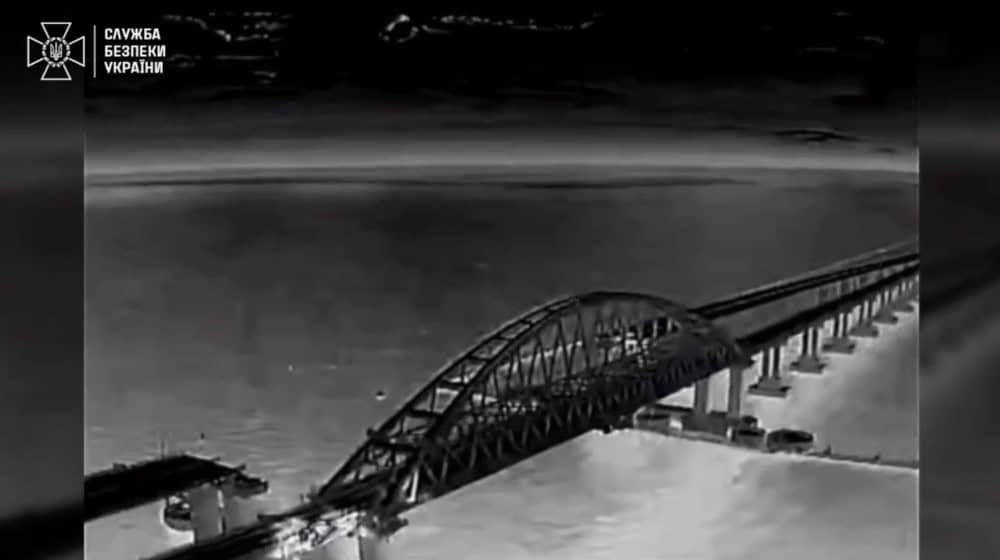
Ukraine has partially destroyed the bridge connecting Russia to the Crimean Peninsula in an operation enabled by careful planning and technical adaptation. The Ukrainians dealt a significant blow to a symbol of Russian occupation, even if the bridge’s role in military logistics has declined from earlier in the war. Yet unexplained restrictions on Ukraine’s access to the American satellite internet service Starshield are hampering strikes on Russia’s alternative logistics routes.
The Crimean Bridge, also known as the Kerch Bridge, consists of a 12-mile, four-lane road bridge running parallel to a double-track rail bridge. In 2018, Vladimir Putin celebrated its opening by driving a truck across the $3.7 billion structure to Crimea, which Russia had illegally occupied and annexed four years prior.
Ukraine launched an initial barrage early on November 16, then a larger one the following night. The second barrage caused a section of the road bridge and its supporting arch to collapse into the sea. The destruction halted road traffic and will obstruct maritime passage through the Kerch Strait until the debris is removed. Ukraine’s Defense Ministry said the strikes also damaged the adjacent railway bridge, but rail traffic quickly resumed, indicating the damage was not prohibitive.
Kyiv framed the attack as payback for a string of recent Russian strikes on bridges in Kyiv and other cities. It appears to have been timed to undermine Putin’s image of strength just as he was about to hold a trilateral sit-down with his American and Chinese counterparts.
“This is the result of the seventh stage of an operation carried out over several weeks, developed and coordinated by the Security Service of Ukraine [SBU] together with the General Staff of the Armed Forces of Ukraine,” President Volodymyr Zelenskyy boasted on social media. He said that to clear their path to the bridge, Ukrainian forces had “gradually destroyed air defense systems, radars, electronic warfare equipment, and other designated targets,” using a variety of cruise missiles and one-way attack drones.
During the operation’s “key stage,” Zelenskyy continued, Ukraine struck the bridge with Flamingo and Neptune cruise missiles as well as the Palianytsia and RUTA, essentially small cruise missiles that the Ukrainians often refer to as jet-powered UAVs or “drone-missiles.” These were preceded by hundreds of drones launched by units from Ukraine’s Unmanned Systems Forces, which saturated Russian air defenses and provided communications support.
The total number of missiles launched is unclear. But the Ukrainians fired at least three Flamingos and seven RUTAs, and the SBU posted footage of a handful of Palianytsia strikes by its elite Alpha unit. Video footage posted on social media showed at least 10 hits on the bridge.
A Flamingo reportedly accounted for at least one of those. With a warhead weighing more than a metric ton, the Flamingo is the most powerful weapon Ukraine had to attack the bridge’s reinforced concrete spans and supports. Low accuracy is a weakness of the missile, but the Ukrainians apparently modified the Flamingos (and potentially other missiles) to enable an operator to steer them toward their target, improving accuracy. Nearby signal-repeater drones enabled control via a mesh radio network, similar to the method the Russians use with some of their Geran-4/5 jet-powered munitions.
A video released online shows a Flamingo careening toward the rail bridge, though the feed lags as the missile approaches — perhaps explaining why that section remained standing.

Although Russia managed to make repairs following earlier strikes on the Crimean Bridge, the damage done this time is far more severe. The Russians will likely be unable to restore the road bridge before the war ends, given the substantial work involved and potential Ukrainian interference with repairs.
After previous attacks, the Crimean Bridge came to play a far smaller role in logistics for Russian forces in southern Ukraine. By mid-2024, it accounted for less than one-quarter of military cargo transported to the peninsula, down from three-quarters in 2022, according to Ukrainian military officials.
Moscow instead turned to ferries and its so-called “land bridge” running through occupied southern Ukraine, where the Russians have been expanding road and rail networks. But those alternatives are not invulnerable, either. In July, Ukraine said it had slashed the capacity at Russia’s Kerch ferry crossing by 75 percent through a series of strikes on vessels.
Ukraine has also found success this year in using so-called “middle strike” drones to target Russian logistics in the occupied territories, with a focus on the R-280 highway running from Russia through southern Ukraine. Meanwhile, Ukrainians have been striking bridges along this route, including multiple crossings over the Mius River near the Russian-Ukrainian border, in the past couple of weeks.
Ukrainian drone units typically rely on Starshield, the military-grade version of SpaceX’s Starlink, to facilitate strikes on dynamic targets such as supply trucks. Its low latency, resistance to jamming, and compact, inexpensive terminals make the system well suited for real-time operator control of drones beyond the radio-signal horizon caused by the Earth’s curvature.
Last week, however, Kyiv announced that its access to Starshield had been abruptly throttled for the second time within the span of a month. In the occupied territories and near the front line, Starshield terminals mysteriously lose connectivity when the drones reach speeds of around 161 kph, according to Ukrainian troops and officials. As a result, the drones crash or must fly slower, making them easier to evade or shoot down.
Apparently, these speed restrictions were the reason Ukraine employed signal-repeater drones rather than Starshield during its attack on the Crimean Bridge. The former method is more complex to execute and is less reliable, since the relay drones can be shot down or jammed. Still, it offers an alternative for Ukraine if Starshield access remains throttled.
Kyiv reported similar restrictions on Starshield in mid-October following a war of words between the American and Ukrainian leaders. In that case, the speed cap covered all of Ukraine, not just the occupied territories. Following bipartisan pressure, connectivity was restored within 10 days, apparently at President Trump’s direction. But the administration and SpaceX gave conflicting accounts of who ordered the restrictions, with some press reports pointing toward an order or at least foreknowledge by the White House.
The Ukrainians have now again reached out to Washington and SpaceX to try to resolve the issue. But after nine days and counting, they say they have yet to receive a convincing explanation.