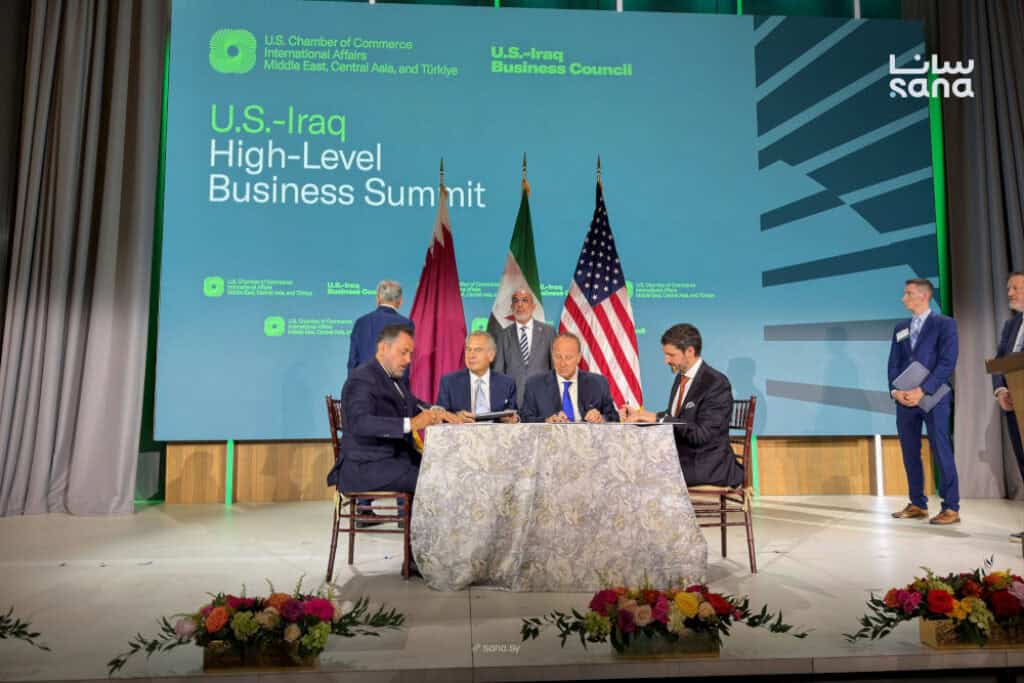
Syria is positioning itself as an alternative route for oil exports from Iraq amid the Iran conflict and its disruption of oil exports via the Strait of Hormuz. On July 17 in Washington, DC, Syrian and Iraqi state oil company executives signed a deal to revive a key oil pipeline from Iraq to Syria’s port of Baniyas. Energy investment is part of a number of developments in Syria that aim to stabilize the country, including a graduation ceremony on July 23 for 1,000 new air force cadets.
The revival of Syria’s energy sector, involving deals with international companies and repairing infrastructure, has been a priority of the Syrian transitional government after the destruction wrought by the country’s civil war from 2011 to 2024. Areas near key energy sector installations, such as the Conoco plant near the Euphrates River, were battlegrounds in past years.
In May 2026, Chevron and Qatar’s UCC Holdings agreed with the Syrian Petroleum Company to conduct offshore gas and oil exploration. In June, the Syrian Petroleum Company signed an agreement with ConocoPhillips and Novaterra Energy to revive gas fields in central Syria.
The latest deal focuses on Iraqi exports via Syria. Iraq has seen its oil exports collapse since the US and Israeli strikes on Iran began on February 28. “The United States has begun importing fuel oil of Iraqi origin shipped through Syria for the first time, according to shipping data and two sources familiar with the operations, as Iraq expands a Mediterranean export route established after disruptions to Gulf trade routes earlier this year,” Reuters reported on July 23.
The pipeline from Iraq’s Kirkuk to Syria’s port of Baniyas is one of the routes that will be improved to enable more exports from Iraq. “The original Banias pipeline runs from the Kirkuk oil fields in northern Iraq to Syria’s Mediterranean coast, with an estimated export capacity of about 300,000 barrels per day. Built in the 1950s, it ceased operations in 1982 amid political tensions between the governments of Syrian President Hafez al-Assad and Iraqi President Saddam Hussein,” Al-Hurra noted on July 18.
The deal was signed at a “Chamber of Commerce summit in Washington on U.S. investment in Iraq. Energy Secretary Chris Wright presided over the signing by Basra Oil Company CEO Bassem Abdul Karim Nasr and Syrian Petroleum Company CEO Youssef Qablawi,” CNBC reported on July 17.
In the wake of the pipeline deal, commentators and analysts have focused on its ramifications for Syria and the region. “An economist says that reviving the Kirkuk–Baniyas oil pipeline will reshape part of the region’s energy map, strengthening the strategic position of Syria and Iraq, gradually reducing Turkey’s influence, and diminishing the strategic importance of the Strait of Hormuz for Iran and China,” the ANHA Hawar News Agency noted on July 24. The Rudaw Media Network also provided context on how investment in Syria is linked to new deals that Iraq has signed while Iraqi Prime Minister Ali al Zaidi visited Washington. One deal involves BP and ConocoPhillips investing in the Kirkuk area to “redevelop Iraq oil fields.”
The energy deals come as Syria continues to focus on various policies aimed at developing the country, improving its security, and establishing international relations.
The state-run Syrian Arab News Agency (SANA) reported that Syrian and International Monetary Fund officials held a meeting on July 23. “During the meeting, the two sides reviewed the outcomes of the IMF mission’s recent visit to Syria and discussed progress made in the economic and financial sectors in a way that contributes to enhancing economic stability and achieving recovery and development priorities,” SANA noted.
Syria also reopened a water station in the eastern part of the country on July 22 and has been restoring its airports, with “at least 12 airlines gradually [resuming] flights to and from Damascus and Aleppo since the fall of the Assad regime in Syria in late 2024.” In addition, new air force cadets graduated in Syria on July 23. “In the presence of Air Force Commander at the Ministry of Defense, Brigadier General Asem Hawari, and a number of officers, a graduation ceremony was held for more than 1,000 cadets from the Air academy,” SANA noted.