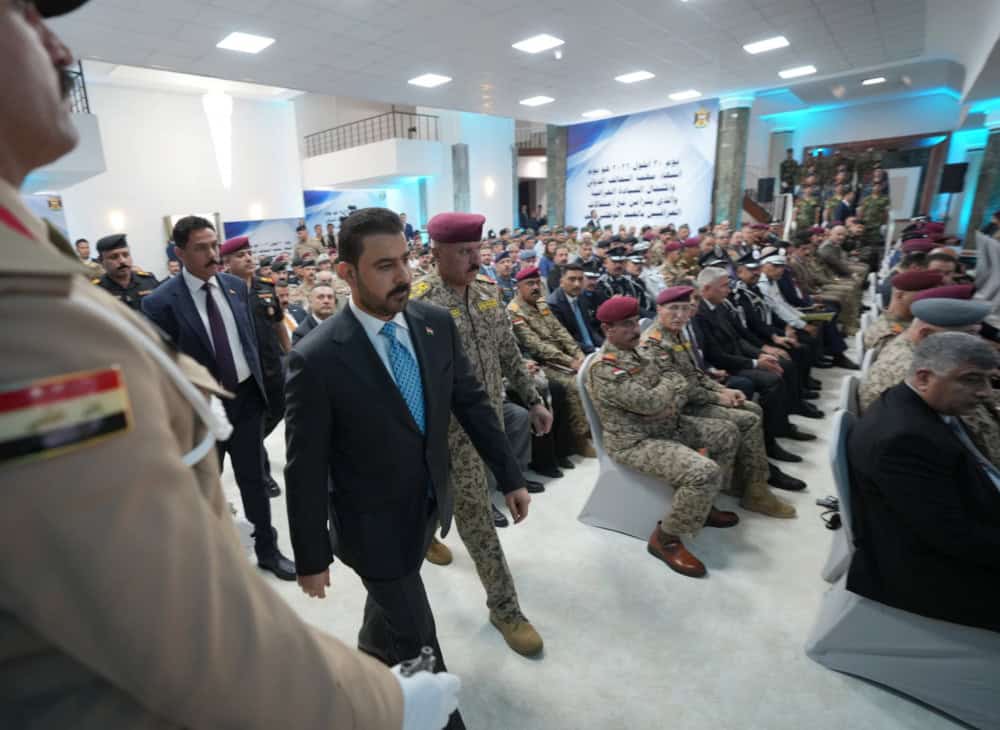
The Iraqi National Intelligence Service (INIS) announced yesterday that it rolled up an Islamic State (IS) financial network that spanned three unspecified West African countries. According to Iraqi media reports, the operation was the first of its kind by Iraqi intelligence on the African continent.
INIS stated on X that it “succeeded in arresting a main financing network for the terrorist entity Daesh [the Islamic State].” According to the Emirati news outlet The National, the effort included the arrest of at least 10 Islamic State operatives.
INIS stated that the network was helping to “smuggle ISIS families,” finance the Islamic State’s activities in Iraq, and fund attack planning in Europe.
INIS said that it carried out the operation “after monitoring movements and communication lines between this network and other networks inside and outside Iraq.” The intel service offered few additional details.
The countries in which the Islamic State operatives were arrested remain unknown. However, the targeted network was likely related to the Islamic State’s West Africa Province (ISWAP). In addition to its main base in Nigeria, ISWAP also maintains cells and networks across much of coastal West Africa.
In addition, Iraqi and Syrian nationals linked to the Islamic State were arrested in the Ivory Coast late last year. These individuals were connected to another Islamic State cell in Madagascar that was also busted at the same time.
Like INIS’s description of the latest foiled Islamic State network, the earlier connected cells in the Ivory Coast and Madagascar were also attempting attack planning in Europe.
African branches now helping the IS core
The fact that operatives most likely linked to ISWAP were helping to finance the Islamic State’s legacy network in Iraq is unsurprising. The Islamic State’s activities in Iraq are at a historic low, with only limited operations occurring after the group has faced years of significant setbacks in the country.
The group’s challenges include the killing of Abdallah Makki Muslih al Rifai, better known as Abu Khadija, earlier this year. Abu Khadija was believed to be one of the Islamic State’s top global leaders, identified as the head of the group’s General Directorate of Provinces (GDP) and Delegated Committee. He was also recognized as one of, if not the top, Islamic State leaders in Iraq.
In Africa, however, the Islamic State’s fortunes are entirely different, as many of its local branches are thriving. In particular, ISWAP remains the Islamic State’s largest and most militarily and administratively capable branch on the continent, where it rakes in millions of dollars from proto-governance, the taxation of civilians, and cryptocurrency networks.
The Islamic State’s Al Furqan Office, located within ISWAP, is one of several so-called regional offices set up around the world to help manage its global affairs. It is responsible for sending funds to other Islamic State wings worldwide. In particular, Al Furqan helps manage most of the Islamic State’s activities in the Sahel, wider West Africa, North Africa, and Sudan.
This function is similar to the Islamic State’s Al Karrar office, situated within the Somali Province in northern Somalia. In addition to helping to fund Islamic State activities in Congo, Uganda, Mozambique, South Africa, and beyond, it has also helped finance the group in Yemen, Turkey, and Afghanistan.
This financing method, in which portions of locally sourced funds are pooled into the coffers of the regional offices for wider dispersal to other Islamic State wings globally, allows the Islamic State to diversify its finances, insulating and supporting its global activities despite any setbacks.
With the Islamic State hurting in Iraq and, for the most part, in Syria, the group’s core legacy networks now rely on its African wings to provide a much-needed lifeline. This situation is a reversal from 2015, when it was the core in Iraq and Syria that financially helped then-fledgling African provinces.