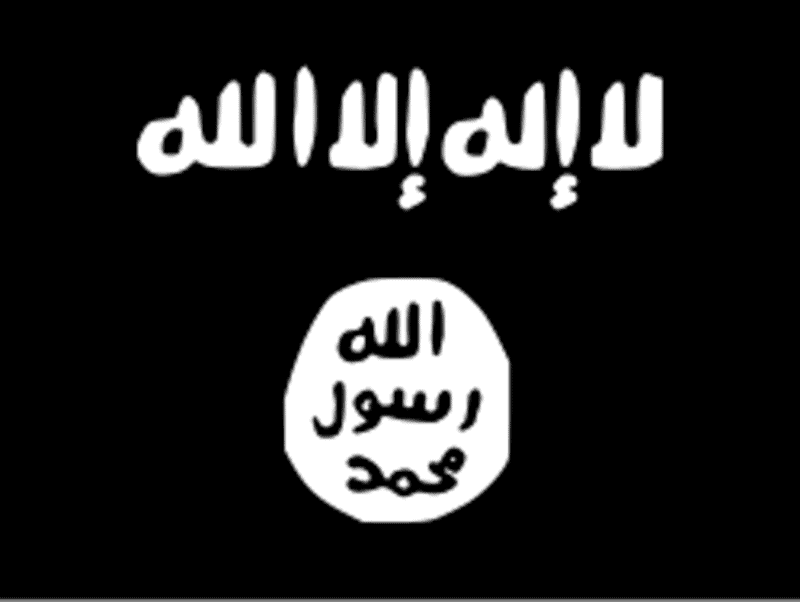
The 14th edition of al Qaeda in the Arabian Peninsula’s (AQAP) Inspire magazine, released on September 9, encourages “lone mujahideen” to pick up the banner of jihad by conducting assassinations. The magazine even provides a list of high-profile businessmen in the US who would make valuable targets.
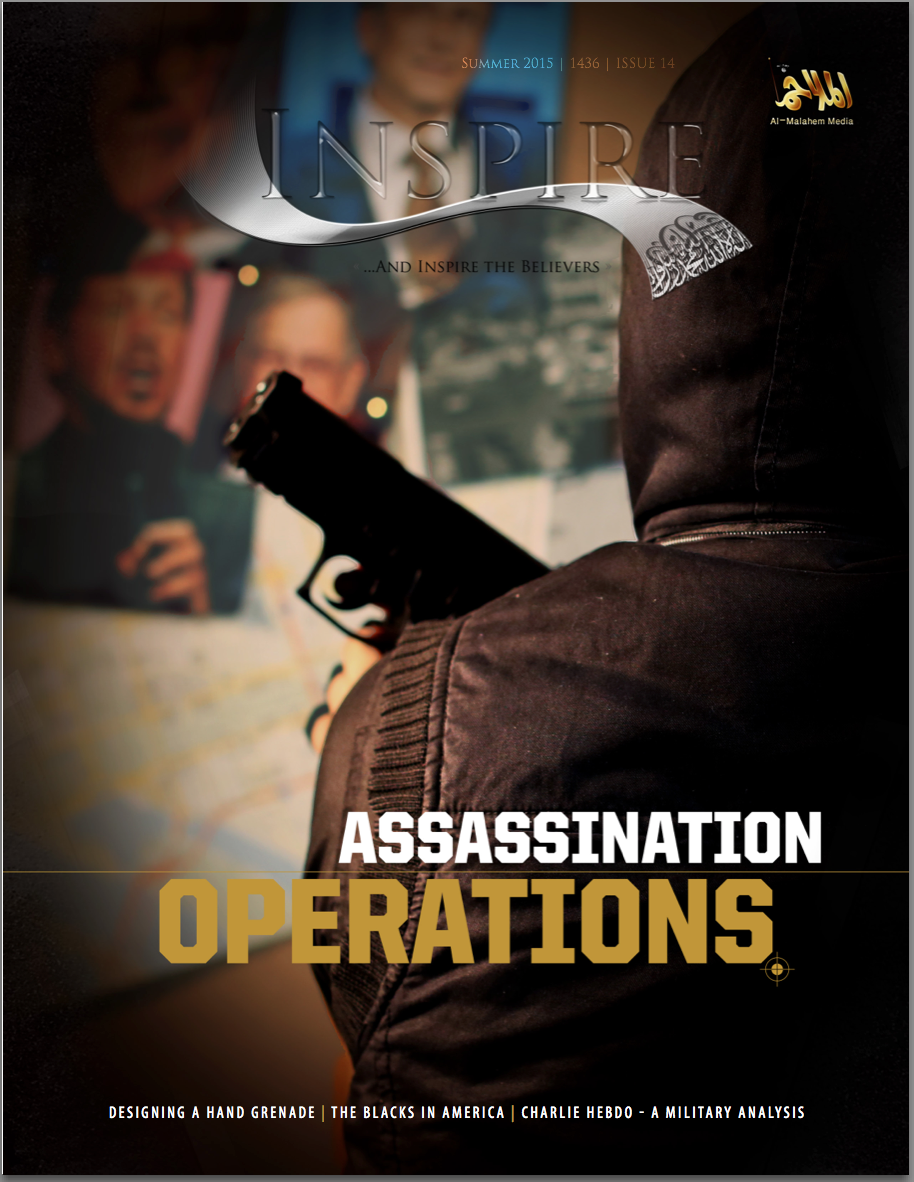
“Whoever understands the components of the American economy knows the importance these personalities play in the revival of the America[n] Economy,” Inspire’s authors claim. Should anyone on the list be assassinated or migrate from America because “they live in insecurity,” it will supposedly bring “instability to the American economy.”
As in past editions, Inspire provides instructions for making homemade explosives. One improvised hand grenade, for example, is purportedly designed to help a “lone” jihadist assault the location of his choosing.
While it is possible that one or more “lone” actors will try to follow through on AQAP’s threats, Inspire contains an important reminder that professionally trained terrorists are still plotting.
A case in point is the massacre at Charlie Hebdo’s offices in Paris in January. Inspire underscores al Qaeda’s responsibility for the operation.
One article is a “military analysis” of the attack on Charlie Hebdo by Ibrahim Ibn Hassan al Asiri, who is widely known as AQAP’s chief bomb maker. However, Asiri’s recent appearances in AQAP’s propaganda underscore his importance within the organization, indicating that he is likely more than an expert bomb maker.
US intelligence believes Asiri is responsible for designing the bomb used by his brother in a failed attempt to kill the Saudi deputy interior minister in August 2009, as well as other sophisticated explosives. The underwear bomb worn by an AQAP-trained operative on board a Detroit-bound plane on Christmas Day 2009 is thought to be another one of Asiri’s inventions.
Asiri lays out the process by which Charlie Hebdo was put in al Qaeda’s crosshairs.
“At first, [al Qaeda’s] central leadership began by selecting a particular target — in this case, caricature artists defaming the religion and the Prophet Mohammed,” Asiri writes. Al Qaeda’s leaders selected “two methods” for “achieving this goal.” The first was the “lone jihad” method, in which al Qaeda would have “no direct connection” to the terrorists except for “inspiring and guiding” them. Thus, AQAP published a hit list featuring Charlie Hebdo’s editorial director Stephane Charbonnier and others in one of its editions of Inspire. The jihadists hoped that “lone” jihadists would attack those on the list.
The second method is an “operation organized by a jihadi group,” that is, “assigning specific persons to target the cartoonists.” The Charlie Hebdo shootings fall squarely in this category, according to Asiri.
Al Qaeda “prepared and trained” Said Kouachi, one of the two brothers responsible, by “[g]iving him necessary training that will prepare him militarily and psychologically to successfully execute the operation.”
“This is how the target-selection [sic] process was completed, as a first step towards the assassination operation,” Asiri writes. “The leadership then selected the method and a suitable person to execute this important operation.” Because “the target was geographically far from the leadership command, information [on] the target was scarce.” Therefore, Kouachi “had to take the responsibility of collecting the necessary information so as to achieve his goal” and “use his own means and method of collecting information.” Upon his return to France, Kouachi “continued with his preparation for the operation.”
Asiri’s description of the plot is consistent with al Qaeda’s longstanding policy of centralizing the decision, but decentralizing the action.
Asiri breaks the planning down into steps. First, there was the “[s]election of the target” by al Qaeda’s “central leadership.” Then, the “planning and initiation of the operation” was carried out by AQAP. The “manner of assassination” was “left for the executor to decide,” based on “his potential and the circumstances surrounding the operation.” This was so he would have “flexibility and wide options in executing the task.”
Other evidence backs up Asiri’s explanation of how the Charlie Hebdo killings were planned and executed.
Al Qaeda’s senior leadership has long plotted and advocated terrorism against those deemed to be blasphemers. Al Qaeda plotted to attack the Danish newspaper Jyllands-Posten in response to its publication of cartoons of the Prophet Mohammed that were deemed offensive. Al Qaeda’s leaders openly threatened Denmark over the issue. And the group said its bombing of Denmark’s Embassy in Pakistan in 2008 “fulfilled the promise of Sheikh Osama Bin Laden…of responding” to the “insulting drawings.”
AQAP continued with this theme. As Asiri notes, the 10th issue of AQAP’s Inspire magazine, which was released in early 2013, includes a “Wanted” poster that is headlined, “Dead or Alive For Crimes Against Islam.” The poster was intended to encourage followers to shoot 11 people, all of whom have supposedly offended Islam. One of them was Charbonnier.
In the very first edition of Inspire magazine in 2010, AQAP ideologue Anwar al Awlaki, who was killed in a US drone strike in 2011, called for jihadists to attack cartoonists who had supposedly smeared the legacy of the Prophet Mohammed.
Shortly after the Charlie Hebdo slayings, AQAP’s Nasser bin Ali al Ansi, who has also since been killed in a US drone strike, said the Kouachis’ operation was planned in “compliance” with the “command” of Allah to support his messenger, as well as the “order of our general emir, the generous Sheikh Ayman bin Muhammad al Zawahiri,” and the “will” of Sheikh Osama bin Laden.
“We clarify to the ummah that the one who chose the target, laid the plan and financed the operation, is the leadership of the [al Qaeda] organization,” al Ansi said. Al Ansi also explained that the “emir of the operation,” Said Kouachi, worked with Anwar al Awlaki.
The Kouachi brothers hardly hid their AQAP affiliation. French television interviewed one of the brothers as they were on the lam. The interviewee was identified as Cherif Kouachi, Said’s brother, who said that he was sent by Awlaki. Cherif Kouachi also said that Awlaki provided cash for the operation. Asiri’s article does not refer to any trips by Cherif to Yemen. But it is possible that Cherif was referring to his brother’s ties to Awlaki. According to multiple published reports, Western intelligence officials believe that at least one of the brothers traveled to Yemen where he received training and financing, just as Asiri claims. Western and Yemeni officials have previously claimed that both brothers were trained in Yemen.
Al Qaeda’s attack on Charlie Hebdo is part of a larger campaign against the supposed blasphemers. Al Qaeda in the Indian Subcontinent (AQIS) has hacked to death several people in Bangladesh accused of offending Islam and the legacy of the Prophet Mohammed.
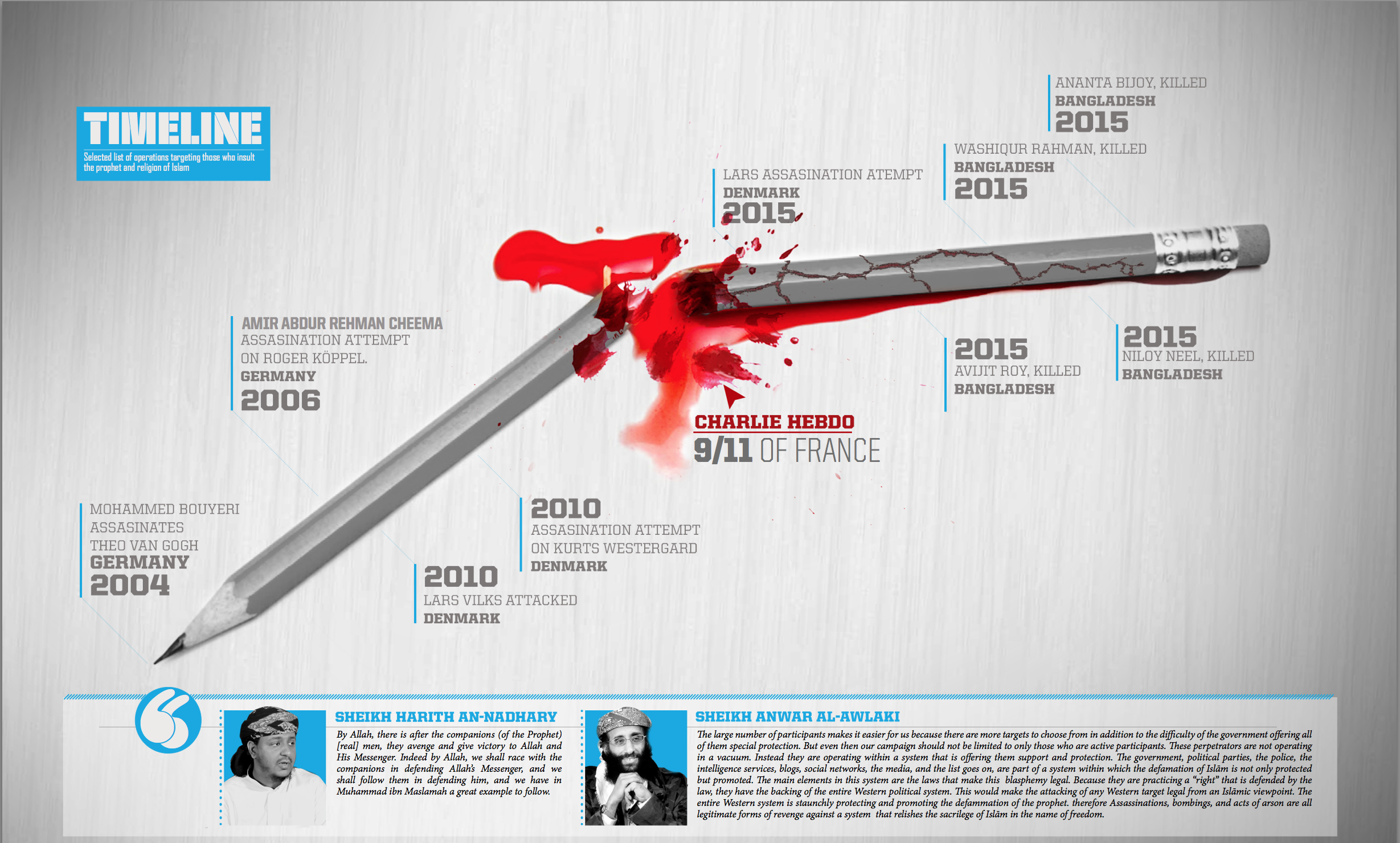
In fact, the newest edition of Inspire magazine ties the Charlie Hebdo killings to the murders committed by AQIS. One graphic, seen on the right, includes all of these attacks on a “list of operations targeting those who insult the prophet and religion of Islam.”
The leader of AQIS, Asim Umar, has said that the assassinations carried out by his men “are part of a series of operations initiated by the different branches of al Qaeda on the orders of our respected leader Sheikh Ayman al Zawahiri (may Allah protect him).”