A year ago, The Long War Journal reported on the Village Stability Operations (VSO) and Afghan Local Police (ALP) counterinsurgency programs. We also noted the importance placed on them by commanders to bring security to Afghans at the local village level.
Recently, Small Wars Journal published a report that provides quite an extensive evaluation of the programs.
Village Stability Operations (VSO) and Afghan Local Police (ALP)
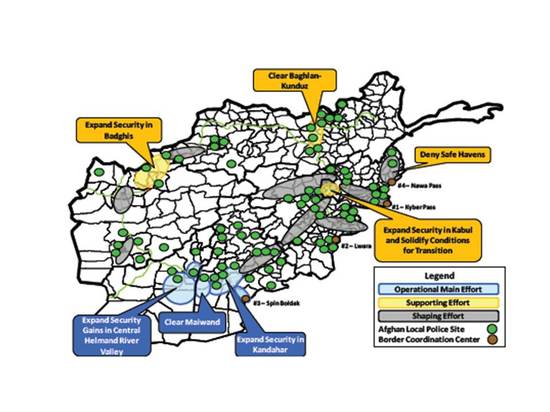 |
| Afghan Local Police sites are located in key districts across Afghanistan. |
Village Stability Operations (VSO) is a counterinsurgency program that started two years ago. The program is not designed to protect the local population directly, but to help the populations protect themselves. Led by US Special Operations Forces, VSO provides rural villages with trainers, mentors, and enablers to support local forces defending their own villages. VSO also provides liaisons between the local villages, Afghan government, and the Afghan National Security Forces (ANSF), allowing local villages to draw on national resources.
Supplementing the VSO program is the Afghan Local Police (ALP) program. ALP is intended to provide additional support to local forces. While local villages provide the personnel, the ALP program provides training, salaries, and equipment, all funded by the Afghan national government.
The performance of the VSO/ALP programs
Overall, the Small Wars Journal‘s report concludes that the program has been successful. VSO/ALP has shown itself to be effective at increasing security in areas where the program has been implemented. Some representative sections of the report are excerpted below.
[T]his paper finds that VSO/ALP is having a positive impact on security and governance at the local level in Afghanistan.
….
It accomplishes several goals necessary for the eventual withdrawal of coalition forces: it develops security and governance from the ground up, while also building connections between rural villages and districts and upper echelons of government; gives Afghans an increasing responsibility for their own well-being, therefore reducing reliance on coalition forces; and allows for the elimination of insurgent safe havens in the rural areas. VSO/ALP has proven to be more effective, more applicable, and more consistent with Afghan culture and history, than any previous or concurrent counterinsurgency policies.
Where VSO/ALP has been implemented, Coalition casualties have declined.
Of the six most volatile provinces in Afghanistan, five provinces experienced decreases in coalition fatalities for 2011. Helmand, Kandahar, and Zabul provinces experienced dramatic decreases in troop casualties (Helmand: 290 in 2010 to 141 in 2011; Kandahar: 105 in 2010 to 91 in 2011; and Zabul: 37 in 2010 to 7 in 2011). These three provinces also happen to have the some of the largest concentrations of VSO sites per province as of September 2011.
Civilian casualties, security incidents, and enemy-initiated attacks are reduced.
[T]otal civilian casualties during the 2011 fighting season (May-September) were slightly lower, though civilian casualties for the months of May and July of 2011 were higher than in May and July of 2010. In addition, the total number of monthly security incidents in the 2011 fighting season appears to be significantly lower than that of the 2010 fighting season, from over 20,000 in 2010 to just over 18,000 in 2011.
News reports support the conclusions.
Peter Bergen, an acclaimed journalist and author … spoke to Major Jim Gant about the effectiveness of VSO/ALP. Major Gant told Bergen “The Taliban are very threatened by this”….”It’s taking their safe haven away.” Bergen also spoke to other security experts who noted that ALP forces were creating “security bubbles” that didn’t exist before.
….
A July 2010 Army Times article, written by Sean Naylor … pointed to the Zerkho Valley in Herat province as an example of the effectiveness of VSO/ALP. The Zerkho Valley had long been an insurgent safe haven and transit point. In fact, the attacks on a SOF firebase in the area were so intense it forced their withdrawal from the base. However, after establishing a VSP between two local tribes, insurgent activity was reduced dramatically. Incidents of improvised explosive devices (IED) became non-existent, local villagers began reporting the locations of weapons caches, and the local ALP force was credited with warning SOF of approaching insurgents. In addition, the Zerkho Valley VSP brought local tribes together to solve problems, tribes that otherwise hadn’t talked to each other before; and led to five to ten other villages in the area requesting SOF to establish VSPs in their villages.
Reports from military professionals are positive.
[I]n November 2011, the National Intelligence Estimate (NIE) suggested that “VSO and the associated development of Afghan Local Police (ALP) are proving more effective than many other concurrent Coalition military efforts.” ….
[A]n article in the July-September 2011 edition of Special Warfare magazine … pointed to the success of VSO in Khakrez District, Kandahar Province, in 2009. Once a booming economic hub, Khakrez fell victim to an increasing Taliban insurgency that used the district as a safe haven for staging attacks on Kandahar City. After the establishment of VSO, however, local villages have been empowered to protect themselves. Taliban control of the district has been reversed through local defense, development projects, and strengthened ties to local, provincial, and national government. In addition, local shuras have become important in settling disputes, which has helped counter local Taliban shadow courts. ….
What is of particular importance here is the fact that each of the districts noted represents a different tribe … for it evidences the applicability of VSO as a malleable framework that can be adapted and effective despite differences in tribal affiliation.
In Congressional testimony, commanders’ comments are also positive.
In November 2011, the Senate Armed Services Committee heard testimony from Michael A. Sheehan, the nominee for Assistant Secretary of Defense for Special Operations and Low Intensity Conflict … [who] stated that “since its inception, VSO has expanded Afghan government influence in key rural areas from 1,000 square kilometers to 23,500 square kilometers today,” and “has enabled a massive expansion in small-scale infrastructure development in these key rural areas.” Mr. Sheehan went on to state that VSO and ALP has proven to be a significant threat to the Taliban, which has led them to initiate a campaign of intimidation, assassination, and disruption against ALP members and government officials. However, Mr. Sheehan points out that for the most part, Taliban efforts have achieved little success.
VSO and ALP are a supplement to the ANSF, not a replacement
While the success of the programs is laudable, that success must be kept in perspective. VSO and ALP are not designed to, and cannot hope to, provide the main basis for security for all of Afghanistan. VSO/ALP are useful as supplements to the Afghan National Security Forces, but they cannot replace the ANSF, for reasons discussed below.
First, VSO and ALP are small programs relative to the size of the ANSF and to the overall security needs of Afghanistan. VSO is currently designed to support about 100 local villages. There are 12,000 Afghan Local Police, with a plan to reach a force level of 30,000, a far smaller number than the 352,000 troops of the ANSF.
Second, the programs’ success depends on the extensive use of a very limited and precious resource, US Special Operations Forces. Setting up VSO and ALP units requires a significant investment of highly-trained SOF operators along with military and civilian support personnel. And so the VSO and ALP units have been limited to the size that can be supported. Some regular US Army personnel have been used to supplement the SOF, but this is of limited utility. While some US Army personnel have been used successfully, the majority of regular troops are not trained with the essential skills to perform the mission well.
Third, the combined VSO/ALP is not designed to be a stand-alone defense force. The VSO/ALP personnel are expected to perform only limited duties. They man checkpoints, detain individuals and turn them over to regular forces, and provide intelligence on Taliban activities. VSO/ALP units are set up in villages near existing ANSF outposts, thereby extending security beyond areas covered by the ANSF. This proximity allows the ANSF to provide prompt reinforcements to the ALP if needed. But without this close ANSF support, VSO/ALP units cannot survive in areas of heavy insurgent activity.