On September 23, the US-backed Board of Peace (BoP) unveiled a $2.45 billion, six-month Gaza recovery plan, but its implementation remains stalled by disagreements over Hamas’s disarmament and Israel’s withdrawal. The following day, Israeli Prime Minister Benjamin Netanyahu addressed the United Nations General Assembly (UNGA). Meanwhile, Israeli forces conducted numerous strikes over the past two weeks against Hamas commanders and financial operatives involved in the group’s efforts to reconstitute itself in Gaza.
The BoP announced its recovery plan for Gaza during a meeting on the sidelines of the UNGA in New York. The proposal includes 66 projects covering infrastructure, housing, healthcare, economic recovery, and security. Representatives from 35 countries and international organizations attended the meeting, where BoP executive board member Jared Kushner, US Special Envoy to the Middle East Steve Witkoff, BoP High Representative Nickolay Mladenov, and National Committee for the Administration of Gaza (NCAG) chief Ali Shaath discussed the transition from planning to implementation.
Shaath outlined a reconstruction strategy beginning in Rafah and expanding to Khan Younis, central Gaza, Gaza City, and northern Gaza as security conditions permit. However, the plan remains dependent on Hamas’s disarmament, the transfer of governing authority to the NCAG, and a phased Israeli withdrawal. The order of these phases represents the key sticking point in implementation.
Board officials acknowledged that negotiations with Israel remain difficult ahead of the October 27 Israeli election. Mladenov said that political considerations had made discussions more sensitive, although negotiations were making gradual progress. Witkoff insisted that there was no alternative to implementing the existing plan. The central unresolved dispute concerns the sequencing of Hamas’s disarmament and Israel’s withdrawal: Netanyahu insists that Hamas surrender its weapons before Israeli forces withdraw, while the proposed framework links disarmament to a phased withdrawal.
In a separate development, the BoP reaffirmed on September 25 that the United Nations Relief and Works Agency (UNRWA) would have no role in its Gaza reconstruction framework, arguing that the agency did not meet its requirements for trusted partners following reports of Hamas infiltration.
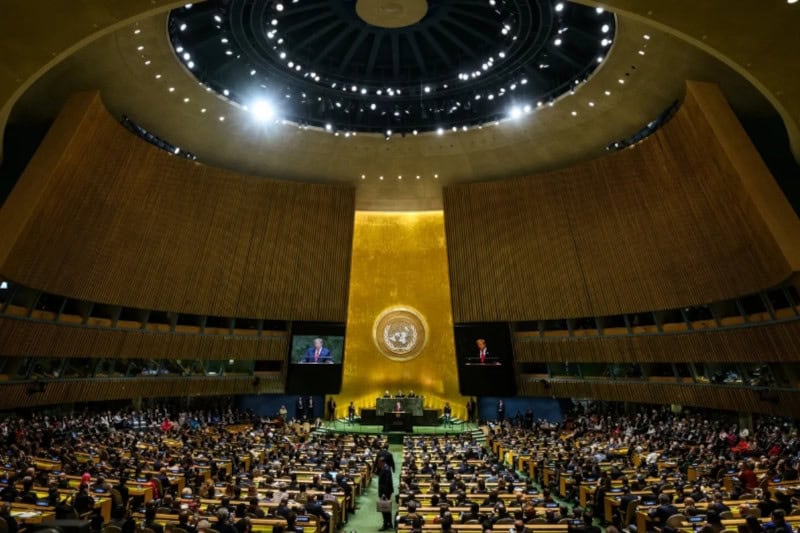
On September 24, Prime Minister Netanyahu addressed the UN General Assembly, defending Israel’s military campaigns against Hamas, Hezbollah, and Iran and rejecting international criticism of the war in Gaza. He credited US-Israeli military operations with severely damaging Iran’s nuclear facilities and military capabilities, predicted the eventual downfall of Iran’s government, and expressed support for Iranian protesters. Netanyahu also categorically rejected allegations that Israel had committed genocide in Gaza, arguing that Israeli forces have taken extensive measures to protect civilians while Hamas used them as human shields.
Netanyahu also criticized Qatar, Turkey and Western governments for their positions toward Israel, while rejecting Palestinian statehood under present circumstances. Dozens of delegates walked out as he began speaking, prompting him to call them “moral cowards.”
Meanwhile, in Gaza, Israel reported 18 operations against and ceasefire violations by Hamas and other Palestinian terror groups between September 15 and 29:
- On September 15, the IDF and Shin Bet announced that they killed Naal Abu Obaid, the commander of Hamas’s Rafah Brigade and head of operations in its military wing, in southern Gaza. Obaid succeeded Muhammad Shabana following his elimination and had previously served as the brigade’s deputy commander and commander of its Tel Sultan and Yebna battalions.
- On September 16, the IDF reported that it killed Jihad Smaeh Mahmoud Ismail, the commander of a Hamas Nukhba squad, in Khan Younis the previous week. Ismail had infiltrated Israel during the October 7 massacre and participated in the attack on an Israeli tank and the abduction of three Israeli soldiers, according to the Israeli military.
- Later the same day, the IDF announced that it killed Saeed Asaad Saeed Akram, a commander in Hamas’s Daraj Tuffah battalion, in northern Gaza. Akram had recently planted explosives and planned attacks against Israeli forces, according to the Israeli military. The IDF also reported killing two additional Hamas and Palestinian Islamic Jihad (PIJ) operatives involved in attacks against its forces.
- On September 17, the IDF reported that it killed Shariff Shadi Ibrahim Labed, a Hamas Nukhba operative who participated in the October 7 assault on the Erez Crossing, in northern Gaza two days earlier. The military also announced the elimination of Yosef Saad al Din Rashid Zaim, a Hamas Nukhba commander, in a separate strike in northern Gaza earlier that week.
- Later the same day, the IDF announced that it killed Muhammad Jamal Ahmad Eid, a Hamas Nukhba commander who infiltrated Israel during the October 7 massacre, in Al Bureij the previous day. In a separate strike in Gaza City, the IDF killed Saleh Ziyad Ibrahim al Maqdad, a platoon commander in Hamas’s naval force, according to the Israeli military.
- On September 19, the IDF reported that it killed Muhammad Sulaiman Biuk, a Hamas commander who infiltrated Israel during the October 7 massacre, in Khan Younis two days earlier. Biuk had recently planted explosives, planned attacks against Israeli forces and civilians, and worked to rebuild Hamas’s military capabilities while violating the ceasefire, according to the Israeli military.
- On September 21, the IDF announced that an Israeli engineering vehicle struck an explosive device during routine operations near the Yellow Line, which separates the Israeli-controlled area of Gaza from the rest of the territory. No Israeli personnel were injured. The military described the incident as a violation of the ceasefire agreement and struck Hamas infrastructure in Gaza in response.
- On September 24, the IDF and Shin Bet announced that they killed Muhammad Abu Alwan, the head of Hamas’s finance department, in Khan Younis the previous day. Alwan had overseen the transfer of more than 1 billion shekels to Hamas during the war, financing its military operations and helping preserve its governing apparatus, according to the Israeli military.
- Later the same day, the IDF reported that it killed Mahmoud Abd al Fattah Awwad, a commander in Hamas’s military wing, in Gaza City the previous weekend. Awwad had participated in holding seven Israeli hostages, including Daniela Gilboa, Karina Ariev, and Doron Steinbrecher, in an underground tunnel during the war, according to the Israeli military.
- On September 25, the IDF announced that it killed Jaber Muqbil, a Hamas operative who led the Muqbil currency-exchange network, in Deir al Balah the previous day. The network had transferred millions of shekels in foreign currency to Hamas to finance its operatives and rebuild military infrastructure, according to the Israeli military. In a separate strike in Khan Younis, the IDF killed Hassan al Bata, a sniper in Hamas’s military wing.
- Later the same day, the IDF reported that it killed Hassan Mahmoud Siyam, a Hamas commander who infiltrated Israel during the October 7 massacre and subsequently participated in holding four Israeli hostages, including Amit Soussana and Keith Siegel, in captivity. The military also announced that it killed Adham Subhi Salem Ziyara, another Hamas operative, in a separate strike in Gaza City. Both had recently planned attacks against Israeli forces and participated in planting explosives near the Yellow Line, according to the IDF.
- On September 26, the IDF announced that it killed Ibrahim Fuzi Ismail Muhsan, the commander of a Hamas Nukhba platoon, in Nuseirat the previous day. The military also reported killing Muhammad Kamel Suleiman Muhsan, another Hamas operative, in Khan Younis. Both had recently planned attacks against Israeli forces and civilians and worked to rebuild Hamas’s military capabilities while violating the ceasefire, according to the IDF.
- On September 27, the IDF and Shin Bet announced that they killed Saher Nadal Latfi Zakr, the operative who drove the motorcycle used to abduct Noa Argamani and Avinatan Or from the Nova music festival during the October 7 massacre, in Nuseirat the previous day. Zakr belonged to “global jihadist organizations operating in the Gaza Strip” and had supplied Hamas with weapons during the war, according to the Israeli military.
- Later the same day, the IDF released footage that it said showed an operative using a child to transfer combat equipment into a civilian home in central Gaza. The military accused terrorist organizations in the territory of exploiting children to transport weapons and avoid Israeli strikes near the Yellow Line. The IDF said it refrained from striking the operative to prevent civilian casualties.
- Also on September 27, the IDF and Shin Bet reported that they killed Mohammed Hamed Mohammed Gubarin, a commander in Hamas’s military wing, in northern Gaza the previous week. Gubarin had participated in holding nine Israeli hostages, including Ziv Berman, Liri Albag, Agam Berger, and Alon Ohel, in captivity during the war, according to the Israeli military. He had recently planned attacks against Israeli forces and worked to rebuild Hamas’s military capabilities, the IDF said.
- On September 28, the IDF announced that it killed Adi Adli Abed al Atzar, a sniper in Hamas’s military wing, in southern Gaza the previous day. Atzar had recently planned attacks against Israeli forces and civilians and worked to rebuild Hamas’s military capabilities while violating the ceasefire, according to the Israeli military.
- Later the same day, the IDF reported that it killed Shadi Abu Hatseira, a key money changer for Hamas’s military wing, in Gaza City the previous day. Abu Hatseira led the Geneva currency-exchange network, which transferred tens of millions of shekels in foreign currency to Hamas, according to the Israeli military. He also operated a trading company, Gardena Professional, which the IDF said facilitated the transfers.
- On September 29, the IDF and Shin Bet announced that they killed Azz al Din Bik, the commander of Hamas’s Northern Gaza Brigade, in northern Gaza. Bik succeeded Ahmed Gandour after his elimination and had previously served as the brigade’s intelligence officer. He had directed attacks against Israeli forces and civilians and worked to rebuild the brigade’s military capabilities, according to the Israeli military.