
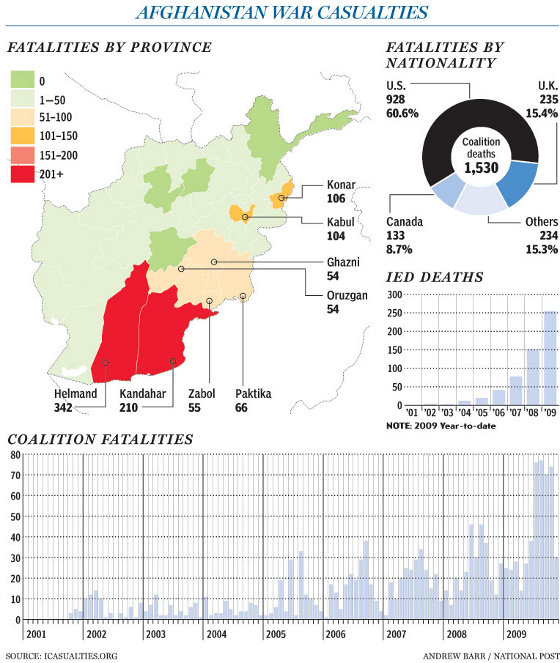
The National Post printed a good graphic on Coalition casualties, by province, throughout Afghanistan, as well as some attack statistics. Some items of note: IED deaths, at more than 250, have increased by more than five times since 2006. The US, Canada, and Britain are shouldering the brunt of the casualties; 84.7% of the deaths in Afghanistan are taken by these three countries. Coalition deaths have skyrocketed in the past year.
The graphic also provides an interesting, but limited, view of the Afghan insurgency. Using Coalition casualties alone to gauge the nature of the insurgency would lead you to believe that the insurgency is by and large concentrated in southern Afghanistan, with spillover into southeastern Afghanistan. There is plenty of truth to this; the provinces of Helmand and Kandahar are the traditional power base for Mullah Omar, and the level of violence in the two provinces has been high.
But just because Coalition casualties are low in other regions does not mean the Taliban are not present there, or even in control. For example, the Taliban control significant areas in the northern provinces of Kunduz and Baghlan; in the western provinces of Farah, Nimroz, Badghis, and Herat; in the northeastern province of Kunar; in the central provinces of Kapisa, Logar, and Wardak; and in the eastern provinces of Khost and Paktia. But Coalition casualties are low in these areas (1-50 deaths since 2001). If you looked at the map and used Coalition casualties as the only metric for the insurgency, you would think the Taliban problem is minimal in these province. The same goes with Uruzgan, Zabul, Ghazni, Paktika, and Nuristan (each with 51-100 deaths), yet the Taliban also control vast regions in these provinces. In Nuristan, the US recently pulled out of some outposts, ceding control after the command recognized it could not control these regions with remote outposts.
There are various reasons for the low numbers of Coalition casualties in some of the provinces with a strong Taliban presence. Many of the European countries operate under restrictive rules of engagement which discourage their forces from engaging the enemy. And some provinces (such as Nimroz and Farah in the southwest) have few Coalition forces present to begin with.
Are you a dedicated reader of FDD's Long War Journal? Has our research benefitted you or your team over the years? Support our independent reporting and analysis today by considering a one-time or monthly donation. Thanks for reading! You can make a tax-deductible donation here.


2 Comments
We keep getting all this bad news about so many parts of Afghanistan, but where is actual progress being made? What provinces have we been turning the tide?
Recent progress in:
-Herat (credit to Italy, Spain, 207th ANA Corps, Provincial governor, Provincial police, 207th ANA Corps commando battalion and its US advisors)
-Oruzgan (credit to Dutch, Australians, French OMLTs, 205th ANA Corps, not sure how much goes to local ANP)
-Some initial indications of progress in Helmand. Credit Marines. Brits are so so. BG Gori’s ANA 3-205 has done well. Provincial ANP = poor. ANCOP = good but not enough of them.
-Kabul (Credit provincial ANP, ANA 111th Division, British mentored ANA 3-201, their OMLTs/POMTLs, and to a lesser degree Italians and Turks)
I am optimistic that ANA 2-209 (German, Swiss, US mentored) and the provincial ANP will show some progress in Kunduz. German combat troops are not doing well however; and this progress has not materialized.