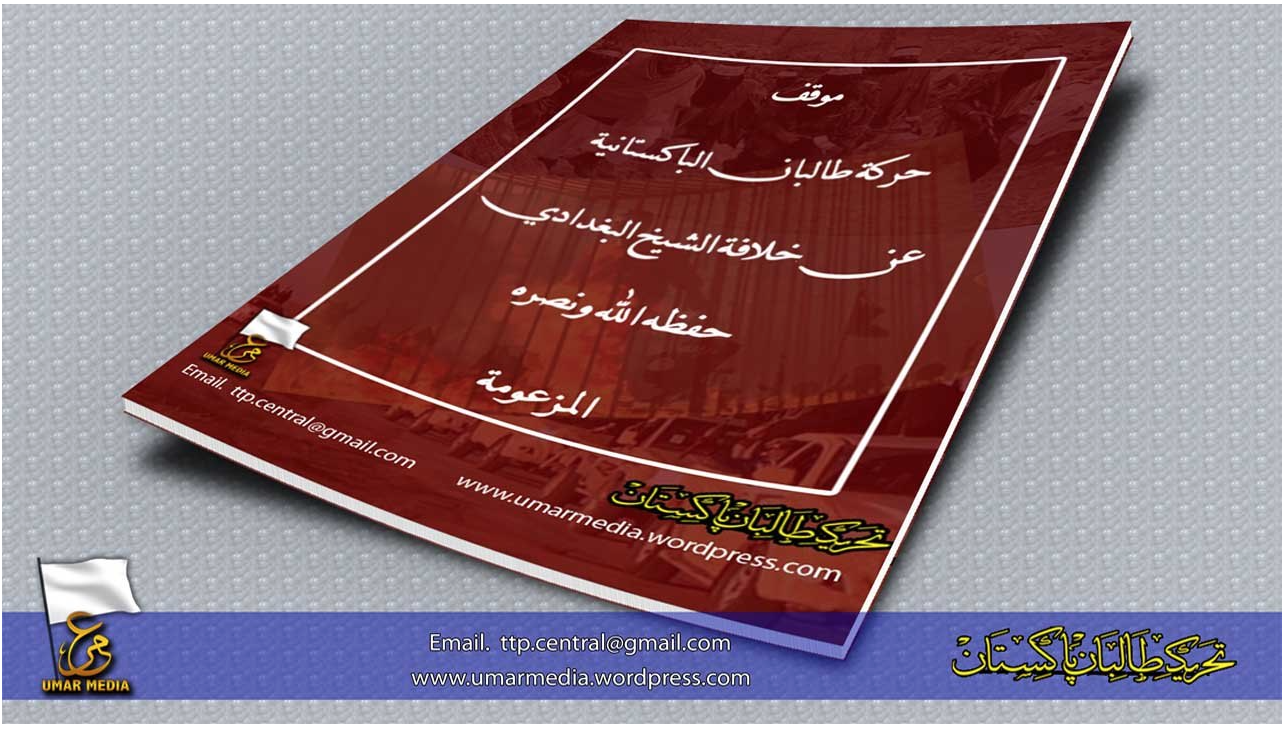
The Pakistani Taliban’s official propaganda wing, Umar Media, has released a statement rejecting the Islamic State’s “self-professed caliphate” in Iraq and Syria. The publication, written by a jihadist known as Abu Usman Salarzai, is nearly 60 pages long and purports to expose the errors in Abu Bakr al Baghdadi’s claim to be the new caliph.
Salarzai praises Afghan Taliban leader Mullah Omar, as well as Osama bin Laden and his successor as the head of al Qaeda, Ayman al Zawahiri.
The Pakistani Taliban’s statement is the latest twist in the competition between the Islamic State and al Qaeda in South Asia. While the Islamic State has made inroads, primarily by poaching disaffected Afghan and Pakistani Taliban commanders, al Qaeda has deep and longstanding relationships with jihadists throughout the region.
Still, the Islamic State has attempted to cut into the support enjoyed by the Taliban and al Qaeda. In January, a group of mid-level Pakistani Taliban commanders pledged their loyalty to Baghdadi. In February, the group’s emir for the tribal agency of Bajaur also defected to Baghdadi’s cause. The defections came after internal discord and disputes dissolved the original Pakistani Taliban coalition last year.
In March, however, a major faction calling itself the Pakistani Taliban Jamaat ul Ahrar decided to rejoin the original umbrella organization. In addition, another jihadist group named Lashkar-i-Islam also decided to join the Pakistani Taliban. [See LWJ report, Pakistani jihadist groups, Lashkar-i-Islam merge into the Movement of the Taliban in Pakistan.]
There have been indications in recent weeks that al Qaeda has been leading the effort to reunite jihadists.
Earlier this month, Matiur Rehman, a veteran al Qaeda leader, united three jihadist groups under his command and then folded them into the Pakistani Taliban coalition. The US Treasury Department has described Rehman as “a planning director for al Qaeda.” Rehman has been connected to multiple planned attacks against the West, including al Qaeda’s 2006 London airliner plot and a thwarted attempt to bomb trains in the New York City area in 2009. [See LWJ report, 3 jihadist groups merge with Movement of the Taliban in Pakistan.]
Umar Media has recently made the Pakistani Taliban’s close relationship with al Qaeda known in other ways as well.
In April, Pakistani Taliban spokesman Muhammad Khorasani released a eulogy for Ustad Ahmad Farooq and Qari Imran, two al Qaeda in the Indian Subcontinent (AQIS) leaders who were killed in separate US drone strikes in January. [See LWJ report, Pakistani Taliban praises slain al Qaeda leaders.]
Khorasani said that Farooq oversaw Umar Media’s propaganda. “We would frequently meet for the purpose of media related tasks,” Khorasani explained. “During our meetings, if he [Farooq] would see any mistakes in any of our Umar Media productions or in any of my statements that I would release as the spokesman, he would point them out in a very kind and loving way, allowing me to benefit from his valuable suggestions.”
Khorasani said Imran was “among the greatest militant teachers,” and noted that he and “thousands” of other jihadists trained under him.
“Thousands of young men received militant training from him [Imran] before going and dealing heavy strikes against the centers of the infidels,” Khorasani said. “I also gained my militant training from him.”
Abu Usman Salarzai’s rejection of the Islamic State’s “caliphate” contains a critique of the operations authorized by Baghdadi. Namely, Salarzai criticizes the Islamic State’s targeting of Shiite holy sites and civilians, saying such attacks are “unwise” as they alienate the population. His critique is somewhat ironic, given that the Pakistani Taliban has repeatedly carried out unpopular attacks, including a massacre at a military high school last year.
Documents recovered in Osama bin Laden’s compound show that al Qaeda has long maintained close ties to the Pakistani Taliban, but has also tried to rein in its violence.