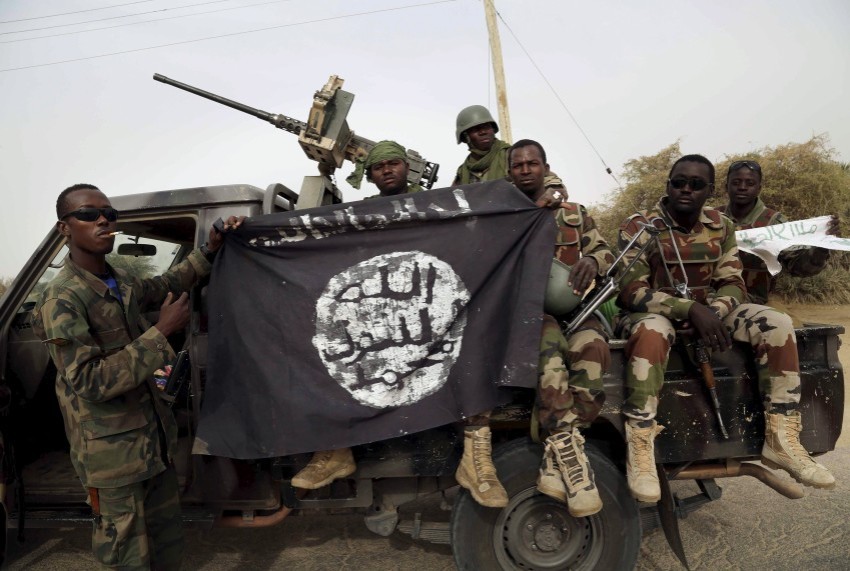
Nigeria and its allies appear to be making headway in the fight against Boko Haram. However, these initial victories may not mean that the region is closer to ending its fight against violent radical Islam.
At the beginning of the month, forces from Chad and Niger joined Nigeria fighting against Boko Haram, and the African Union (AU) supported the development of an 8,000-strong regional counterterrorism force. Last week, the Nigerian army stated that it had pushed Boko Haram from all but three local government areas in Nigeria’s northeast including Abadam, Kala-Balge, and Gwoza. The country’s national security spokesman claimed that the military had begun the “final onslaught” against the terrorist group. Earlier in the year, the State Department-designated terrorist group controlled vast swathes of northeastern Nigeria, including areas of Yobe, Borno, and Adamawa States.
President Goodluck Jonathan is also predicting the group’s demise; he told the BBC that “They are getting weaker and weaker by the day … I’m very hopeful that it will not take us more than a month to recover the old territories that hitherto have been in [Boko Haram’s] hands.”
While pushing Boko Haram from its physical bases and recovering land is important, Nigeria is far from free of the violence generated by the jihadist group. Boko Haram has continued to launch attacks within the country and across the border even as it weathers assaults by multi-national forces. On Sunday March 15, the group attacked the Chadian town of Djargagoroum. The morning attack was repelled, but one man was killed and at least two houses were burned to the ground.
On Wednesday, the group attacked the Nigerian border town of Gamboru, killing 11 civilians. The jihadists were reportedly driven out by Cameroonian forces who responded to their gunfire. Gamboru was taken over by the terrorist outfit last August after it was attacked several times. The besieged border town remained under Boko Haram’s thumb until early February, when the group was ousted by a combination of forces from Nigeria, Chad, Cameroon, and local vigilante outfits.
The recent attack in Gamboru shows that even once expelled from a town, Boko Haram is often not done with it. On Saturday, Chadian forces, who had been stationed across the border in Fotokol, moved into Gamboru to push and keep out any remaining Boko Haram fighters in the area.
In his interview with the BBC, Jonathan revealed that Boko Haram’s ascendancy caught him by surprise. “We never expected that [Boko Haram] will build up that kind of capacity. We under-rated their external influence,” he said. The group’s rise has contributed to weaknesses in Jonathan’s control and effectiveness as a leader, toughening the current presidential campaign for the incumbent.
Active since 2009, the jihadist group’s insurgency has claimed thousands of lives in numerous terrorist attacks and raids across the region. In part, the group’s success is attributed to the questionable capability of Nigeria’s forces and the government’s failure to adequately confront the group from the beginning of the conflict. The inability of Nigerian forces to save the hundreds of girls kidnapped in Chibok nearly a year ago pushed the country’s deficiencies on to the global stage. Wary of repeating past military coups, Nigeria’s army has been kept relatively small in proportion to the country’s massive population. One Nigerian analyst aptly noted “the military and security forces were designed to protect the head of state and his government from coups, not protect national security. That continues to paralyze our response to security issues. It is the fundamental problem.”
Joining the Islamic State
In early March, Boko Haram publicly declared its allegiance to Abu Bakr al Baghdadi, the emir of the Islamic State. Shortly thereafter, spokesman for the Islamic State Abu Muhammad al Adnani accepted the pledge, noting that recruits to his group had the option to travel to West Africa to fight if they could not get to Iraq or Syria. The announcements underlined what were already suspected ties between the two groups. In early February, NCTC Director Nicholas Rasmussen highlighted “the increased intercommunication between Boko Haram and other terrorist groups in the northern part of, the northwestern part of Africa, and even with [the Islamic State].”
While the long-term implications of Boko Haram’s new partnership with the Islamic State are not clear, significant improvements in its media messaging have already emerged. Early videos released by the group were grainy and out of focus, often showing leader Abu Bakr Shekau, flanked by his “soldiers,” standing in front of a row of vehicles and simply ranting in Hausa or Arabic. Recent videos are slick and polished affairs utilizing graphics and videos from battle, layered on top of jihadist music and spoken hadiths. The evolution of Boko Haram’s media strategy may simply indicate that the group is learning from its Middle Eastern cousins.
Boko Haram may receive other forms of assistance through its official connections to the Islamic State, including cash, weapons, and, perhaps more importantly, fresh manpower. The new injection of support will likely help Boko Haram maintain a some sort of operational capacity in the region, in spite of the increase in cooperative military action against them. The group may not hold vast swaths of land at the moment, but their ability to build bombs and launch deadly attacks is likely to continue for some time.