
A senior Qods Force officer who led one of the three commands in Iraq assigned to attack US and Iraqi forces was one of five Iranians released by the US military on July 9.
Mahmud Farhadi, the leader of the Zafr Command, one of three units subordinate to the Qods Force’s Ramazan Corps, was among five Iranians turned over to the Iraqi government and then subsequently turned over to the Iranians.
A spokesman from the Iranian foreign ministry identified Farhadi as one of the five men released on July 9, according to a report on Iranian state-run television.
Reports initially indicated that five Iranians who were captured by the US in Irbil in northern Iraq in January 2007 were released from custody. But US military intelligence officials told The Long War Journal that Farhadi was disguised as one of the Irbil Five to soften the blow of the release.
The US had previously released two members of the Irbil Five in November 2007, according to The Associated Press, but the report received little attention. This “left room for Farhadi to be pawned off as one of the Irbil Five and snuck out the back door,” one official told The Long War Journal.
The US captured Farhadi during a raid in the northern Kurdish province of Sulimaniyah on Sept. 20, 2007 [see LWJ report, Captured Iranian Qods Force officer a regional commander in Iraq].
Farhadi’s detention caused a row between Iran and Iraq. Iran closed the border after claiming Farhadi was an Iranian trade delegation representative named Agha Farhadi who was visiting Iraq on a sanctioned business trip.
Farhadi is considered one of the three most dangerous Iranian operatives to have been captured in Iraqi since the US began targeting the Iranian-backed Shia terror networks. His role as one of the three theater commanders in the Ramazan Corps means he is directly responsible for planning, coordinating, and executing attacks against US forces.
The Ramazan Corps is responsible for the death of hundreds of US soldiers in Iraq, and the corps backed the various uprisings by Shia extremist groups. Ten percent of US deaths in Iraq are estimated to have been caused by the Iranian-supplied, armor-piercing explosively-formed projectiles, or EFPs.
US handover of Iranian agents to continue
The US military is slowly and quietly turning over some of the most dangerous Iranian operatives and officers as it draws down in Iraq. The release of Farhadi and the other four Iran operatives was preceded by the release last month of Laith Qazali, the brother of Qais Qazali.
Qais Qazali was the commander of the Qazali network, which is better known as the Asaib al Haq, or the League of the Righteous. Qais’ network was behind the January 2007 attack on the Provincial Joint Coordination Center in Karbala, as well as other high-profile terror attacks in Iraq. Five US soldiers were killed during the Karbala attack and subsequent kidnapping attempt. After US and Iraqi security forces closed in on the assault team, the terrorists executed the five US soldiers.
Laith was released as part of negotiations to free five British contractors taken captive by Qais’ group. The Brits were kidnapped in early 2007 shortly after Qais was detained by US forces.
The League of the Righteous responded to Laith’s release by turning over the bodies of two of the hostages and demanding the return of all of the group’s leadership before releasing any other captives. The two hostages were murdered months before their bodies were turned over to the British.
US intelligence officials who directly deal with the Iranian threat in Iraq are dismayed by the release of the Qods Force agents, who they believe will quickly return to initiate attacks on US and Iraqi forces.
The US will continue to release more of these dangerous Iranian agents as time goes by, intelligence officials say.
“If you didn’t like the release of Laith and the Irbil Five, you’d better get used to it,” one official told The Long War Journal on July 11.
Background on Iranian activity in Iraq
|
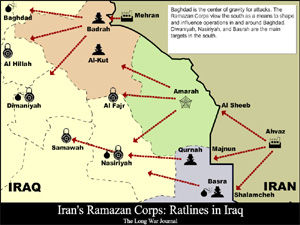
Flash Presentation on the Ramazan Corps and the Iranian Ratlines into Iraq. Click the map to view. A Flash Player is required to view, click to download. Presentation by Nick Grace and Bill Roggio, December 2007. |
Both the Iraqi government and the US military have said Iran has backed various Shia terror groups inside Iraq, including elements of the Mahdi Army. While the Iranian government has denied the charges, Iraqi and US forces have detained dozens of Iranian Qods Force officers and operatives, captured numerous Shia terrorist leaders under Iranian command, and found ample documentation as well as Iranian-made and Iranian-supplied weapons.
Since late 2006, US and Iraqi forces have captured and killed several high-level Qods Force officers inside Iraq. Among those captured are Mahmud Farhadi, one of the three Iranian regional commanders in the Ramazan Corps; Ali Mussa Daqduq, a senior Lebanese Hezbollah operative; Qais Qazali, the leader of the Qazali Network, which is better known as the Asaib al Haq or the League of the Righteous. Azhar al Dulaimi, one of Qazali’s senior tactical commanders, was killed in Iraq in early 2007.
Since mid-October 2008, Iraqi and US forces have killed one Qods Force operative and captured 17 during raids throughout southern and central Iraq.
Qods Force, the special operations branch of the Islamic Revolutionary Guards Corps, has supported various Shia militias and terror groups inside Iraq, including the Mahdi Army. Qods Force helped to build the Mahdi Army along the same lines as Lebanese Hezbollah. Iran denies the charges, but captive Shia terrorists admit to having been recruited by Iranian agents and then transported into Iran for training.
Immediately after the fall of Saddam Hussein’s regime, Iran established the Ramazan Corps to direct operations inside Iraq. The US military says that Iran and Lebanese Hezbollah have helped establish, fund, train, arm, and provide operational support for Shia terror groups such as the Hezbollah Brigades and the League of the Righteous. The US military refers to these groups along with the Iranian-backed elements of the Mahdi Army as the “Special Groups.” These groups train in camps inside Iran.
US military officers believe that Iran has been ramping up its operations inside Iraq since its surrogates suffered a major defeat at the hands of the Iraqi military during the spring and summer of 2008. Iraqi troops went on the offensive against the Mahdi Army and other Iranian-backed terror groups in Baghdad, Basrah, and central and southern Iraq.
More than 2,000 Mahdi Army members were killed and thousands more were wounded. The operation forced Muqtada al Sadr to agree to a cease-fire, disband the Mahdi Army, and pull the Sadrist political party out of the provincial elections. Sadr’s moves caused shock waves in the Mahdi Army, as some of the militia’s leaders wished to continue the fight against US forces in Baghdad and in southern and central Iraq.
Iranian-backed Shia terror groups in Iraq
The League of the Righteous is a splinter group that broke away from Muqtada al Sadr’s Mahdi Army after Sadr announced he would disband the Mahdi Army and formed a small, secretive military arm to fight Coalition forces in June. The new group, called the Brigade of the Promised Day, has not been linked to any attacks since its formation last summer.
Sadr loyalist Qais Qazali was commander of the League of the Righteous up until his capture in 2007. The group is now said to be under the command of Akram al Kabi, a former Sadr loyalist.
The League of the Righteous receives funding, training, weapons, and direction from the Qods Force. The League of the Righteous conducts attacks with the deadly armor-piercing explosively formed projectiles known as EFPs, as well as with the more conventional roadside bombs.
The size of the League of the Righteous is unknown, but hundreds of members of the group were killed, captured, or fled to Iran during the Iraqi government offensive against the Mahdi Army from March to July of 2008, according to the US military.
Sadr is looking to pull the rank and file of the League back into the fold of the Sadr political movement. Earlier this year Sadr issued a message rejecting the US-Iraqi security agreement and said he “extends his hand to the mujahideen in the so-called Asaib but not their leaderships who have been distracted by politics and mortal life from the [two late] Sadrs and the interests of Iraq and Iraqis.”
The Hezbollah Brigades, or Kata’ib Hezbollah, has been active in and around Baghdad for more than a year. The terror group has increased its profile by conducting attacks against US and Iraqi forces, using the deadly explosively-formed penetrator land mines and improvised rocket-assisted mortars, which have been described as flying improvised explosive devices. The Hezbollah Brigades has posted videos of these attacks on the Internet.
The terror group is an offshoot of the Iranian-trained Special Groups, the US military said last summer. Hezbollah Brigades receives funding, training, logistics, guidance, and material support from the Qods Force.
The US and Iraqi military believe the Special Groups are preparing to re-initiate fighting as their leaders and operatives are beginning to filter back into Iraq from Iran. On Feb. 4, Lieutenant General Lloyd Austin, the deputy commander of Multinational Forces Iraq, said that Iran continues to arm, fund, and train the Special Groups, and that munitions traced back to Iran continue to be uncovered in Iraq. Recent intelligence and the finds of new Iranian caches “lead us to believe that Iranian support activity is still ongoing,” Austin warned.
In July 2009, General David Petraeus, the commanding officer of US Central Command, said Iran continued to back the Special Groups during an interview at the World Affairs Council’s Global Leadership Series in Seattle.
“There is no question that Iran continues to fund, train, equip, and direct to varying degrees some of the groups still active in Iraq,” Petraeus said.

22 Comments
“There is no question that Iran continues to fund, train, equip, and direct to varying degrees some of the groups still active in Iraq,” Petraeus said.
Long past time we start using the Geneva Conventions for War — all of them. Summary execution for foreign spies and saboteurs. Otherwise we will lose the Peace that Gen. Petraeus and his team so valiantly crafted.
“Ten percent of US deaths in Iraq are estimated to have been caused by the Iranian-supplied, armor-piercing explosively-formed projectiles, or EFPs.”
That is 10% , what and who caused the 90% of American deaths in Iraq , Bill?
How come kurds allowed those Quds brigade members to enter the areas they control? Kurds are supposed to be one of the U.S. biggest allies in Iraq , could it be that the U.S. made a mistake and that those people were actually what they said they are?
Camellia,
Those people could have been both what we said they were AND what they said they were. After all, weapons trade representatives are still trade representatives. And weapons are among Irans biggest trade categories.
I am still very curious just what Maliki got from Iran in return for these guys. He surely didn’t do it for nothing – it would be humiliating for an Arab to get suckered in a deal with a non-Arab, Shia or otherwise.
This isnt news. This is fact. I already new this.
Camillia,
There’s a reason that this “diplomatic”
The Thunder Run has linked to this post in the blog post From the Front: 07/27/2009 News and Personal dispatches from the front and the home front.
You have to go further back than 2007. Sometime in 95 or 96 then President Clinton stopped funding to the Kurds. They had been arguing which led to an open civil war. The Patriotic Union of Kurdistan(PUK), which was headed by Jalal Talibani, turned towards Iran for funding and help. Masood Barzani, the leader of the Kurdish Democratic Party(KDP,) turned to Saddam for help. We placed them in that position. So it’s no surprise when the present Iraqi government was established that someone(Talibani) other than a Shi’ite with Iranian ties is appointed to a high position. Suleimania, Talibani’s hometown and center of power, is heavily influenced by the Iranians either through IRGC or MOIS.
Yeah, just release them. They all have American blood on thier hands. I agree %100 with PhilMB. Now, they can kill more Americans. Unbelievable. Wat, if anything, did we get in return?
Again I have to point out. It sucks. It really does. But as we steadily exit the country there really weren’t many options for what to do with these guys. We’re going to be transferring custody of 99.95% of our prisoners to Iraqi custody if not more by 2012.
What Iraq does with those prisoners after they’ve got them is largely their business. These snakes were captured on sovereign Iraqi territory.
And while I’m not making a direct comparison between the two cases, Dave Petraeus won over Iraq’s Sunnis in large part by reconciling and releasing many thousands of Sunni and Baathist insurgents. Including those we are certain have killed many Americans. I don’t think these Qods force killers are about to sing Kumbaya, I’m just saying I don’t know what else is at play.
A lot of counter-intuitive stuff has had to happen for this relative calm and stability to be made reality. I remember not so long ago being furious at the thought that we were allying ourselves with 1920 Revolution and Hamas of Iraq during the fight in Diyala. I once considered the whole idea of the Sons of Iraq to be tantamount to subsidizing IEDs. Paying Sunnis $600 a month to not plant bombs.
So no longer am I so quick to judge the right and wrong courses of action.
The former U.S. ambassador to Iraq says he does not know of any evidence linking three Iranian Quds Force officers to specific acts against U.S. forces even though the three were jailed by U.S. authorities for more than two years.
…Ryan Crocker, U.S. ambassador to Iraq from March 2007 to February 2009, told The Washington Times, “I was not aware of any specific information linking [the three Iranians] to specific acts against coalition personnel.”
Washington Times, July 22.
Do some more digging folks, and then realize Iran is not some crackpot country any more. They don’t have friends, they have similar objectives with groups/people. In this case, they support the Kurds because they have been a thorn in Iraq’s side for decades (the enemy of my enemy is my friend). Its the same reason Iran has supported (sunni) AQ since 2001 (they are a thorn in the US’ side). Iran is smart enough to not let little things like ideology get in the way of progressing their nation’s foreign policy and interests. In this case it’s the ‘reverse big-score’ for them though. They don’t have to win outright … as long as the US doesn’t win, they win.
“The former U.S. ambassador to Iraq says he does not know of any evidence linking three Iranian Quds Force officers to specific acts against U.S. forces even though the three were jailed by U.S. authorities for more than two years.”
Which three Qods Force officers were those? My money is on the three remaining members of the Irbil Five.
Farhadi is a different animal.
And, by the way, a “specific act” means just that: a particular bombing or attack incident. This doesn’t mean the three QF officers weren’t involved in operations at a higher level.
“…Ryan Crocker, U.S. ambassador to Iraq from March 2007 to February 2009, told The Washington Times, “I was not aware of any specific information linking [the three Iranians] to specific acts against coalition personnel.”
Keep in mind that we don’t routinely burn intelligence sources and methods in open-press. Maybe it had been determined that releasing them was the lesser of two evils.
and Tyler, really good post. Dead on.
Its because they did not read him his rights?
E said: “as long as the US doesn’t win, they (Iran) win.”
The only thing the Iranian’s will respect is force. Shoot them on sight. I was in Viet nam. I understand the risks but isn’t that what they do to our soldiers? They are just LOL at us.
We should have “Lost ” these guys in the system some how. oops…
When do we start playing to win?
It’s hard to believe that we’re as dumb as everyone is suggesting. Possible, but not likely in my view. Interesting that bin Laden’s son, who was just recently in Iran, was killed right before these guys were set free. Probably an even trade. Hopefully we have a couple of draft picks to be named later.
Neo,
First off, we lost Iraq to Iran in April of 2003 when we toppled the Baath regime, we just didn’t realize or understand the second and third-order effects at that time. Iran had to have been tickled pink that they didn’t even have to fire a shot in the process. I mean, this was such a stunning opportunity for them … their principle rival is gone, his political party is crushed … what more could they have asked for. Oh wait, we then paid no attention to ANYTHING Shia-related until almost 2007. And it’s not like Iran was starting from scratch in establishing their influence in southern Iraq. There was already an established resistance/underground/support infrastructure that had been in place for decades to oppose Hussein. We just removed every remaining obstacle in their way.
But I digress … you speak as if there is a real multi-party political system (i.e. Sunni, Shia, Kurd) in Iraq right now…there isn’t . Despite everything you might see in the press, the real power struggle (if you want to call it that) is within the Shia groups (Dawa, Sadrist, etc). The Sunnis and Kurds will not dominate Iraqi politics at least as long as I’m alive (i’m 34). It’s all going to come down to which Shia mutt you want to deal with. And since almost every one of the Shia political and militant groups is funded/supplied by Iran (not to mention various Sunni and Kurd groups), they win. Again, this was the same playbook as was used in Lebanon…it’s not new. Similarly, for any Shia politician that might want to cozy up to the West, or simply gets sick of Iran, he would simply be killed and replaced. I mean, this has pretty much gone on since 2003 at the local level with cops, mayors, judges; although it has expanded in the last year or so to more senior officials. Again, seen in Lebanon, not new.
And don’t get me wrong, I agree with some of your bigger picture goals…I just think some of them have already been met. I also think the Sunni ‘superpowers’ haven’t figured out yet that the balance of power in Islam has shifted from the Sunnis to the Shia, or at least they’re not willing to admit it yet. Again, Iran’s already won that battle (in 2000 & reiterated in 2006) … it’s just going to take some time for everyone to get onboard with the idea that the center of power in Islam is now in Qom, not Mecca.
Stimulating,
E
Sorry E,
NOT so Stimulating.
First off; I don’t talk of Arabs, Sunni’s, Kurds, and Shia as if they were political parties. They are ethnic and religious groups within Iraq. Rather prominent ones at that. I speak of these ethnic and religious groups as they form a multiplicity of political blocks. Yes, the Shia are the most numerous religious group and dominate Iraqi politics. For your information, none of these groups form monolithic political blocks. The Shia are in fact as politically divided as any other group within Iraq.
“First off, we lost Iraq to Iran in April of 2003 when we toppled the Baath regime, we just didn’t realize or understand the second and third-order effects at that time. Iran had to have been tickled pink that they didn’t even have to fire a shot in the process.”
Alrighty then…
— When it comes to politics, they are broken down like that. That’s the way we (CPA) helped set up the top (three) positions. It really is that simple (here’s the like to the Wiki page: http://en.wikipedia.org/wiki/Politics_of_Iraq). So, with Talabani (Pres…Kurd) being firmly in Iran’s camp, Hashimi (VP…Sunni) completely marginalized because his post is mainly ceremonial (I find it humorous he’s not even listed on the main Iraq page on Wikipedia), that leaves Maliki (who as PM controls both the MOI and MOD); which now makes any vote at the Presidency Council a 2 to 1 vote every time. Additionally, the next legislative body (Council of Representatives) is dominated by the Shia sect (40/20/15% split between the top three) So, to me it’s clear that Iraqi politics are dominated by pro-Iranian guys. And when Iran maintains various levels of support and influence into every one of them, I’m of the opinion they’ve won. Everything now is just the various groups jockeying for their little fiefdoms of power inside Iraq.
— You have your opinion, I have mine. Couple of things though … 1) I do think there is a tremendous amount of Iraqi Shia nationalism, I’ve seen it personally downrange. We have just failed to exploit it well enough. Iran learned their lessons early on, and are much more careful to conceal their activities (i.e putting an Iraqi face on things) now. That’s why they are so successful at it. 2) Iraqi shia (for the most part) follow Karbala, not Qom, but even Sistani can’t stray too far off course or he risks getting replaced. It’s been done before. 3) I don’t ignore political developments since Apr 03. I give full consideration to them, and am of the opinion that they only exasperated the situation (i.e. the elections of 2005 that led to Sunni/Shia civil war of 05/06.)
— and I havent’ disregarded the thousands of articles that are out there. I try and read as many as I can (as well as others) before I form my opinion on something.
At the end of the day, Iraq’s Shia population knows that despite everything, eventually we’ll be gone and they’ll still have to deal with their next door neighbor. A lot of Iran’s influence comes from sheer pragmatism.
You’re right and wrong E.
The Iranians have way too much influence inside Iraq, but while you see the strength of Iran which Neo doesn’t fully see you’re not aware of the full diversity and strengths either.
It’s an up and coming battle.
Either way I’m sure the Iran theocracy will never have proper victory, for one simple truth:
They act like jerks, and they’re not Arabs (but traditional invaders)/Iraqis… in that order.
If they would be actually nice to the Iraqis they’d win this, but they aren’t so they lose.