|
|
|
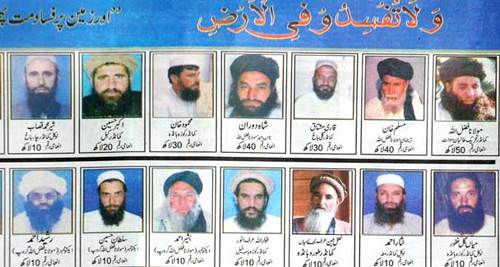
Wanted flyer for Swat Taliban leaders. Fazlullah is the last Taliban commander in the first row. |
As the Pakistani government and military rush to declare victory against the Taliban in the war-torn district of Swat, Mullah Fazlullah has broadcast on the airwaves for the first time in months.
Fazlullah has not been heard on the radio for months after the military launched a major operation to clear the Taliban from Swat and the neighboring districts of Dir and Buner at the end of April.
Fazlullah’s broadcasts were infamous for the anti-government screeds and the radical interpretations of Islam. He was nicknamed “Mullah FM” and “Radio Mullah” for pioneering the use of illegal radio broadcasts to promote his radical agenda.
Residents of Swat would be glued to the radio as Fazlullah would issue lists of government and security officials, as well as tribal leaders, who were to be executed for opposing the Taliban. Fazlullah would also campaign against polio vaccination drives, insisting the shots were a Jewish plot to sterilize Muslims, and railed against young girls attending school. More than 200 schools have been torched by the Taliban in Swat since 2007.
Residents in Mingora said Fazlullah’s recent speech was subdued and lacking in invective against the military. “You can feel as if the operation has taken the sting out of him,” one resident told Daily Times.
Fazlullah’s re-emergence on the airwaves crushed the claim of the Pakistani government and the military that he had been gravely wounded during fighting in his home town. Fazlullah has been reported to have been killed, wounded, and surrounded multiple times since the operation began.
Last week, Swat Taliban spokesman Mullah Omar said Fazlullah was alive, along with all of the group’s senior leadership.
“Fazlullah is safe and the government claim is totally baseless,” Omar told Pakistani journalists. He also said the Taliban leadership had gone underground “as part of their overall strategy” once the Army launched operations in Buner, Dir, and Swat, Daily Times reported.
Both the government and the military have claimed that Swat is now over 90 percent cleared of the Taliban and have called an end to major military operations. The government is urging internally displaced people who fled the violence to return to their homes in Swat and neighboring Buner.
The military is also planning to build bases in Swat and Buner, and plans on remaining in the region for two years.
But reports from the region paint a less-than-positive picture of the security situation in Swat and Buner. The government is being accused of pushing the internally displaced people out of camps by providing poor services, and sending them back to regions where the fighting is still ongoing, according to Newsweek.
The Taliban are still able to control ground in Buner, where the military also claimed the Taliban had been defeated more than a month ago. According to local residents in Buner, the Taliban are active in many of the major towns, and have been seen setting up a checkpoint where they are seen “singling out government officials and their opponents,” according to The News.
A group called the Aman Tehrik, or Peace Movement, was highly critical of the military operation in Swat, Dir, and Buner. The group said the military operation was “nominal” and failed to kill or capture “third rank” Taliban leaders.
The Aman Tehrik “said terrorist leaders were still safe and their sanctuaries were intact in Swat and Buner,” according to Dawn.
The Amam Tehrik opposes the establishment of military bases in Swat and Buner, and said the building of these bases would inflame the situation.
Background on the Malakand Accord and fighting in Swat
The fighting in Swat, Dir, Buner, and Shangla broke out after a peace agreement with the Taliban failed. The agreement, known as the Malakand Accord, placed the Malakand Division and the district of Kohistan under the control of the Taliban. The Malakand Division is comprised of the districts of Malakand, Swat, Shangla, Buner, Dir, and Chitral. The Malakand Division and the neighboring Kohistan district together encompass nearly one-third of the Northwest Frontier Province.
The government signed the Malakand Accord with Taliban front man Sufi Mohammed, Fazlullah’s father-in-law, on February 16 after two years of fighting that put the Taliban in control of the district. During those two years, the military was defeated three separate times while attempting to wrest control from the Taliban. Each defeat put the Taliban in greater control of the district.
The peace agreement called for the end of military operations in Swat, the end of Taliban operations, and the imposition of sharia, or Islamic law, in the Malakand Division.
But the Taliban violated the agreement immediately after signing it, and proceeded to attack security forces and conduct armed patrols. The military remained silent while the government approved the Taliban’s demand for sharia throughout Malakand.
The government ordered a military offensive in Dir and Buner after enormous pressure from the US and other Western governments to stem the Taliban tide pushing toward central Pakistan. The Taliban advanced from Swat into Buner in early April and took over the district in eight days. The move into Buner has put the Taliban within 60 miles of Islamabad and close to several nuclear facilities and the vital Tarbela Dam. The Taliban also have moved into Mansehra and established bases and a training camp in the region.
Pakistani government and military officials have dismissed the Taliban threat to Islamabad and the country’s nuclear facilities, but at the end of April, the local Islamabad government ordered troops to deploy in the Margala hills just north of the city to block a Taliban advance, while the Haripur government beefed up security at the Tarbela Dam.