|
|
|
Lashkar-e-Taiba leader Hafiz Saeed. |
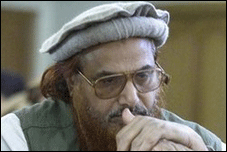
A three-judge panel of the Lahore High Court has ordered the release of Lashkar-e-Taiba / Jamaat-ud-Dawa leader Hafiz Saeed.
Saeed was placed under a loose house arrest in mid-December 2008 after the United Nations Security Council declared the Jamaat-ud-Dawa a terrorist entity and front group for the Lashkar-e-Taiba just weeks after the deadly terror assault on Mumbai in late November that killed more than 170 people and locked down the city for more than 60 hours. Saeed and Zaki-ur-Rehman Lakhvi, Haji Mohammad Ashraf, and Mahmoud Mohammad Ahmed were identified as Lashkar-e-Taiba leaders.
Today Saeed was ordered released by the Lahore court, despite the government’s presentation of evidence that linked him to al Qaeda. The evidence was presented in a closed session, as the information was deemed a national security secret.
The court did not give a reason for Saeed’s release. His lawyer claimed, however, that the detention had been unconstitutional and that the release was a victory for Pakistan’s legal system.
“The arrest violated the constitution, therefore Hafiz Saeed and his colleagues are being released,” A.K. Dogar, Saeed’s lawyer said, according to Dawn. “Today’s verdict shows that sovereignty lies in Almighty Allah,” Dogar proclaimed as a crowd of supporters chanted “Allahu akbar,” or “God is greater,” outside the courthouse.
Yahya Mujahid, a spokesman for the Jamaat-ud-Dawa, celebrated Saeed’s release. “The order shows that courts in the country are free now and people are getting justice despite pressure,” Mujahid told AFP. “We hope the authorities will now withdraw police guards deputed outside his residence which had been declared a sub-jail.”
US intelligence officials are dismayed at Saeed’s release and say the move shows that Pakistan has a long way to go to defeat terror groups operating on its soil.
“Forget what you are seeing in Swat,” an intelligence official closely watching Pakistan told The Long War Journal. “More than six months after Mumbai, there has yet to be a single conviction or even a trial of anyone involved in the attack. Pakistan does not have the capacity to try and convict known terrorists.”
“Saeed is untouchable, and don’t think the courts and the police don’t know this,” another official said, warning that the continuous policy of releasing of leaders like Saeed, Red Mosque leader Maulana Abdullah Aziz, and others is sending a terrible message to those on the front lines against the terror groups.
“As long as he and others like him are free, Pakistan will remain a terror state,” the official said. “Until Pakistan shows it is serious about taking down the leadership of the Taliban, Lashkar-e-Taiba, Jaish-e-Mohammed, these groups will regenerate and prosper. And law enforcement in Pakistan will shy away from taking them on.”
Saeed and Lashkar-e-Taiba have extensive links with al Qaeda and Pakistan’s military intelligence service
Hafiz Saeed is the founder and leader of the al Qaeda-linked Laskhar-e-Taiba, or Army of the Righteous. India has implicated Lashkar-e-Taiba and Saeed as being behind the Mumbai terror attack. Saeed and the Laskhar-e-Taiba have strong links with elements within Pakistan’s military and the Inter-Service Intelligence agency, or ISI.
Osama bin Laden and his mentor Abdullah Azzam encouraged Saeed to form Lashkar-e-Taiba in the late 1980s, and helped fund the establishment of the terror outfit. Lashkar-e-Taiba, like al Qaeda, practices the Wahabi strain of Islam, and receives funding from Saudis and other wealthy individuals throughout the Middle East. Lashkar-e-Taiba is an ally of al Qaeda; the two groups provide support for each other, and their operatives train in each other’s camps. Lashkar-e-Taiba has established training camps in Pakistan’s Northwest Frontier Province and the tribal areas.
Lashkar-e-Taiba has an extensive network in Southern and Southeast Asia, where it seeks to establish a Muslim caliphate. The group essentially runs a state within a state in Pakistan; the group has established an organization that is as effective as Lebanese Hezbollah. Its sprawling Murdike complex, just northwest of Lahore in Punjab province, is a town of its own. Lashkar-e-Taiba runs numerous hospitals, clinics, schools, mosques, and other services throughout Pakistan and Pakistan-occupied Kashmir. In support of its activities, Lashkar is active in fundraising across the Middle East and South Asia, and the group has recruited scores of Westerners to train in its camps.
The group succeeded in providing aid to earthquake-ravaged regions in Kashmir in 2005 while the Pakistani government was slow to act. Most recently, Lashkar-e-Taiba provided relief to tens of thousands of internally displaced persons who have fled the fighting between the military and the Taliban in the Malakand Division.
Jamaat-ud-Dawa has long been known to be a front for the Lashkar-e-Taiba. Saeed renamed the Lashkar-e-Taiba as “Jamaat-ud-Dawa” in 2002 after Lashkar was banned by the Pakistani government. Pakistan has never acted against the Jamaat-ud-Dawa.
In reality, Saeed and his leaders rebranded the group as a Muslim charity to mask the operations of Lashkar-e-Taiba. Saeed has been arrested several times by Pakistani security forces after attacks in India, but each time has been quietly released. After Mumbai, Pakistan claimed to shut down Lashkar-e-Taiba / Jamaat-ud-Dawa offices and camps, and detained followers, but the efforts were largely cosmetic.
The Lashkar-e-Taiba is one of the primary terror groups used by Pakistan to direct military and terror operations inside India and India-held Kashmir. During the 1999 Kargil War, when Pakistan invaded Indian-held Kashmir, the Lashkar-e-Taiba fought as the vanguard for Pakistani forces in the mountainous region. To this day, Lashkar-e-Taiba military and terror units continue to infiltrate into Kashmir, with the help of Pakistan’s military.
In March, Lashkar-e-Taiba took credit for the fighting in Kupwara, and warned India of new attacks. “The gun battles should serve as a message to India that the struggle for Kashmir’s freedom is on with full vigour,” spokesman Abdullah Ghaznavi said in late March. Twenty-five Lashkar fighters and seven Indian soldiers were killed in the fighting.
India’s Army chief said Lashkar-e-Taiba still operates 40 to 50 camps in Kashmir and Pakistan.