
|
|
|
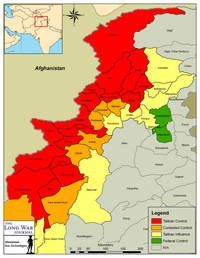
Click map for full view. Taliban presence, by district and tribal agency, in the Northwest Frontier Province, Punjab, and the Federally Administered Tribal Agencies. Information on Taliban presence obtained from open source and derived by The Long War Journal based on the presence of Taliban shadow governments, levels of fighting, and reports from the region. Map created by Bill Raymond for The Long War Journal. Last updated: April 24, 2009. |
The Taliban overran a local headquarters and captured 10 troops of the Dir Levies, a paramilitary police force, as fighting continues in the district the government claimed was secured four days ago. The military also claimed the Taliban suffered heavy casualties in Buner as al Qaeda encourage Pakistanis to rebel.
A company of 60 Taliban fighters attacked a Levies outpost in the town of Dir in the district of the same name, Dawn reported. The Levies are a paramilitary police force. A Subedar, one of the senior most ranks in the Levies, was among those captured during the assault. The Taliban released the Levies personnel just 13 hours after their capture.
The fighting in Dir continues despite claims from senior government and military officials that Dir was secured days ago. The military claimed seven Taliban fighters were killed during clashes in the Darmal region. A curfew has been imposed in the Madain region, a Taliban stronghold, Geo News reported. The military is shelling Taliban targets in Madain as well as in the Chakdara, another Taliban stronghold.
Fighting continues in Buner as peace talks are underway
The Pakistani military is battling for the fourth day in an effort to dislodge the Taliban in the district of Buner. The military continues to fight to take control of the strategic passes that lead into the district. The military claimed it secured the Ambala heights yesterday, but fighting is said to be raging for control of the ridge.
The military claimed another 55 to 60 Taliban fighters were killed during fighting in Buner over the past 24 hours. Previously, the military said an estimated 50 Taliban fighters were in Buner, and another 82 Taliban fighters were killed in Dir, putting the total Taliban reported killed at more than 190.
Between 500 and 1,000 Taliban and al Qaeda fighters, led by Ibn Amin, are thought to be operating in Buner. No estimate is available for Taliban forces in Dir.
Despite the Taliban resistance in Buner and Dir, the government is eager to restore the peace agreement, known as the Malakand Accord. The peace agreement called for the end of military operations in Swat and the imposition of sharia, or Islamic law, in the districts of Malakand, Swat, Shangla, Buner, Dir, Chitral, and Kohistan, a region that encompasses nearly one-third of the Northwest Frontier Province.
The government is in active talks with Sufi Mohammed, the leader of the banned pro-Taliban Tehrik-e-Nifaz-e-Shariat-e-Mohammed [TNSM or the Movement for the Enforcement of Mohammed’s Law]. Sufi is supposed to be the intermediary in negotiations but has openly sided with the Taliban, led by his son-in-law Mullah Fazlullah.
Sufi is demanding that the military end operations in Dir and Buner, and insists on personally approving the judges for the Islamic courts.
The TNSM has admitted in the past it can control the violence in Pakistan’s northwest, and again confirmed this. “The fighting will end automatically [after the enforcement of sharia],” said Izzat Khan, a spokesman for Sufi. “We are ready for talks with the government on the appointment of judges and a ceasefire in the region.”
Al Qaeda leader calls for uprising
As the fighting continues in the northwest, a senior al Qaeda leader has called for Pakistanis to fight the Pakistani Army and the government.
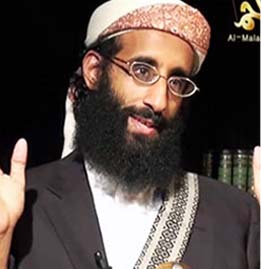
“Muslims in Pakistan, and especially their clerics, should prepare themselves and rise up to perform the duty … of fighting the Pakistani army and the rest of the apparatus that are the pillars of their tyrannical state,” said Abu Yahya al Libi, a senior al Qaeda spokesman and ideologue, in a 29-page document released on the Internet.
Al Libi described the Pakistani government and military as tools of the West.
“The criminals in the Pakistani government and its army have not only been a cover for the occupying crusader infidels in Afghanistan, they have directly helped them in committing all their crimes in Afghanistan and elsewhere,” Al Libi said, according to excerpts provided by Reuters.
Al Libi was the first al Qaeda leader to urge the Pakistani people and the Army to turn against then-President Pervez Musharraf’s regime after the military stormed the radical Red Mosque in the heart of Islamabad. Zawahiri and bin Laden have repeated this call to rebellion several times since then.
The US put a $5 million bounty out for al Libi at the end of March 2009. Al Libi was a military commander in Afghanistan until his capture by the US military during 2003. He rose to prominence in al Qaeda after he escaped from Bagram Prison in Afghanistan in the summer of 2005, along with senior al Qaeda operatives Abu Nasir al Qahtani, Abu Abdallah al Shami, and Omar Farouq. Al Libi is the only member of the notorious “Bagram Four” active in al Qaeda; the others have been killed or captured.
For more information on Buner and operations in the region, see:
• Pakistan, Taliban battle for control of Buner
April 30, 2009
• Taliban still in control in Dir
April 30, 2009
April 29, 2009
• Taliban capture 70 security personnel in Buner
April 29, 2009
• Pakistan launches operation against the Taliban in Buner
April 28, 2009
• Pakistan touts success of Dir operation
April 27, 2009
• Rangers deployed to secure Islamabad outskirts
April 24, 2009
• Taliban advance eastward, threaten Islamabad
April 23, 2009
• Taliban flex muscles in Malakand Division
April 22, 2009
April 17, 2009
• Taliban move on Buner despite promise to withdraw
April 10, 2009
April 7, 2009

20 Comments
Hmmm… 500 to 1,000 Taliban fighters in Buner.
60 killed in an encounter. Should be about 17 days of that and all the Taliban fighters will all be killed off.
So easy a caveman could do it.
Has the Kyber Pass reopened? If not, how is NATO getting supplies. The dearth of news is awfully distrubing. Your about it Mr. Roggio.
Things are going well, in region, this all we want to not obey the orders of out order people, as talibans are un-educated, unhealthy, completely freaking people.
We as a citizen of Pakistan would not allow any third party rule our country.
We have already islamic-Constitution which is known as constitution of 1973, so we dont need to create another constitution under-pressure of taliban.
It is impossible that talibans would get support of of citizen of pakistan.
Because we dont need to get any dictation from anyone according to our way of life and religion practise.
I dont know what is interest of U.S in afghanistan but we really needed to see this kind of operation against jolter-headed people, in pakistan, they were challenging the rit of government, and we will not allow anyone to do so.
If people really need to see islamic trend in pakistan they must go and read Constitution of pakistan 1973, they will get to know that they are already having Nizam-e-adal 🙂 the need is to just practise it, rather then worrying about American And american ideology about taliban.
We are muslims and we proud at our religion our prophet PBUH and our The Islamic-republic-of-Pakistan.
BBC reports Pakistan is redeploying troops from Dir to Buner after the victory there.
Local reports including from BBC says the Taliban remain in control all over the place except for a few pockets the government cleared. With the government forces leaving, how long will it be before the Taliban retake all of Dir?
Please note Bill’s article: Taliban overran a large police post in the town of Dir, which is likely the largest in the district. Some government victory.
Further, local reports say the Taliban is advancing into parts of Dir it has so far left alone.
This whole Pakistan “offensive” is – for the gazzillionth time – a bad joke. why cannot the US Government understand the Pakistan Government CANNOT stop the Taliban, particularly because what the Taliban is doing is staging a revolution – see their tactics in Swat where they used local peasants against the major landlords. This stuff no longer is limited to religion
People need to know land is inequitably distributed all over Pakistan. Taliban are already in Punjab, Pakistan’s heartland. If this peasants revolt thing spreads into the Punjab, we can all say goodbye to Pakistan and sit home and suck our thumbs. Pakistan is a country of 175-million people, most poor. How on earth can an army of 675,000 and police and paramilitary forces of well less than 300,000 stop a peasant’s revolt?
And do they WANT to stop it in the firsrt place? After all the rank and file is recruited from the same peasantry.
I sincerely hope I am wrong and the Pakistanis will pull a hundred rabbits from the magicians hat.
But everything I am told from Pakistan and India indicates the Taliban are on the march – and increasingly Pakistanis are resigned to their taking over.
France 1940 collapsed not because the Germans were stronger than the French: the French had the most powerful army in the world and more tanks. But they were divided and dispirited. Most of France did not fight the Germans. They simply gave up.
Ravi i think one should tell authentic story rather then expressing your perceptions,
You are making your wishes dishes, but it is not true all is getting ok and under-control.
Talibans are nothing just local illiterates people, and they are not strong enough, the thing we mostly get worried that they use human shield that get us to get worry, else talibans can not threat Pak-Army through their, rocket launchers :P.
These illiterates you can find every where in this world, just look into india, it is completely distributed in sects, hindus, muslims, sikhs, so on.
so like that we are also having extremists here and we are capable to face them.
So you need to suck lollypop instead thumbs
Jerjes,
Nice points. We must make sure Taliban is not just another Mossad wing trying to destabilize Pakistan.
/sarcasm
It makes you wonder,
1. What was an outpost doing in a hot zone without armor or artillery support
2. Why was the outpost manned with a scant enough force to be captured
3. Why were reinforcement not able to be called in
Things like this don’t exactly inspire my confidence in the Pakistani government’s level of seriousness.
The capture of the post is without using heavy weapons, sadly pak does not have good communications and close air support. F16s are not good for close air support and helicopter take too long to arrive. But they will release captured local police.
But taliban will eventually run out of heavy weaponry, and manpower count in nwfp and even punjab wont matter then. But US should help upgrade pak close air support, which will reduce casualties and scare away enemy.
Can anyone tell me – Who is arming the Taliban? Where do they get their weapons from? And funding – is there more to this than the Afghan opium?
Jerjes – You are right and Ravi Rikhye is wrong. This is all a CIA/Mossad/RAW conspiracy and Pak army and FC is winning. Now, you can go back to your peaceful sleep and dream about strategic depth.
Talpur-
You are so wrong about your country. Taliban is in Pakistan’s DNA. Pulling that strand-out and destroying is not going to be easy. Pride in one’s country/religion and a begging bowl for international aid does not go hand-in-hand. The solution that Pakistan is looking for is going to come from human development and tolerance of others. No amount of foreign aid is going to get you there. Your thousand year war has just begun… let us see , pride aside, if Pak will sustain them over a long period before they see any results. Thought that’s what Ravi was pointing to.
As far Ravi, I respect his opinions and like to read his blog.
Ravi: Very nice to have you commenting here. (long time Orbat reader) I don’t speak for anybody but myself around here, but I’d love to see more of you in these comments sections.
=
I suspect the Pakistani Army and Intelligence groups (or factions within those two elements) could stop this, almost overnight, if they really wanted too. Therein lies the issue…
HIGHEST
HOPES,
R
Talpur,
If you are a typical Pakistani then RAW/CIA/Mossad needs more like you, in denial. If Pakistan capitulates to Taliban then the international community is likely to intervene and seize the nukes. AT this juncture Pak may break into pieces.
Now the interesting thing will be that Pak administered Kashmir will be hanging loosely since according to Pak official policy and constitution Pak admin Kashmir is not integral part of Pak. They have to return the land when Kashmir forms.
Now the pak admin Kashmir will be up for grabs once Pak disintegrates. For Indians this will be a magic moment.
I hope the Taliban marches forward into Islamabd soon so that Pakistan can get its desired fulfilled – solution to Kashmir problem.
I do not mean Indians should interfere in this business, because Taliban are no friends of India. They can just watch and enjoy the show. With Pakis in the delusion of religion India is not big enough threat.
This has got to be wakeup call for Americans as well. Recently there has been a call from conservatives for seceding Texas from the US.
Talpur wrote:
“Raven we are not begging bowl for our country….”
Yes, you are… here is why..
This whole initiative started after secretary Clinton said Pakistan is imploding, international donors pledging $5 Billion, congressional discussions on next aid package and media picking-up on it. As if this was a cue, pak army started “fighting” Taliban. What were y’all doing before that?
This is what troublesome for lot of us. Once the aid check is cleared, pak administrators will go back to their sleeping ways till the money runs out. And Taliban will grow till then. We will be back where we are. At some point of time, this model will break and that’s not good for Pakistan.
On the other hand, the political realities within the Army may make full deployment too risky, despite the West paying hand and foot for the assistance. Most of the military is Punjabi, but whatever isn’t Punjabi is Pashtun. The Pashtuns of the Frontier may not care for the Taliban, but they don’t care for the government either, due to heavy handed military tactics and civillian neglect. In a full military deployment, the Army would be even MORE indiscriminate and thousands would die. That would be enough for the Pashtuns to splinter against both the State and the Taliban into a third faction. The panic that would arise from such a situation would allow sensitive areas already removed of government writ to split off entirely.
In short, if the Pak Army fully deploys, even if it is for their own good, it will end up destroying the Pakistani federation, and its clear from the GHQ’s actions that they would rather have a Wahabi Pakistan than no Pakistan at all. For that reason, I think it would be best if the relevant powers started planning on a post-collapse Pakistan, because the Pak Army will not be able to turn this thing around in two weeks.
If you use foul language in the comments section, your comment will be deleted. If you continue to do it you will be banned. It would be nice for me to tell you this personally but when you use an invalid email address (which is also a violation of the comments policy) I can’t.
I don’t like deleting comments because it throws everything off track and creates confusion, but I won’t tolerate the foul language.
EDITED FOR BILL ROGGIO
I really feel your fear, but unfortunately you rely at the observers they make their story and trape your mind and you think oh yes he is right, but my point is more authentic and more powerful because i am living here since 30 years, so at the behalf of my 30 years experience i am telling you the exact situation.
Problem of your wrong diagnose is lack of understanding to the grass root scenario of tribal area.
Tribal people pressurizing government to revise your constitution and deal us as it is mentioned in constitution of pakistan, so it is not any new thing to worrying about, and government must fulfill their demands, because according to law this is their right they can ask for justice, and no one can stop them.
This demand is demanded by tribal elders not by talibans, what talibans need to get control at area, as talibans use to make tribal people fool, that we are here for religious reason, and that reason was Nizam-e-adal, and this is right of tribel people, and constitution own this, it mentioned in 1973 that FATA would practice their nizam-e-adal, then who we are to stop them.
After agreeing to tribel people we thought talibans will go back to afghanistan because now there is no reason for them to stay in Pakistan, but unfortunately they said we will stay here, and we will not obey government, now at this point we seprated tribels by talibans, now tribels are against taliban and they have created their lashkar to kick them out, because tribal demand is filled.
Could you even know how much talibans are in FATA ? only 500 to 700 hundred and more then 200 has killed in last two days because now it is easy for us to spot them, because tribal people are peaceful already in government of NWFP 🙂 so they really respect the writ of government , and those who don’t respect the writ of government are Talibans and they are carrying guns, and it is quit easy for us to target them you will see within one week condition will get more better then before.
This was the story of Pakistan, now Talibans has no reason to stay in Pakistan , now where they will go ? obviously to their country Afghanistan for launching operation against NATO, we have cleared our part of country now , lets see how NATO is going to clear 75% population of Taliban’s in Afghanistan.
It appears at times that the poster is correct, I would say that the Taliban have a form of justice that will bring the country out of financial disaster, that is the enemy of the US. I don’t know that that will happen but if it does I hope that the justice that the Taliban uses is done wisely, justly and with care for diversity. I am just shocked that one would assume that the Taliban could be killed off in 17 days, nor do I believe that anyone really has been given an accurate discription of the Talib.
I would expect to see a shift in character and form soon enough. All of my love out to everyone, I have been busy and unavailable. I broke my wrist awhile ago and everything has just started catching up too me. Love you Richard, miss you.
Hope Bill is okay?
Midnight,
Sure Taliban has a sense of justice even if it is twisted to their own benefit. However the imposition of their version of morality severely undercuts business which means the economy will suffer as many activities are banned(watching movies, listening to movies, shaving beards). If people can not do such a simple thing as shaving beard you can expect that the unemployment will shoot up.
A functioning economy requires some relaxation in Islamic (and tribal) moral code.
From US and Indian(and international community) point of view however Taliban need not be opposed so vigorously. All they need to do is secure the nukes.
If Pakistan disintegrates then they have a smaller country to deal with who influence will have diminished. Baloch and Sindh people are more liberal and not such a big threat as Punjabis and Pasthuns.
Sorry “listening to music” not “listening to movies” in the previous post