
|
|
|
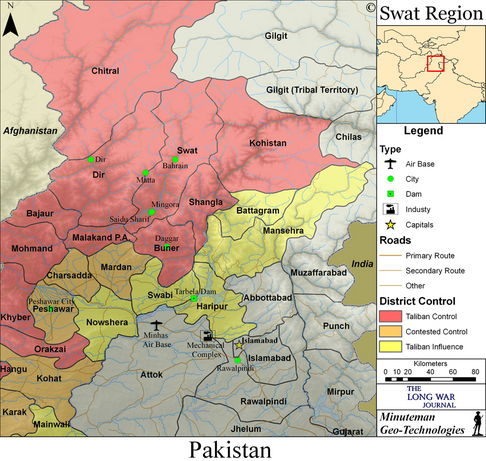
Click map for full view. Taliban presence, by district, in the Malakand Division region in Pakistan . Information on Taliban presence obtained from open source reporting and sources, and derived by The Long War Journal based on the presence of Taliban shadow governments, levels of fighting, and statements from ISAF commanders. Map created by Bill Raymond for The Long War Journal. |
The Pakistani government is preparing to launch a military offensive in Swat as security forces suffered heavy casualties during the past two days of fighting.
The military is being dispatched to “eliminate” the Taliban after the Taliban violated the peace agreement, Prime Minister Yousaf Raza Gilani said during an address on Pakistani television.
The government has “decided not to bow [their] heads in front of terrorists The army has been called in to eliminate the militants,” Dawn reported.
The government “implemented the Swat peace accord because of the people [and] implemented the Nizam-e-Adl [Islamic law regulation] despite both domestic and international pressure,” Gilani said. But the pro-Taliban group that negotiated with the government “did not abide by the peace agreement and continued with violence. The militants have waged war against all segments of society.”
It is unclear if the government will announce the end of the Malakand Accord. The Taliban declared the agreement dead days ago.
Fighting in Swat has been heavy over the past two days. The military claimed 55 Taliban fighters and six civilians were killed today as Pakistani Air Force fighters and Army helicopters pounded Taliban positions. The military claimed it killed Taliban commander Ibn Aaqil, who is the brother of Ibn Amin, the leader of a brigade of al Qaeda’s paramilitary Shadow Army that is operating in Swat and now Buner. The Taliban has more than 7,000 fighters active in Swat.
Nine Pakistani troops have been killed during fighting in Swat and 15 more have gone missing in the neighboring district of Dir, where an operation to dislodge the Taliban is in its 13th day. Twelve of the missing troops are reported to have been executed by the Taliban. Five more soldiers were killed in the Malakand district.
The Taliban killed seven of the soldiers after ambushing a military convoy as it attempted to enter Mingora, the main town in Swat. “The troop carrier was coming and there were seven soldiers killed in that,” military spokesman Major General Athar Abbas told Dawn. “Two soldiers were killed somewhere in the valley north of Matta.” Abbas said.
It is unclear if the soldiers were killed by gunfire or in a roadside bomb attack. Abbas also did not state if the soldiers were part of the regular Army or the paramilitary Frontier Corps. The Pakistani military says it has more than 15,000 troops in Swat. But the soldiers have largely been confined to barracks.
Nine soldiers were killed during fighting in Swat yesterday. Most were killed in roadside bomb attacks in regions throughout Swat. The Taliban reportedly assaulted an artillery base and a camp at an airfield, but there is no word of casualties on either side. The Taliban also attacked police stations throughout the district.
The military responded by pounding Taliban positions at an emerald mine that was taken over several months ago and served as a source of funding for Taliban operations. The military claimed 35 Taliban fighters were killed at the mine and 20 others were killed in clashes throughout the district.
The Taliban took control of Mingora and have occupied government offices and the electrical grid station. Forty-six security personnel were reported to have been surrounded at the grid station, but there is no word of their fate.
Reinforcements are being sent to Swat, but the number and composition of the forces are unknown. Convoys of regular Army soldiers have been seen moving through the Malakand district south of Swat. The Taliban killed five soldiers in Malakand in a roadside bomb attack on a military convoy. Reinforcements are also moving through Shangla, Dawn reported.
Missing soldiers feared executed
In neighboring Dir, the military is in its 13th day of fighting, despite declaring the district secured just one day after the operation began.
Pakistani troops killed Kifyatullah, the son of Sufi Mohammad, during an artillery bombardment in Madain. “I have been informed by the family of Maulana Sufi Mohammad that his son, Kifayatullah, has died and his brother-in-law is seriously injured,” said Amir Izzat Khan, the spokesman for Sufi and the radical, banned pro-Taliban Tehrik-e-Nifaz-e-Shariat-e-Mohammed [TNSM or the Movement for the Enforcement of Mohammed’s Law]. Sufi is supposed to be the intermediary in negotiations between the government and the Taliban but has openly sided with the Swat Taliban, led by his son-in-law Mullah Fazlullah.
The Taliban also captured 15 Pakistani troops during a battle in the town of Gumbar in Dir. A Taliban commander named Mifthahuddin told Dawn that 12 of the soldiers were murdered and then left in the town’s bazaar.
The incident in Gumbar is the second of its type in Dir this month. On May 1, a Taliban force overran a Levies outpost in the town of Dir and took 10 officials captive, including a senior officer. The Levies personnel were later released.
The Taliban hold nearly 100 security personnel taken captive during recent fighting in Swat, Dir, and Buner. On April 29, 70 police and Frontier Constabulary officers were captured after the Taliban besieged a police station in Buner. Ten officers have since been released. Twenty-one security personnel have been taken captive in Swat since late April.
Background on the Malakand Accord and fighting in Swat
The government signed the Malakand Accord with Taliban front man Sufi Mohammed, Fazlullah’s father-in-law, on Feb. 16 after two years of fighting that put the Taliban in control of the district. During those two years, the military was defeated three separate times while attempting the wrest control from the Taliban. Each defeat put the Taliban in greater control of the district.
The peace agreement called for the end of military operations in Swat, the end of Taliban operations, and the imposition of sharia, or Islamic law, in the districts of Malakand, Swat, Shangla, Buner, Dir, Chitral, and Kohistan, a region that encompasses nearly one-third of the Northwest Frontier Province.
But the Taliban violated the agreement immediately after signing it, and proceeded to attack security forces and conduct armed patrols. The military remained silent while the government approved the Taliban’s demand for sharia throughout Malakand.
The government ordered a military offensive in Dir and Buner after enormous pressure from the US and other Western governments to stem the Taliban tide pushing toward central Pakistan. The Taliban advanced from Swat into Buner in early April and took over the district in eight days. The move into Buner has put the Taliban within 60 miles of Islamabad and close to several nuclear facilities and the vital Tarbela Dam. The Taliban also have moved into Mansehra and established bases and a training camp in the region.
Pakistani government and military officials have dismissed the Taliban threat to Islamabad and the country’s nuclear facilities, but at the end of April, the local Islamabad government ordered troops to deploy in the Margala hills just north of the city to block a Taliban advance, while the Haripur government beefed up security at the Tarbela Dam.

28 Comments
That’s strong language. I wonder how it compares with Gilani’s previous statements on the subject.
Call me cynical, but somehow I think they are going to get their asses kicked again and wind up cutting another deal with the Taliban to save face.
Yes, Pakistan may eliminate the Taliban from Buner and even Swat, but the PM is still talking in terms of confining and taming the Taliban, rather than defeating and destroying them. The implication is that Pakistan still wishes to see them as an asset that can be preserved for future use against somebody.
Remember, Pakistan’s defense strategy is less aimed at defeating its enemies in future battles as much as it is a matter of destabilizing them in the present. As long as this is central to Pakistan’s defense philosophy, it is unlikely Pakistan will forswear supporting terrorism entirely.
Just wanted to point out that in almost every article on here recently, the background information includes the line that “The move into Buner has put the Taliban within 60 miles of Peshawar and close to several nuclear facilities and the vital Tarbela Dam.” I assume you mean Islamabad, rather than Peshawar, because Buner is actually farther from Peshawar than several other areas that the Taliban have controlled for quite a while, such as Mohmand and Khyber.
I am not trying to be a pain, but since this error has been repeated in multiple articles, it is probably worth fixing just so nobody is confused as to the significance of the advance into Buner. Peshawar has been under threat from the Taliban for some time, it is the threat to Islamabad that made the advance into Buner such a huge issue.
Great catch, James, and yes you are correct, that was meant to be Islamabad. We’ve gone back and made the corrections, appreciate that.
I think the original loss of territory to Taliban, counter-attack to recover it, so-called success in this campaign, why-even the original Swat-Sharia deal, was nothing but a stage-managed show….to bring this ‘show’ to a crescendo to match with Zardari’s visit to get maximum ‘mulah’ from Uncle Sam.
Now that basic objective is achieved, it is possible that they will try seriously and regain the so-called lost territory.
The only real thing in this drama was firing on Sri Lanka cricketers and bombing of Marriott Hotel.
“the original loss of territory to Taliban, counter-attack to recover it, so-called success in this campaign, why-even the original Swat-Sharia deal, was nothing but a stage-managed show….to bring this ‘show’ to a crescendo to match with Zardari’s visit to get maximum ‘mulah’ from Uncle Sam.”
That may have been a factor, yes. But most disturbing is that the Pakistani government is justifying its newly-found opposition to the Taliban on the basis that they are lying militant Islamist extremists, not on the basis of upholding the government of Pakistan’s democratic legitimacy. The result is tens of thousands of refugees (supported by the UNHCR, i.e., U.S. tax dollars) and a stifling of the propects of future reforms of the corrupt government (“You got something to complain about? Would you rather I invite the Taliban back? So don’t complain that I miscounted some votes and purchased others in yesterday’s election, or gave that road contract to my cousin.”)
And who do you think gets blamed for this? The U.S.A., of course, for encouraging Pakistan to challenge its home-grown terrorists, rather than giving them the keys to Kabul.
The Pakistani’s must be very careful about retaking Mingora. The Taliban may well try to make the city a wasteland and a trap for Pakistani forces. Think Fallujah or Grozney. I don’t think that it will have the same resonance with the local populous as in the past. The Pakistani army must be very careful to position themselves with enough forces before making any attempt at the city. The Taliban respects nothing, I fully expect them to sack everything of any substance in the city, all of it’s commercial and government assets, and all of its cultural and historical heritage. I wouldn’t be surprised if they try to turn the picturesque Saidu Sharif valley south of Mingora into a killing zone, it’s a particularly defensible position with steep slopes and dense vegetation interspersed with buildings.
The Pakistani government needs to stop piddling around and recognize that this is a large scale operation with a long timescale. Solidifying their position along the Mardan, Malakand, Chakderra, Mingora road is an essential precursor to any success in the region. The area around the Saidu Sharif airport, Kanju, and the Kanju bridge north of Mingora need to be secured. If the Taliban does choose to make a battle out of Mingora, the Pakistani army must have a firm approaches west and north of the city from which they can not be dislodged.
If Mingora turns into a big battle the greatest danger for the Pakistani Army is direct humiliation. There won’t be a big scream in the press this time around like there was in Fallujah and Grozney. The western neo-pacifists and culturati don’t have a dog in this fight, so they’ll shut up for the most part. I doubt the press tries to score any points either. There is a basic recognition that things get much worse for everyone if the Pakistani army fails at this. The story will be covered as important in the press, but I suspect much of the western public will be deaf to it all.
And this is why the Pakistani state must be dismantled. Once the current Taliban threat is defeated, if it is defeated, first thing that should be done is begin hearing the Baloch people about their oppression and help our PR with Afghanistan by siding with them on the Durrand Line issue, as well as India on Kashmir. The Pakistani government would hate it, but their people would be better off in the long run. We’d be less villified too (cept from the Punjabis), since we wouldn’t be making the corrupt rulers even more rich than they are now (Nawaz Sharif is a bloody billionaire, and who knows how many millions Zardari has in Switzerland).
Its not unlike Yugoslavia in certain ways and the crap it took to finally dissolve it. Makes me wonder about Holbrooke’s presence actually.
K B Kale,
I’ll answer your basic premise that this is a “stage managed show”
Spooky,
Yugoslavia fell apart is stages long before Holbrooke had any say in the mater. The dissolution of Yugoslavia began with citizens Croatia and Slovinia clashing with Serb dominated police forces way back in 1990. Much later Holbrooke had a say in ending the Yugoslavian war and discrediting the Serbian ultra-nationalists.
Considering that the Taliban is the occupying power in the NWFP and Swat, why haven’t the CIA or Pakistanis trained and supported local tribes opposed to the Taliban in insurgent tactics? This strategy could disrupt the Taliban’s offensive operations and relieve a good deal of pressure on the Frontier Corps and Pakistani Army. A modest-size IED could easily destroy a pickup truck, the Taliban’s primary mode of transport, and take out at least a half dozen Taliban — all without civilian casualties.
Which method is corrupt: waging wars to see who will lead the country, or casting votes to see who will lead the country? Sufi Mohammed’s recent statements seem to suggest voting is equal with Kuffar. These statements also seem to justify future attacks on anyone who votes in the next election.
It is well known that killing civilians is part of the Taliban’s war strategy. Other Taliban have publicly stated that getting civilians killed is their strategy in Afghanistan, especially during elections. They deliberately intend to cause civilian deaths in order to achieve their goals. In previous years, this strategy has worked well in the Pakisatni tribal areas and especially in Swat. The more civilians the Taliban can get killed, then the more likely they will win. With every civilian death, Pakistan absorbs the guilt while the Taliban rejoice. Every civilian death is another loss for Islam, but for the Taliban it is the path to victory.
Pakistan has gone out of it’s way to repeatedly make bargains with these criminals and terrorists for peace and Pakistan has done this even when it did not seem appropriate. However, it does not seem appropriate for the Taliban to demand peace and immunity in Swat while they themselves are standing on the graves of massacred tribal leaders they car-bombed earlier. So what do you do with the Taliban when they repeatedly use peace treaties as a shield to cause new wars? If you make another peace treaty with them, it will only cause more wars. If you do not make a treaty with them, they will still cause more wars.
Pakistan has done the right thing. They have gone out of their way to avoid wars and civilian deaths while the Taliban have gone out of their way to cause wars and civilian deaths. Pakistan has negotiated with the Taliban even when it did not seem appropriate, yet the Taliban have repeatedly betrayed Pakistan. Pakistan has gone out of their way to avoid this war, and no one can deny this. No one can blame Pakistan for what is happening now. Every civilian death is at the hands of the Taliban. It is part of their strategy.
Whisperer,
I am dumbfounded by your gymnastics. You treat Taliban as if they fell out of sky. They were supported, nurtured and armed by Pakistan to achieve “strategic depth” in Afghanistan against any potential Indian attack.
Pakistan used them and when the hawks come home to roost you behave as if it is none of Pakistan’s fault. I do not see how Taliban’s idealogy is much different from Zia Ul Haq’s. Read “Quaranic Concept of War” by S. Malik, with inputs from Zia Ul Haq. It is a strategy by which you achieve global Islamization and Taliban is keeping pace with the ideas.
I assume that you are a Pakistani and I have a question for you. A Muslim is as hardcore theist(meaning unwavering belief in a god) as one can get. A communist is as hardcore an atheist as one can get. Can you explain to me how Islamic republic of Pakistan and Communist China are “best friends”.
Whisperer,
While you are thinking about my previous question I got a supplementary question. If Pakistan was fighting “evil atheist communist” USSR in 80s what was it doing with “evil atheist communist” China?
I think the jig is up and everyone who can flee is leaving. Just today it was announced that Musharref would NOT be returning to Pakistan from his European “trip”. Truth is that he and his family have long since moved to Turkey where he owns a Mediterranean villa and speaks fluent Turkish! All the while his fellow countrymen are displaced and dying due to his past ineptitude.
Jawad,
Perhaps you should go an read the transcripts of the conversation between Gen Musharaff in 1999 at the time of Kargil and recently of Gen Kiyani.
Both of these gentlemen make the statement to the effect that the ‘Taliban is Pakistan’s strategic weapon’. Now neither of these gentlemen nor the Government of Pakistan has ever tried to rubish these claims. Hence I think we can assume that senior leaders from you country are openly acknowledging the alignment between the Taliban and your government.
You may choose to belief what you may but when people like Gen Musharaff choose not to return to Pakistan then I think we can safetly say that the end for Pakistan as it exists at the moment is near.
I personally have no problem with the Taliban provided they do not have access to any weapons of mass destruction.
Just a note: don’t bother responding to comments that contain foul language. the comments will be deleted (As Bill Longley and Jawad’s have).
I hope that the Pakistan can produce a Statesman of stature and maturity who, finally, realises and accepts that Pakistan’s real friend is the one on its Eastern border and abandons the obsession that it is his enemy. The only country in Asia (between Israel to the West running a chaotic democracy like India) and Japan/Australia to the East, India has been a democracy since 1950, has been secular all along and peace-loving. Whatever Hindu extremism has crept in is because of the votebank politics of its pseudo-secular political parties.
The day the Pakistanis will realise this, they will be a happy and prosperous nation. President Obama has been saying this since he took oath and for this reason, I consider him as a Statesman par excellence and a visionary.
I sincerely hope that Pakistan throws a leader larger than life and extends a hand of friendship towards India. India will welcome such a gesture.
Meanwhile back in Peshawar, the Taliban bomb the shrine of Sheikh Omar Baba. But not before stealing all their Qurans.
Twisted how they will save a book, but not life.
The Thunder Run has linked to this post in the blog post From the Front: 05/08/2009 News and Personal dispatches from the front and the home front.
Looks like Pak military “Surge”. Definitely good approach given there is political support, Frontier Corps are insufficient.
Neo-
Thats my point actually. He’s gonna be there to stop the Punjabis from trying to hold on to non-Punjabi territory once it becomes clear that the federation of Pakistan is no longer held together.
Well, finally, it looks like the Pakistani Army is waking up and doing something! Sure took them long enough. It is interesting to note the number of paramilitary troops the Taliban have captured (and executed). Bill said that, “The Taliban also captured 15 Pakistani troops during a battle in the town of Gumbar in Dir. A Taliban commander named Mifthahuddin told Dawn that 12 of the soldiers were murdered and then left in the town’s bazaar.” I’m sure this act of “compassion” sure endeared the Taliban to the local population. So why don’t more people rebel against these murderers? This is what I don’t understand. The people there keep seeing these atrocities being committed against the Army troops, yet they do nothing about it. Why?
Also, are there any reports from anywhere of Pakistani Army troops deserting or defecting? Has it begun?
Spooky,
I think you incorrectly interpret the current war as an interethnic conflict. This is primarily and religious-ideological war centered around a particularly hateful manifestation of political Islam. It is also the result of decades of manipulation by Pakistan and Arab interests. The conflicts of the present tend to inherit all the sins of the past, therefore we can also include the Pakistani – Indian border conflict, and the cold war confrontation in Afghanistan between the Soviet Union and the United States as contributors to the current mess.
Nationalism does come into play, but is not a dominant theme. The Taliban has successful at harnessing Pashtun nationalism to further their agenda, but in the end they really have little interest in Pashtun society or culture. Punjabi dominance in Pakistan looms as a background issue but has yet to come into play as a major contributor to the current conflict.
I’m not so sure how you justify the breakup of Pakistan as either inevitable or desirable. In general people tend to overstate the desirability of single ethnicity states. Horrendous amounts of blood have been spilled over the last two centuries trying consolidate states into monocultures. Any breakup of Pakistan into smaller states would just increase the current bloodshed and the resulting rump states would be a disaster. India may feel less threatened by smaller states but wouldn’t ever want the same sort of disastrous breakup for itself.
>>>Libertyship46 says: why don’t more people rebel against these murderers? This is what I don’t understand.
I worry about coup myself. World leaders don’t think about it enough, they should all consider the risks instead of putting it in the hands of others.
The Taliban violation of the peace deal has resulted in a major shift of public attitude towards them in Pakistan, and as a result the government has ordered an offensive against them.
Looks like the whole “peace treaty” exercise served its primary purpose of unmasking the Taliban. Now it is time to support Pakistan Armed Forces.