
|
|
|
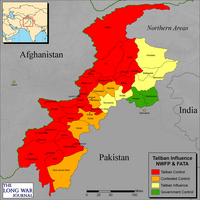
Click map for full view. Taliban presence, by district and tribal agency, in the Northwest Frontier Province and the Federally Administered Tribal Agencies. Information on Taliban presence obtained from open source and derived by The Long War Journal based on the presence of Taliban shadow governments, levels of fighting, and reports from the region. Map created by Bill Raymond for The Long War Journal. |
Flush with success in forcing the Pakistani government to implement sharia, or Islamic law, in a large region in Pakistan’s Northwest Frontier Province, the Taliban now seek to coerce the tribes in a small nearby district into implementing sharia there as well.
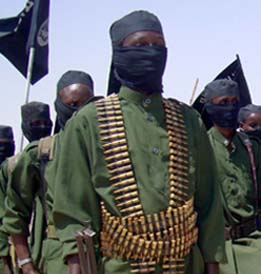
On Sunday, a Taliban force of 100 advanced into the district of Buner from the neighboring district of Swat and demanded to speak to tribal elders about enforcing sharia. “The Taliban said they would stay in Buner until their chief had had talks with the local chapter of the Tehrik-e-Nifaz-e-Shariat-e-Mohammed [TNSM or the Movement for the Enforcement of Mohammed’s Law],” Daily Times reported.
The TNSM is a radical pro-Taliban group that negotiated the Malakand Accord with the Pakistani government. The accord, which encompasses the districts of Swat, Shangla, Kohistan, Buner, Dir, and Chitral, allows for the enforcement of sharia and put an end to military operations in Swat and surrounding districts. Sufi Mohammed, the leader of the TNSM, is the father-in-law of Mullah Fazlullah, the Swat Taliban leader.
The local tribes in Buner gathered to devise a strategy to deal with the Taliban and formed a tribal lashkar, or militia, to halt the advance. More than 1,000 civilians and policemen are said to have taken positions to oppose the Taliban advance into Buner. The tribal leaders ordered the Taliban to leave the district or be forcibly ejected.
The Taliban claimed they are on a peaceful mission. “The Taliban said they meant no harm to the people of Buner, adding that they had come to make a peace deal with the people,” Daily Times reported.
But just one day after moving into Buner, the Taliban attacked the tribal militia. One tribal fighter was killed and another was wounded in the battle. The fighting escalated today after the Taliban killed three policemen and two tribal fighters in another battle. Sixteen Taliban fighters were also reported killed. The Malakand division commissioner is currently negotiating with the Taliban. The Taliban are said to be moving heavy weapons into the region in preparation for another fight.
Last summer, the Taliban ramped up pressure in Buner after members of a tribe surrounded six Taliban fighters who had been involved in attacks on policemen and killed the Taliban fighters after they attempted to flee. Two weeks after the incident, the Taliban bombed four video centers at a bazaar and sent night letters to shop owners ordering them to shutter their businesses.
In early December, the Taliban carried out two suicide attacks in Buner. The first suicide bomber’s vest detonated prematurely as he attempted to attack a government building. One child was killed and four more were wounded.
At the end of December, a suicide bomber struck at a polling center where elections were being held to fill a vacant seat in Pakistan’s national assembly. Thirty-five people were killed and scores were wounded. Pakistan’s election commission closed down polling stations in Buner and suspended the by-election.
The Taliban have viciously responded to efforts by tribal leaders to oppose the spread of extremism. The Taliban have violently crushed tribal opposition in Peshawar, Dir, Arakzai, Khyber, and Swat. Suicide bombers have struck at tribal meetings held at mosques, schools, hotels, and homes.
The Taliban have also made examples of local leaders who have dared to resist. In Swat, the Taliban executed a local tribal leader named Pir Samiullah, then returned to the village to dig up his body and hang it in the town. The villagers were warned not to remove his body or they would face the same fate.

13 Comments
Not surprisingly, the fighting has escalated in Buner.
Dawn: 21 killed as Lashkar, police fight Taliban in Buner
I wonder if the Pakistani army will back up the locals. On the other hand maybe the locals don’t like indiscriminate artillery bombings.
This reminds betrayal of Orakzai tribesmen by Pak army. Taliban killed over 100 by a suicide blast in a tribal meeting and Pak army yet to take military action there. Orakzai is the next strategic attack target for army after Bajaur.
It is now easy to attack from the havens in Swat due to peace deal there. Military should wipe those Taliban with Air force. Taliban ready to sacrifice more body-count is their strength that makes enemy give up.
To bad Pakistan is totally off limits to American solders. They could set up a base a few hundred yards inside Pakistani territory with nice firing lines. It would attract every militant in Western Pakistan like a big bug strip.
Only problem is it would probably attract half the Pakistani military and the ire of most of the Pakistani populous. It would also be roundly condemned worldwide and within the UN. Even if we stuck the base on some sterile mountainside barely within Pakistan it would be condemned as an outrage. How dare those Americans stick their stinky imperialist feet an inch inside of Pakistan. There’d probably be a riot in half the universities in the United States as well.
The encroachment on Islamabad continues.
Lets understand the ground reality in Pakistan, the people of Pakistan are not interested in living like the rest of us. They want Islamic justice and in my view if people want it then we should get out of the way and let them have it. Instead of trying to tempt them with the Kerry plan or any other plan
The US government is sending billions of $$ to a government and people who will take your tax $ and give nothing in return!!!
Pakistan was set up as a homeland for the Indian Muslim and as such Sharia should be imlemented in full and as long as they implement Sharia in their land then I for one won’t have a problem.
I know the problem I will face is when the Taliban try and come after me and they will because that is the nature of things, then I will support my government fully when it destroys them.
My short term view is that right now my government needs to ensure that Pakistan’s nuclear weapons are put out of use and that all knowledge related to nuclear weapons is ‘destroyed’. As long as this is done I am OK for a while
The people of Pakistan want Islamic justice, not Taliban justice. There is a HUGE difference.
The essential problem as far as Islamic Justice is concerned is that it is ‘malable’ i.e. the person with the gun can say what its is and if you don’t have a gun or even if you a gun and no inclination to use it then you loose!!!
I always thought that I would never ever see a repeat of Germany of the 1920’s & 1930’s but I was wrong and I am witnessing a repeat of that period as far as Pakistan is concerned.
1% of the population with the active support of another 4% of the population manages to impose their will on the remaining 95% because the 95% want a easy life and have lost the argument against the 5%!!!
Agree, 5% fundamentalists say anything that is adverse to them as “un-islamic”. They are nothing but crooked poor people in pursuit for their own better life.
Taliban could win in Swat by banning girl education and now wants to expand kingdom. Govt. could not block a radio transmission – that could have been achieved by just transmitting noise/tunes at same frequency – lost the war politically.
The Thunder Run has linked to this post in the blog post From the Front: 04/08/2009 News and Personal dispatches from the front and the home front.
I think its only a matter of time before Pakistan falls to the Taliban. The Taliban have shifted their war from Afganistan to Pakistan that appears to be an easier target
The nukes and all info pertaining to them needs to be safeguarded, but there is no guarantee.
The only question, if worse came to worse, is who would be the recipiant of the nukes if under Taliban control?
The question is now, ‘Will they leave Buner today (Friday) like they are promising?’.
Geo TV: Taliban say will abandon Buner on Friday
we want to smail and happy life but talbin want to distry my buer we want to save our buner for thats need your saports