|
|
|
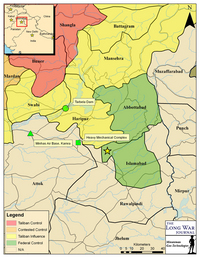
Click map for full view. Taliban presence, in the Islamabad region. Information on Taliban presence obtained from open source and derived by The Long War Journal based on the presence of Taliban shadow governments, levels of fighting, and reports from the region. Map created by Bill Raymond for The Long War Journal. Last updated: April 24, 2009. |
Islamabad officials have moved paramilitary forces to block a potential Taliban advance into the nation’s capital as US officials question Pakistan’s ability to stop the creeping insurgency.
Islamabad’s deputy commissioner and its senior police official said they are taking steps to counter the Taliban encroachment from the Northwest Frontier Province, Geo News reported. The Pakistan Rangers, a paramilitary force under the command of Pakistan’s Interior Ministry, have been deployed to the Margala hills on the northern outskirts of Islamabad. The deputy commissioner said the Taliban will not be able to cross through the Margala hills and into Islamabad.
The move to reinforce Islamabad comes just one day after Maulana Fazlur Rehman, the chief of the Jamiat Ulema-e-Islam Fazl, an Islamist political party, said the Taliban are beginning to move into the districts of Haripur and Mansehra. Haripur directly borders Punjab province and Islamabad, and is close to two sensitive nuclear storage facilities.
In Buner, the Pakistani government suffered another defeat as paramilitary police forces were beaten back by the Taliban’s advanced guard. The government sent an estimated 250 Frontier Constabulary officers into Buner in an attempt to secure government offices. The Taliban ambushed a convoy and killed one officer. The paramilitary police were ordered to withdraw from Buner as the Taliban celebrated their latest victory against the security forces.
The Taliban occupied Buner by force on April 10 and took full control of the district eight days later. Government offices, courts, medical clinics, and offices run by non-governmental agencies have been shut down. The Taliban have been patrolling and recruiting new fighters while they loot government offices.
|
|
|
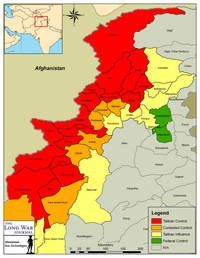
Click map for full view. Taliban presence, by district and tribal agency, in the Northwest Frontier Province, Punjab, and the Federally Administered Tribal Agencies. Information on Taliban presence obtained from open source and derived by The Long War Journal based on the presence of Taliban shadow governments, levels of fighting, and reports from the region. Map created by Bill Raymond for The Long War Journal. Last updated: April 24, 2009. |
Pakistan’s tepid response infuriates US officials
US military and intelligence officials have expressed horror at the speed of the Taliban advance and the lack of a strong response from the Pakistani government and military. The officials spoke on condition of anonymity because the sensitivity of the issue.
The Taliban have taken years to consolidate control of the tribal agencies bordering Afghanistan. The battle for Swat lasted almost two years, and ended after the government agreed to implement sharia, or Islamic courts, and withdraw its troops from the region. But the blitzkrieg takeover of Buner and the swift redirection of forces into neighboring districts marks a dramatic change in the pace of the conflict.
US officials are shocked that the government and security forces have offered little more than a token resistance to the Taliban.
“The Pakistani Army is sitting on the sidelines as the Taliban march all the way to Islamabad’s back door,” one intelligence official said. “Why is the government putting inferior troops in the path of the Taliban, only to watch them get chewed up and spit out. Where is the Army? The Army is purposefully sitting on the sidelines, either demoralized by losses or unwilling to fight, while Pakistan is burning.”
A military officer said the Pakistani government missed its window of opportunity to contain the Taliban. “The time to stop this madness was five years ago, in Waziristan,” the officer said. “Instead, the government caved to the Taliban in North and South Waziristan, and this only emboldened them to conquer more and more territory. Now the Taliban is within reach of the capital, yet the government still seems to have no grasp on the threat.”
A senior intelligence official said the lack of response by the Pakistani government and military ensures a bloody fight. “The longer the state has deferred taking the Taliban head on, the stronger the Taliban has gotten,” the official said. “Any attempt to put the Taliban genie back in the bottle will result a major bloodbath. Assuming the Pakistanis make an effort to defend themselves, that is.”
Some US officials have expressed frustration at Pakistan’s shifting of the blame for the Taliban insurgency. Pakistani officials have pointed fingers at Afghanistan and India for fueling the Taliban; they have also claimed that the US is withholding funding and advanced weapons. However, since 2001, the US has provided more than $10 billion in aid to Pakistan, of which several billion dollars are unaccounted for.
A senior military officer said the Pakistani complaints about a lack of advanced weapons systems such as F-16s and attack helicopters are “nonsense.”
“The Pakistani Army doesn’t need airplanes and night vision goggles to fight the Taliban,” the official said. “First and foremost, they need to grow backbones, pick up their weapons, and fight it out. And if they don’t do it soon, they might not have a country left to fight for.”
For more information on recent Taliban advances, see: Taliban advance eastward, threaten Islamabad