|
|
|
Iraqi and Coalition forces Order of Battle as of January 31, 2009. |
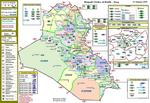
The February 2009 updates to the Iraqi Security Forces Order of Battle are now available at the ISF OOB homepage.
The updates and key information from the release of the December 2008 9010 Quarterly Report to Congress were addressed separately and will not be addressed in this update. The significant changes to the Order of Battle that occurred in January are summarized below.
Provincial Iraqi Control.
|
|
|
PIC and SoI schedules from Jan. 30 SIGIR report. |
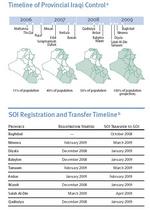
While the Jan. 30 Special Inspector General for Iraqi Reconstruction’s Quarterly Report focuses on reconstruction, it also lists the order of the transfer of the remaining five Iraqi provinces from Coalition control. Despite political claims and distractions, the first two provinces to transfer are Salahadin and Kirkuk. These provinces are to be followed by Diyala and Ninawa provinces, and finally Baghdad province by July of 2009.
Iraqi Air Force.
The Iraqi Air Force continues to concentrate on building up bases and its infrastructure. Kut Air Base is currently under renovation for operations. At Kut, “Future mission plans include stationing Iraqi Air Force Mi-17 helicopters at the FOB, as well as an Intelligence-Surveillance-Reconnaissance ground station for downloading data from ISR aircraft. The IqAF is in the process of procuring fuel trucks to support aircraft and generator requirements.” This will be the fifth Iraqi Air Force base to be made operational.
Communications infrastructure is part of the upgrades required to make air bases operational. Communications squadrons are being formed and given specialized training as part of the build-up. “The courses provide the basic technical skills for each career field and prepare NCOs to contribute to the mission when they report to their Communications Squadrons. The graduates will be stationed at Taji, New al-Muthana, Kirkuk, Basrah, and Al Kut Air Bases, and the Iraqi Air Operations Center.”
According to Multi-National Force-Iraq, the Iraqi Air Force’s current bases include Taji, Basrah, New Al Muthanna (NAMAB), Kirkuk, and Kut. The Iraqis’ plan indicates they will expand as soon as personnel, funding, and equipment become available. The expansion is to include the following bases: Ali (Tallil), Suwayrah, Al Asad, H2, Irbil, Habbaniyah, and Shaibah. Basrah may or may not remain a permanent base after Shaibah opens.
Balad, Q-west, Mosul, Sinjar, and Najaf were not mentioned as currently planned Iraqi Air Bases. Balad, Q-west, and Sinjar are current US air bases. Mosul and Najaf International Airports are probable dual military and civilian bases. This indicates that these bases are further down the planning list, probably part of Phase 2 (2011-2015) upgrades.
Iraqi Arms Purchases.
Reports of an Iraqi deal for rebuilt T72s are incorrect. This is a resurfacing of an old Defense Solutions proposal and is not a formal deal. The Office of the Commander-in-Chief — Iraq’s Prime Minister — stated in response to that story that Iraq has no intention of purchasing T72s. Multi-National Force-Iraq has also dismissed this story as incorrect. Defense Solutions has been unsuccessfully and repeatedly trying to sell this proposal since 2005.
Korean press reports have been talking about a deal for T/A-50 aircraft, possible artillery, and co-production of armored vehicles. However, according to Lieutenant Commander Russell, Multi-National Force-Iraq Press Desk Officer, “We are getting information that the commanding general of the Iraq Air Force stated MOD is only in discussions with South Korea on the purchase of TA-50 aircraft. There is no agreement, no quantity, and no schedule at this time.”
Similar reports of possible purchases of armored vehicles from Serbia are being aired. The deal has not been made; it is only negotiations. Iraq is shopping, but that does not mean it is buying. Competitions for potential buys like the armored personnel carrier are to be expected.
The transfer of HMMWVs from the US Army to the Iraqi Security Forces continues. In January, the 4,000th HMMWV was transferred. The current plan is for all 8,500 HMMWVs to be transferred by July, instead of the originally planned deadline at the end of 2009.
Iraqi Army Force Developments.
A new Iraqi Army brigade, called the Baghdad Brigade, appeared on Jan. 1, 2009. The Baghdad Brigade took over the lead for security of the International Zone from Coalition forces on New Year’s day. In response to a request for information, Captain Calio of Multi-National Force-Iraq’s Press Desk amplified:
The Baghdad Brigade is different from the Presidential Brigade. The Iraqi Army’s Presidential Brigade is used primarily for the President’s Office protection. It consists of three battalions, one for the president and one for each his two deputies. The Presidential Brigade was established after the collapse of the previous regime. The Baghdad Brigade reports directly to the Prime Minister and its commander is Brig. Gen. Emaad Yahseen Al Zuhary.
The Government of Iraq’s National Media Center confirmed that the “Baghdad Brigade belongs to Iraqi Army under the supervision of the office of the General Commander of Armed Forces.”
Also on New Year’s day the 41st Iraqi Army Brigade graduated from initial training at Besmaya.
On Jan. 3, the 5-44/11 Battalion was reported in Sadr City. This is the first report of a 5th Battalion or the inferred 4th Battalion in the 44th Brigade.
The 8th Iraqi Army Division is receiving mortar training. This recent emphasis on mortar training indicates this division will be the first to receive mortars heavier than 60mm.
The first 30 Iraqi M1A1M tank instructors started training at Besmaya in January. “…[T]he instructor candidates will serve as assistant instructors when the initial crews begin arriving in April 2009, building basic M1A1 skills prior to the arrival of the 140 Iraqi M1A1 tanks in the fall of 2010.”
|
|
|
US ISFF construction projects from Jan. 30 SIGIR report. |
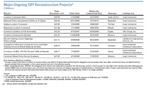
The Jan. 30 Special Inspector General for Iraqi Reconstruction’s Quarterly Report provides planned completion dates for US Iraqi Security Force Fund construction projects. The Feb. 25 completion date for the 26th Brigade facilities in Ramadi may explain why the 26th Brigade, 7th Division, is still in Basrah and the 53rd Brigade, 14th Division, is still in Baghdad. The 26th Brigade is awaiting its new home, and the 53rd Brigade is waiting for the 26th Brigade to transfer home so the 53rd Brigade can move into its facilities.
Iraqi National Police.
The new 3rd Iraqi National Police Division in Mosul continues to fill out and expand. Of the reported 1,797 new graduates for the 3rd Division, most are for the Abu Risha Brigade.
The first mention of a 4th National Police Division was reported in January. These reports indicate that the Basrah Brigade, which is still building up, is to be the first element of this new division. The Basrah Brigade’s third battalion remains in the planning stage, according to Staff Sergeant Thacker of Multi-National Division-South East Public Affairs Office. “We don’t know at this point what other province they [4th INP Division] will control. The permanent headquarters hasn’t been identified as of yet.”
Possible New Iraqi Army Division Planned in West Baghdad?
There are signs that a new Iraqi Army division probably is assembling in Baghdad. Ministry of Defense Order 151 established the numbering pattern for Iraqi Army divisions in February 2008. The IA has six brigades that are abnormally designated according to that order. All of the abnormally designated brigades were so designated over the last year. All six brigades are west of the Tigris River in Baghdad Province:
• Presidential Brigade – One of only two brigades in the Iraqi Army that does not have a publicly stated numeric designation. Suspect it is a Kurdish transferred brigade.
• Baghdad Brigade – The other named-only Iraqi Army brigade. First mentioned on Jan. 1 when it took over the International Zone. Suspect it is a Kurdish transferred brigade.
• 54th Brigade/6th Division – When Ministry of Defense order 151 renumbered the brigades a year ago, this brigade received a number that should belong to a 15th Division brigade.
• 55th Brigade/17th Division – When formed in May 2008, this brigade received a 15th Division brigade number (54th-57th), rather than 17th Division (62nd-65th).
• 23rd Brigade/17th Division – When formed in May 2008, this brigade received a 6th Division brigade number (22nd-25th), rather than 17th Division (62nd-65th).
• 25th Brigade/17th Division – When split to form 17th Division in May 2008, this brigade was not re-designated. It still has a 6th Division brigade number.
While temporary brigade designations are possible, these abnormal designations are over eight months old and are showing no signs of changing. There is one possibility that makes sense if these brigades are not to be renumbered. A new IA division (15th) could be being assembled in west Baghdad. As the 62nd thru 65th Brigades are built for the 17th Division, and as US forces depart the facilities around Baghdad International Airport, the abnormally numbered brigades will shift subordination and adjust areas of responsibility:
• 6th Division (22nd-25th Brigades) in Northwest Baghdad and Baghdad International Airport. Probably Airborne Division.
• 15th Division (54th, 55th, Presidential, and Baghdad Brigades) in International Zone, Mansour, and Bayaa districts.
• 17th Commando Division (62nd-65th Brigades) in south Baghdad Province.
This would also explain the reports of Kurdish troops in Baghdad. Kurdish troops have been reported to be guarding the International Zone. The Presidential and Baghdad Brigades could be transfers to Baghdad from the previously reported 15th Mountain Division in Sulmaniyah. The 15th and 16th Mountain Divisions are Kurdish transfers to the Iraqi Army. These troops could be part of the ethnic balancing of the forces in Baghdad by adding Kurdish forces.
Speculation on Iraqi Lend/Lease and/or Armor Transfers.
The reported M1A1 training being performed has a time problem. The first Iraqi-purchased M1A1M tanks will start delivery in the fall of 2010. The tank crew instructors are already in training. They are to start training the first tank crews in April 2009. There will be 18 months of training crews before the first Iraqi-purchased M1A1s arrive on the fall of 2010. If it only takes three months to train instructors, why does it take 18 months to train the tank crews?
One possible explanation is that there are plans to loan or lease US M1A1s to the Iraqis prior to the delivery of their own tanks. There are almost 1,000 M1A1s in the US inventory that have not been upgraded to M1A2. On a normal year, 140 US M1A1s are upgraded to M1A2. It is possible that the US plans to loan M1A1s to the Iraqi Army until they receive their own M1A1Ms. If they were to loan or lease these US tanks, approximately 700 could be loaned and then, upon return to US custody, be refitted to M1A2s without disrupting the upgrade program. This would allow the Iraqi Army to take over the tank support role from US forces by equipping up to four Iraqi divisions with US-loaned tanks.
In addition to the existing 9th Armored Division, three other Iraqi Army divisions show signs of having a priority to being upgraded to tracked armored or mechanized status. These divisions are:
• 3rd Division in Ninawa is using M113 armored personnel carriers.
• 7th Division in western Anbar is using BMP1 mechanized infantry combat vehicles and has a tracked repair facility co-located with its headquarters.
• 11th Division in eastern Baghdad is using BMP1s and MTLB armored personnel carriers.
The US Army has also started replacing its 7,000 M113 armored personnel carriers. The M113 is used in many support roles in addition to its role as armored personnel carrier. These roles include mortar carrier, armored ambulance, and ammunition carrier. The transfer of some of these armored personnel carriers to the Iraqi army would provide much of the required support armor to accompany the M1A1s loaned to or purchased by the Iraqi Army. The Iraqi Army already uses more than 200 M113s.
The US Army is also in the process of replacing its M109 self-propelled howitzers. Some of these howitzers could be donated or loaned to the Iraqi Army to fill the indirect fire role for these Iraqi tracked heavy divisions, pending purchase and receipt of their own new howitzers.
All three of the above possibilities have a higher likelihood of occurring than the proposal being pushed by Defense Solutions to sell Iraq used and rebuilt Soviet-designed T72 tanks. The current Iraqi Ministry of Defense has shown a distinct aversion to buying Soviet-designed ground equipment. Almost all of the Soviet-designed ground equipment used by the Iraqi Army today is leftover or donated. The Iraqi Ministry of Defense prefers to purchase new Western equipment. The Iraqis have experience losing Iraq’s last two conventional wars while using predominately Soviet-designed equipment like the T72.