|
|
|
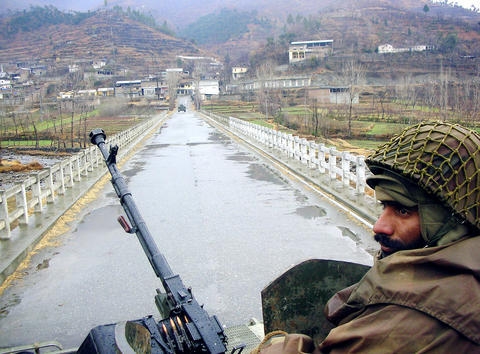
A Pakistani Army soldier sits on an armored vehicle as he patrols in Matta in Swat, where the Taliban has effectively taken control of the settled district and neighboring Shangla. AP photo. |
The Pakistani military continues to withdraw forces from the troubled Northwest Frontier Province and the adjacent tribal areas. Another division is believed to be leaving the region to return to the eastern frontier and bolster Pakistani forces facing India during rising tensions over last month’s terror attack in Mumbai.
Witnesses in Pakistan’s tribal agencies of Bajaur, Mohmand, and North and South Waziristan said large, heavily armed columns have been leaving the region, The News reported. A 200-truck convoy with accompanying artillery and tanks was seen withdrawing from the town of Miramshah in North Waziristan.
Hundreds of soldiers were seen leaving the military base at Ramzak in North Waziristan. Ramzak borders South Waziristan. Operations against Baitullah Mehsud’s forces in early 2008 were launched from Ramzak. Other witnesses said more than 20 military trucks left Ghalanai, the main town in Mohmand.
The Pakistani military began moving troops from the insurgency-riddled Northwest Frontier Province on Dec. 26. The 14th Division began withdrawing from the Bajaur-Dir region and was moved back to its assigned area of operations in the Bahawalpur region in southeastern Punjab province. The 14th Division was one of two divisions assigned to reinforce the counterinsurgency operation in Bajaur.
A second Pakistani Army division is expected to be pulling out of the northwest. The headquarters element of the 23rd Division along with the attached brigade is thought to be moving out of the Northwest Frontier Province, according to Ravi Rikhye, the editor of Orbat.com.
Pakistan may remove most of the units assigned to reinforce the Northwest Frontier Province, Rikhye told The Long War Journal. An estimated 14 to 15 brigades were assigned to Pakistan’s northwest as the Taliban insurgency grew over the past several years; this number may be reduced to five brigades.
“We are approaching the point where two-thirds of the reinforcements sent west are in the process of withdrawing,” Rikhye said.
Pakistan’s redeployment of troops is strictly a defensive move, according to Rikhye and several US officials. The Pakistani military basically stripped the eastern front of units over the course of the past several years to bolster its forces in the northwest.
The move is designed to counter a feared Indian strike, a senior US military intelligence official told The Long War Journal. “The Pakistanis are terrified the Indians may launch an attack, and have to reinforce [their] eastern front,” the official said. “What they are doing is prudent from a military perspective, but it is raising alarm bells in India and in the West.”
The Pakistani military has built a complex system of fixed defensive positions to blunt an Indian attack, Rikhye said. “The essence of Pakistan’s defense strategy is to man several lines of very extensive fortifications, usually built on their irrigation canals,” he told The Long War Journal. Canals have been built to prevent amphibious assault vehicles from crossing, and the military can flood the canals as well as plains to slow down an armored attack.
“These canal defenses are combined with extensive earthworks, pill boxes, minefields, etc.” Rikhye said. “It’s not easy to get through these defenses,” he noted, explaining that one armored and one infantry brigade held off eight strike brigades from the Indian Army in the Shkaergarh salient during the 1971 war.
The deployment of forces to the northwest has compromised the effectiveness of the defensive positions. “If the defenses are not manned then they’re no use,” Rikhye said. “That’s why the Pakistani infantry has to come back from the NWFP [Northwest Frontier Province]. It is completely expected for them [the Pakistani Army] to man their defenses at this time, and that they do not want to be in the NWFP [fighting the Taliban] is perfect.”
The regular Pakistani Army has not aggressively fought the Taliban in the northwest. The task has been left to the poorly armed and trained paramilitary Frontier Corps. Occasionally, as in the case of the Bajaur offensive in the Loisam region this fall, or the offensive in South Waziristan in January, a Pakistani unit is assigned to combat duty. But the regular Army largely sits in garrison while the Taliban consolidate power in the region.
For more information on recent Pakistani troop movements, see:
• Pakistan deploys troops from tribal areas to the Indian border
Dec. 26, 2008
• Taliban consolidate control in Arakzai tribal agency
Dec. 28, 2008