|
|
| A terrorist outside the train station in Mumbai. |

India’s financial capital of Mumbai is under a terrorist attack as teams of gunmen attacked hotels, a train station, a restaurant, two hospitals, and an airport. Early reports from India indicate more than 100 people have been killed and more than 300 wounded, however the toll is expected to rise as security forces sort through the chaotic situation in the city. The Times of India reported 80 killed and more than 900 wounded.
The attacks started with military-style assaults at several locations in the city, followed by coordinated bombings. Gunmen opened fire with heavy machineguns, AK-47s and lobbed grenades inside the lobby of two five-star hotels and at a train station. Terrorists are said to have taken hostages at the posh Oberoi and Taj hotels after detonating bombs and opening fire on the patrons in the lobbies. Fighting has also been reported inside two hospitals and at a local airport.
The terrorists are seeking out foreigners, according to report from London Times. They wanted anyone with British or American passports,” a witness said. “They wanted foreigners.” Both the Oberoi (or Trident) and Taj hotels are frequented by foreign businessmen. Attacks have also been reported at the Marriott and Ramada hotels
At least a dozen foreigners, including Americans, have been taken hostage at the Oberoi hotel by at least 15 terrorists. More than 200 Indian counterterrorism commandos have been pushed into the city and are preparing to storm the hotel. The Oberoi hotel is on fire.
|
|
| Fire at the Taj Hotel. Image from NDTV. |
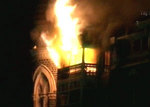
At the Taj, more than 15 hostages, including seven foreigners, have been taken hostage by two terrorists. Hundreds are said to be trapped inside the hotel. Commandos are also preparing an assault on the Taj, which was rocked by five bombs. The Taj is currently aflame.
Hotels have become the jihadi’s target of choice, according to terrorism expert Rohan Gunaratna. “There is a global trend to attack hotels,” he told The Long War Journal. “In 2008 alone the best protected hotels in Pakistan (Islambad Marriott) and Afghanistan (Kabul Serena) were attacked. Open facilities are always a challenge to protect. The attacks specifically targeting hotels will have a significant impact on the the hospitality industry. With international hotels emerging as second embassies, governments and the private sector will need to work closely with each other to protect this vital sector.”
Gunmen are also reported to have been cornered at the main rail station after opening fire on the passengers at the crowed terminal. Commandos have been deployed to the train station as well. Fighting is ongoing at the Cama hospital, as police and soldiers have surrounded the hospital and are battling with gunmen.
A police van has also been hijacked by gunmen, who are driving around the city, firing wildly. The chief of the Mumbai counterterrorism police and two other senior police officials have been killed during heavy fighting.
The Deccan Mujahideen, or Indian Mujahideen, has claimed credit for the attacks. The constellation of Kashmiri and Pakistani-based terror groups are the likely culprits, a senior US military intelligence official told The Long War Journal.
“This looks like LeT and the groups it spawned,” the official said, referring to the Pakistani-based Lashkar-e-Taiba and its affiliated groups such as Harkat ul Jihad al Islami (HuJI), the Indian Mujahideen, and the Students’ Islamic Movement of India (SIMI). The official cautioned that it is too soon to know who exactly was behind the strikes, but the attacks have similar characteristics of past attacks by these groups.
Indian intelligence claims HuJI-B created a front group called the Indian Mujahideen to confuse investigators and cover the tracks of the Students’ Islamic Movement of India, or SIMI, a radical Islamist movement. The group receives support from Pakistan’s Inter-Service Intelligence and is an al Qaeda affiliate. SIMI provides logistical support for attacks in India.
These terror groups have been implicated in numerous mass-casualty attacks in New Delhi, Mumbai, Samjhauta, Ahmedabad, Bangalore, Jaipur, Assam, and Uttar Pradesh over the past several years. Thousands of Indians were killed or wounded in the attacks.
Nick Grace contributed to this report.