
|
|
|
Omar Khalid, the Taliban commander of Mohmand agency. |
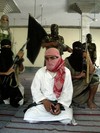
The Pakistani government has signed another peace agreement with the Taliban in the tribal areas and the Northwest Frontier Province. On Monday, the Pakistani government signed a peace agreement with Taliban commander Omar Khalid in the Mohmand tribal agency, making this the third such agreement in northwestern Pakistan since April 20.
The deal requires the Taliban to renounce attacks on the Pakistani government and security forces. The Taliban will maintain a ban on the activities of nongovernment organizations in the region and agreed not to attack women in the workplace if they wear the veil. Both sides exchanged prisoners. Eight members of the Saafi tribe were exchanged for a doctor. Khalid is a member of the Saafi tribe.
The Taliban immediately moved to establish a parallel government in Mohmand. “The local Taliban have set up a complaint cell to resolve people’s problems,” GEO News reported. “The decision to establish the complaint cell has been taken to provide people with quick dispensation of justice.”
The Mohmand peace agreement is the latest in a series of negotiations with the Taliban in the tribal areas and the Northwest Frontier Province. On April 20, a six-point deal was struck between the Pakistani government and the Tehrik-e-Nifaz-e-Shariat-e-Mohammadi (TNSM – the Movement for the Implementation of Mohammad’s Sharia Law) in the Malakand Division. Just one month later, the Pakistani government inked another peace deal with the Taliban in the settled district of Swat. The Pakistani government is also in negotiations with the Taliban in South Waziristan.
Who is Omar Khalid?
Omar Khalid’s involvement with terrorism stretches back at least a decade. He was a member of the Harakat-ul-Mujahideen, a banned terrorist group that conducts attacks in Kashmir. He trained in terror camps in Kashmir and fought Indian forces, The Asia Times reported. He maintained close links with the Kashmiri terror outfits but also looked to contribute to the Taliban cause. Immediately after the US invasion of Afghanistan in 2001, Khalid took hundreds of fighters across the border to fight US forces.
Khalid claims to have 3,000 armed and trained fighters under his command. In July 2007, Khalid’s forces seized a historic mosque and shrine in the Mohmand tribal agency and renamed it the Lal Masjid, or Red Mosque, after the Taliban mosque in Islamabad that was assaulted by the government in mid-July.
Last Summer, Khalid denied links with the Taliban and al Qaeda even as he pledged allegiance to Red Mosque leader Ghazi Abdur Rashid. “If [the Taliban] come to us, we will welcome them,” said Khalid. “We will continue Ghazi Abdur Rashid’s mission even if it means sacrificing our lives.” Khalid also threatened to “use suicide bombers in self defense” if the new Red Mosque was raided. He seeks to “Islamize” the local tribes and plans establishing a “vice and virtue force.”
|
|
|
Red agencies/ districts controlled by the Taliban; purple is de facto control; yellow is under threat. |
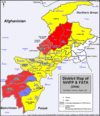
But Khalid has since joined the Movement of the Taliban in Pakistan, the umbrella Taliban organization led by Baitullah Mehsud that united movements in the tribal areas and the settled districts of the Northwest Frontier Province. Khalid is the Taliban’s representative for Mohmand agency.
For more information on the terms of the peace agreements in Swat and Bajaur, and the proposed terms for the agreement in South Waziristan, see:
Pakistani government inks peace deal with Swat Taliban
Pakistan is negotiating a new peace agreement with Baitullah Mehsud (South Waziristan)
Pakistan releases Taliban leader, signs peace deal with outlawed Taliban group (Bajaur, Malakand Division)
See The Fall of Northwestern Pakistan: An Online History for more information on the rise of al Qaeda and the Taliban in Pakistan and the peace agreements signed between the government and the Taliban.

8 Comments
Two points.
First, if Pakistan has ceased to be an ally in the Long War, can we finally side openly with India and form stronger ties to fight terrorists?
Second, assuming that we will eventually go after the Taliban in the Pakistani badlands, it seems there can be no illusion that we will find, underneath, the makings of a civil society. There doesn’t appear to be anybody or anything there to work with to do COIN or nation-building. On the other hand, it is hard to imagine that world opinion would allow us to go in and exterminate them like cockroaches. So guys, what is the solution?
Batman
Just let them rule awhile. Soon they will have alienated the people like they did in Chechnya, like they did in Anbar, Basra, and everywhere else they impose their oppresive rule. Then there will be plenty of people willing to drop a dime on them if we ever show up and establish COPS. However, that is a very doubtful and difficult prospect.
Syed Saleem Shahzad has posted his third in a series of three articles. As usual, he overdoes his admiration for the Taliban.
Asia Times: In the footsteps of Osama …
“On the other hand, it is hard to imagine that world opinion would allow us to go in and exterminate them like cockroaches. So guys, what is the solution?”
The Thunder Run has linked to this post in the blog post From the Front: 05/29/2008 News and Personal dispatches from the front lines.
Deal with taliban means acceptence of their system and surrender in front of them. No one can tell them throw away weapons and join main stream political system. In all deals they have the superior hand and own stste inside the stste.In khyber Mangal Bagh has courts and own programe for local school.In Kurram they have blocked the main road for the past six months and army vehicles are usually intercepted.In Bajur they just allowed government department servants to attend offices excluding women and NGOS.No video shop can run buisness and the hair dressers are not allowed to shave the beareds. The deal is just provision of safe passege for government authotities and on the othe rhand recognition of talibanization with due respect.
The solution is to recruit the tribal maliks which requires lots of money and respect. Keep in mind that the Arab invaders & Taliban are like us – foreign devils/invaders in the FATA. Believe me, the Pathan tribal folk, want ALL foreigners (including the Arab and Afghan Taliban invaders) thrown out. Recent Taliban developments (training ten-year olds to decapitate locals) in Bajour and Swat have only increased their angst with the local Pathans. The Pathans just want to be left alone – they hate the Arabs (particularly the Saudis) and want them out as bad as we do. And contrary to the media, they do like the Americans. How do you do this? Very simple: $$$ and respect – forget about NGO local capacity building and air strikes, etc. If we spent more money on the tribal maliks and less on bombs, they would most definitely side with us. These good Pathans are sick of these Taliban frauds and are ready to thrown them out, but they need some help…and the Paks are not coming to the rescue. Bad guys are simply paying them more…plain and simple. Money & Land is all that counts in the FATA. We did this once in Afghanistan with the Soviets; we can do it again. Just ask Gus…
Hi, The deal is essentially allow “us rest and recreation in pakistan and we will do all the attacks inside Afghanistan and India without bothering the pakistani army and FC.
This suits the ruing establishment but then this is what Americans taught them when russians were ruling afghanistan. Now americans are ruling and they want the same system.